Chapter 10 - Recovery
In the records of those days, the wounds of Samuel were spoken of with quiet awe. Fire and stone had conspired against him, and yet he endured. In later ages, healers would give such suffering many names—shock of the blood, bones broken by weight, flesh scorched by flame. Today, a doctor might diagnose his injuries as post-traumatic hypovolemic shock with crush injury, second-degree burns, and bilateral tibial fractures. This would likely take 8-12 weeks to recover, even with modern medicine and instruments.
But in that first world, the air itself lent strength to those who would live. The oxygen was thicker then, rich with what the heavens had not yet spent. A man of good stock and steadfast heart could rise from ruin in a shorter length of time.
The care room smelled faintly of myrrh, resin, and clean linen. Lamps burned low along the walls, their light unwavering. It was a room made for healing, not for grief—a rare mercy in a world that had forgotten the difference. Linora kept to it from first light until exhaustion took her, moving with hushed precision among the jars and bandages.
Samuel drifted between waking and sleep, fever glistening on his brow. His wounds told a cruel story—burns where the fire had kissed him, bruises from the beam, and the arm still raw from its earlier copper wound. She worked methodically, changing the wrappings by lamplight, speaking little. It was not words that kept him tethered to life, but rhythm: water poured, herbs ground, linen tightened, pulse monitored.
When the fever spiked, she mixed a solution of willow and honey, pressing the rim of the cup to his lips. "Swallow," she whispered, her voice gentle and insistent. When he shivered, she laid a warm cloth across his chest. When he groaned, she remembered a tune her mother used to sing when food was scarce—the words long forgotten, but the melody clear. She hummed it softly, letting the memory steady her hands.
Others came to her as well. The servants, weary from long labor, began to knock softly at the care room door—a cut that would not close, a hand swollen from an old burn, a child's cough that had worsened in the damp air. Linora tended them all. Word passed through the estate that the healer of Shuruppak worked as one touched by heaven.
Loshim was a regular sight in the care room. Each time he entered, the tension eased. He carried the scent of the fields with him—dust, sun, and the faint musk of animals. Samuel would brighten at once, grinning through the pain. "Tell me something new," he'd say. "Anything but how my legs look."
Loshim obliged, half leaning against the doorway as Linora worked. He spoke of the woods—the new foal born at dawn, the stubborn ox that refused to plow straight, the crows that had learned how to steal grain from the bins. His voice carried an easy calm, the kind born of long days outdoors.
With Linora's hands changing bandages, she found herself listening as closely as her patient. The rhythm of his stories eased Samuel's pain better than any elixir. When he mentioned a falcon nesting in the rafters of the large storehouse, Samuel groaned, "You always find the strays."
Loshim smiled faintly. "Someone has to."
"Don't tell me you named it," Linora teased.
"Of course he did," Samuel answered for him. "He names everything."
Both he and Linora turned to look at Loshim, expectant. He didn't answer right away—only tilted his head, carefully weighing whether the truth was worth saying. His jaw flexed once, twice, and still he said nothing.
"Well?" Linora prodded, folding her arms.
He finally exhaled, lips curving into the smallest grin. "Her name's Rasha," he said. "Means 'the one who steals.' Fitting, don't you think?"
Samuel groaned. "You named a falcon after a thief!"
"It's not an insult if it's true," Loshim replied.
Linora tried to stifle her laugh, but it escaped anyway, quick and bright. Even Samuel joined in, the sound warming the space more than the brazier itself.
For a moment, there was no burn, no broken bone, no pain—only three souls in a quiet room, sharing stolen joy.
After a week, the bandage on his arm was no longer needed. The burns along his legs still demanded her care, but his skin had begun to remember how to heal. Each morning arrived, blending time into a continuum—the rhythm of footsteps in the corridor, the clink of copper basins, the soft murmur of servants exchanging a few words.
Linora's hands moved with care over the healing skin. She told herself it was habit—the natural response of a healer's work—yet every time her fingertips brushed the edge of a scar, she felt him flex, and she wondered if he noticed how her pulse quickened.
Samuel's appetite returned in slow defiance of his weakness. At first, it was just broth sipped between grimaces. Then bread. Then bits of fruit, sweet enough to make him close his eyes. By the second week, the kitchen had learned his pace—every meal arrived just when he was ready, as if the house itself knew his hunger before he did.
Linora spent her mornings beside him, sleeves rolled, hair bound loosely, the scent of thyme and smoke clinging to her. She worked in quiet rhythm—unwrap, wash, apply salve, wrap again—each motion practiced and sure. When he winced, she spoke to distract him: a tale from the infirmary, a riddle from her father, a memory of the twin stones glinting in the sun. Sometimes he smiled, sometimes he only closed his eyes and listened.
The two of them marked time by counting victories: the first time he sat without help, the first step with a crutch, the first night he slept without waking in pain. Recovery, she realized, was not measured by the sun, but by courage repeated quietly.
Loshim's visits grew more frequent as the air warmed. He always brought something useful—clean linen, a pouch of herbs, a bit of kindling for the brazier. And he'd bring something else—a story, a joke, or a small kindness. Linora caught herself watching him longer than intended. There was an effortlessness about him, something that invited admiration without seeking it. When he smiled, it was like sunlight breaking through a quiet morning.
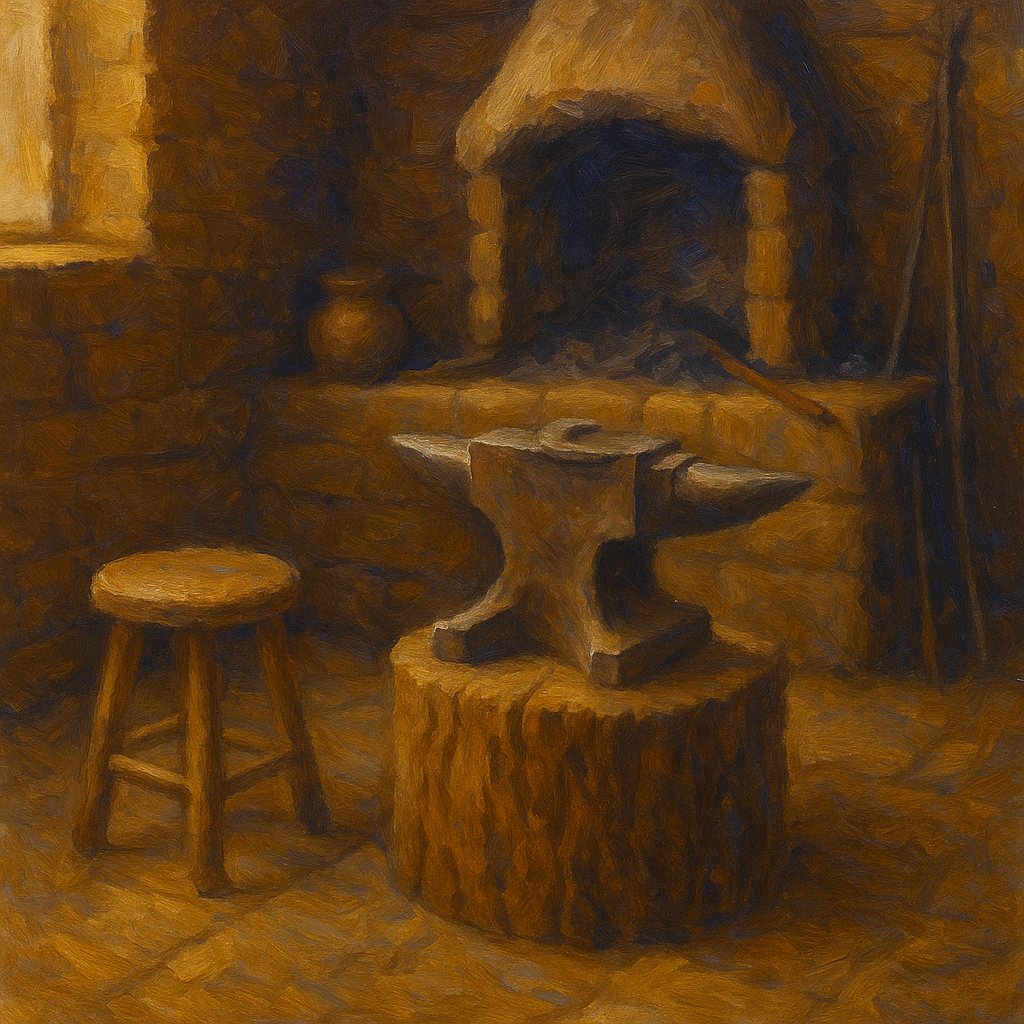
One morning Loshim arrived with a small wooden stool, sanded smooth, the grain still fragrant with resin. "For the forge," he said, setting it beside the bed.
Samuel eyed it with amusement. "You'd have me working before I can walk?"
"I'd have you living before you forget how," Loshim replied. His tone was even, but there was warmth behind it. "Every man needs his tasks. Even if it's shaping nails or straightening rods."
Linora paused in her wrapping, the faintest smile tugging at her lips. "You think he's ready?"
"I think he's restless," Loshim said. "And that's the same thing."
Samuel chuckled, shaking his head. "You always did mistake stubbornness for strength."
"Then I learned it from the best," Loshim answered. Linora caught sight of the ghost of a grin between them, a look that belonged to brothers who had shared more than words ever could.
The stool stayed by the door, within direct sight of Samuel, daring him to reclaim it. And Loshim, though he said little more about it, always found a reason to stop by—and never left without glancing back at the stool on his way out.
By the fourth week, Linora had noticed a change in him. Whenever Loshim visited, his jaw would tighten just slightly, his replies trimmed shorter than before. He still laughed, still thanked his brother, but something behind his smile had sharpened. When Loshim praised her mixtures or offered casual kindness, Samuel's gaze drifted away—not in anger, but in something unspoken, every word striking deep.
The stool lingered like an open invitation to rise again. So one morning, Samuel met its challenge with a small request—a shave. His voice carried that low resolve that left no room for persuasion. Afterward, he asked for outdoor clothes—plain, durable, the kind meant for work, not comfort. Once dressed, he picked up the stool and tested his weight against crutches. His legs held, barely. The tremor was visible, but his eyes were steady.
"Today," he said quietly, half to himself, half to Linora.
She moved closer, instinctively ready to steady him. He waved her off—not unkindly, but with the finality of someone reclaiming a part of himself. "If I can reach the forge, I can heal there too."
He made it through the hallway, Linora walking beside, and opened the door. The air outside struck cool across his newly shaven skin. Servants paused at their chores, whispers spreading faster than he could move—the blacksmith was walking again. No one spoke as Samuel crossed the yard. Each step landed heavy but sure, the sound of crutches marking time.
When he reached the forge, he paused for reverence. Omri, along with a handful of servants, had gathered outside. Loshim stood among them, arms folded, the trace of pride hidden behind his usual reserve.
"Brother," he called as Samuel hobbled through the doorway, stool still in hand, "you've kept the anvil waiting long enough."
Inside, the forge smelled of oil and iron. Samuel set down the stool, lowered himself onto it, and grasped a hammer resting on the ground. The head was cool, the weight familiar. A single cold horseshoe lay near the anvil. He lifted it, set it straight, and brought the hammer down once.
The sound rang out—clean, bright, final. Omri shouted for joy, and others broke into scattered applause. Linora smiled through the sting behind her eyes.
That first strike was pure ceremony, but the next wasn't. Nor the dozen that followed. Within a fortnight, the blacksmith's rhythm returned—measured, patient, precise. Each morning, he'd get new bandages over breakfast and from dawn to dusk he shaped what the estate required: nails by the hundreds, hinges, buckles, bits, tools. Nothing ornamental, nothing proud—but every piece sound and true. His strength returned with each strike, the muscles of his arms remembering what his mind and heart still longed for.
And though his legs still bore the memory of fire, his spirit burned clean again.
With Samuel finding his trade, Linora was able to restock the care room with healing supplies. Mid-mornings found her in the gardens, sleeves rolled, hands among the herbs she had planted. The scent of sage and marjoram clung to her when she returned each evening, and Loshim would jest that he could tell the hour by which fragrance she carried.
His presence threaded through each day—never intrusive, never far. Linora saw him in the pasture at dawn, mending a gate; at noon, leading a mule toward water; at dusk, passing by the forge, offering a nod or a wordless glance. Even when they didn't speak, their silences grew easier, their crossings more natural—familiarity replacing introduction.
One evening, as she gathered herbs from the drying racks, Loshim stepped into the doorway, holding a wounded dove cupped in his palms.
"Mara, here, flew into the forge chimney," he said softly. "I thought you might help."
Linora took the bird, their fingers brushing briefly—a moment too small to matter, too real to ignore.
"You care for creatures no one else would notice," she murmured.
"Can you help her?" he asked.
"I can certainly try." She smiled at the thought that she'd be caring for a bird. "Hold her wing open—gently."
Loshim obeyed, his calloused thumb steady against the trembling feathers. Linora dabbed a salve of honey and oil along the singed edge, her movements sure, practiced. "There now," she said softly, "you'll fly again soon enough."
Loshim gave a quiet laugh. "Now you're getting it. They need to hear from us."
"Maybe they do," she said, glancing up. "Maybe they just need someone to believe it first."
Over the next few weeks, Samuel was walking with the help of a cane he'd fashioned himself—a sturdy piece of olivewood, smooth at the grip and darkened from oil. He'd retired his crutches at last, though not without pomp. "The twins have earned their rest," he declared, tapping the new staff once against the floor. He'd named it Ann—an echo from the brotherly sport that never truly ended.
"Seems a good name for something that refuses to be forgotten."
Loshim smiled and said, "It's a fine name. I knew you'd eventually come around to my way of thinking."
With Ann by his side at the forge, Samuel no longer needed help with the bellows. The hammer rose and fell at a steady rhythm again, and Linora learned to tell the state of his pain by the sound of it. When the pace slowed, she knew he'd be limping by nightfall.
Sometimes, in those quiet evenings, Samuel's voice would drift softer, more thoughtful. He spoke often of Oren—of the forge he knew, the heat, the long hours that had felt like belonging. "He'll scold me for my weak hammer arm," he'd say with a wry smile, "but he'll be glad I kept both legs."
Linora smiled, but a strange ache followed. She caught Loshim watching her across the courtyard, expression unreadable. In that moment, she realized how much of her heart had tangled itself between them—one bound by history, the other by possibility.
Samuel's strength had nearly returned by the time the mists of morning began to thin. The forge fire still burned low each evening, more for comfort than for heat. Linora sat beside him, unwinding the last of his bandages. The skin beneath had paled to new scar, tight but clean.
"I must see Oren soon," he said at last, wiping a streak of soot from his wrist. His voice was calm, yet his fingers betrayed the restlessness he sought to conceal. "I've learned what healing can give, but I need my master to teach me what I can make of it."
He was quiet for a moment, then added, "I've been wanting to say something." His eyes didn't quite meet hers. "About Loshim."
Linora's hands stilled. "What about him?"
Samuel shifted his weight, the cane creaking softly beneath his grip. "He's a good man. The best brother I could ask for." He paused, working his jaw. "But he's... restless. Always has been. He cares for strays—birds with broken wings, lost causes." His gaze finally lifted to meet hers. "I don't want you to become one of his projects."
Linora blinked, processing the words beneath the words. "A project?"
"That's not—" He exhaled sharply, frustrated. "What I mean is, you shouldn't spend so much time with him. Not alone. People talk, and—"
"Now that your legs work," Linora interrupted, her voice light but edged, "you think you can tell mine where to walk?"
Samuel froze. The color rose in his neck. "No. That's not what I—"
"Because it sounds," she continued, folding the old bandage with deliberate precision, "like you're trying a little too hard to protect me."
"I love my brother," Samuel said quickly, almost desperately. "I do. But he doesn't understand what it means to commit to something. To someone. And I don't want to see you hurt when he moves on to the next thing that catches his eye."
Linora set down the bandage, her expression unreadable. "That's very thoughtful of you, Samuel. But you don't have to worry about me."
"I know that." He stopped, searching for words that wouldn't make it worse. "I care about you. Both of you. That's all."
"Then trust me to make my own choices," she said softly, but with resolve beneath the kindness.
The silence that followed was different from the comfortable quiet they'd shared over weeks of healing. This one had weight.
Linora thought about home. Maybe it was time. She knew it wasn't only the forge calling him—it was progress, memory, and something else deep within.
"I'm not sure you are well enough to travel," she said, a near challenge.
"Well enough to try." He managed a faint smile. "Besides, Ann will keep me steady."
That drew a small laugh from her, though her heart tightened all the same.
When he stood, she rose with him, following to the open doorway. The light from the forge cast shifting gold across his face—strength renewed. The healer's hands had done all they could. The rest, the world itself would decide.
The evening meal had ended in quiet contentment. The hall still carried the faint warmth of bread and roasted cinnamon, the sweetness of wine lingering in the air. Lirit and other servants cleared the last dishes as Nahala rose, graceful even in weariness, and motioned for her guests to follow. Together they made their way to the receiving hall, where the fire in the central brazier burned low and steady, throwing its light along the carved beams and polished floor. The day's workmen had retired for the evening; the sound of the forest outside was only the coos of insects and the rhythmic creak of the windmill turning in the distance.
Samuel stood before them, leaning lightly on his cane. Linora and Nahala sat opposite him, their posture forming a quiet symmetry—one born of care, the other of command. Loshim was not yet there; his absence made the space feel broader. The flickering light caught the scar along Samuel's temple, the healed lines of his hands. He looked every bit a craftsman again, but still not the man he had been before Shuruppak fell.
"I'm ready," he said at last, his voice steady though his weight shifted slightly on the cane. "I've enjoyed enough of your kindness. I have to return to my master. The forge calls me more each day."
Nahala regarded him for a long moment, her face half-lit, half-shadowed. "You would leave so soon? You've only just regained your strength. We have no idea what kind of state Shuruppak is in."
Samuel had courage in his voice. "I will go around the city, along the north. If I keep my distance, there shouldn't be an issue."
Nahala, considering the additional cost, "That would add a decent amount of time, and a beast might have trouble with you forging your own path."
Samuel inclined his head. "That's why I'll go on foot." The two women looked at each other with uncertainty. "I can do this—I have to do this."
Nahala brows drew together. "You speak as though danger is something you can plan around."
His faint smile carried both humor and humility. "A blacksmith learns to read risk. Too much heat and the metal cracks, too little and it won't hold shape. I'll find the balance."
Linora, sitting patiently, unfolded her hands. "Then let me come with you," she said carefully. "It isn't only your forge that needs tending. What if the wounds reopen? What if fever returns? It will be nice to see my parents after all this time."
Samuel's face brightened at once. "Truly?" he said, hands outstretched. "Oh, that'll be great. You've walked me through the worst of this—and if Oren sees me standing beside you, he'll know I'm whole again!"
The fire crackled softly. Nahala's gaze drifted between the two of them, her eyes sharp but not unkind. "Both of you act like the road has no teeth," she said. "Very well. You will take one of my guards, Gud, and he will make certain you stay to the northern path. No detours, and no heroics. Stay out of sight of the ruins."
Samuel inclined his head in gratitude. "That's fair. Thank you."
From the doorway came a low, familiar voice. "Gud will be carrying him back by the time they've reached the twin stones. That, or we'll know he's healed."
Loshim stood there, arms crossed, leaning against the doorframe, the faintest grin on his lips. Samuel looked back with mock reproach. "Ha! I turn back, you'll never let me forget it."
"That's right," Loshim said. "Someone has to keep the legends honest."
Nahala's eyes flicked between them, the corner of her mouth tugging upward. "Then it's settled. One brother off to his duty, another to his mischief."
Linora felt something shift between them—a closing of one chapter, a beginning of another. The brothers' banter eased the weight of farewell, but only just. When she looked at Samuel again, she saw pride in his bearing, but also something deeper in his expression—like bigger plans awaited him beyond this trip.
He bowed to Nahala and offered Linora a small nod of thanks that said more than words could.
The fire dimmed as the wind pressed softly against the walls, and for a moment the hall became the heart of the whole forest—steadfast, glowing, and heavy with unspoken things.