Chapter 9 - Feast
The care room smelled faintly of lavender and ash. Lamps burned in even intervals along the walls, their glow catching in the copper basins set on a nearby table. It was unlike the infirmary Linora had known—neat, ordered, suffused with calm. No cries, no chaos, no shortage. Everything here had its place: folded linen, sealed jars, a brazier kept gently warm for water. Nahala's touch was everywhere—quiet authority made visible in order and care.
Linora moved with purpose, but the weight pressing her shoulders was no longer fear. Every breath from him was a small miracle—steady, living proof that the terror behind them was real and past. The nurse beside her worked in perfect rhythm, anticipating what was needed before she asked. It was strange and soothing, this feeling of partnership. In Shuruppak, she had learned to save lives with little more than torn cloth and willpower. Here, there were mixtures of clean herbs, fresh salve sealed against dust, and water that steamed faintly when poured. She gave prayerful thanks as she cut away the old wrappings from Samuel's legs.
His wounds had calmed. The swelling had lessened, though the burns still blazed angry and red. Linora pressed cool oil into the skin, steadying her hand as his muscles tensed beneath her touch. The nurse handed her more bandages without a word. Together they worked until his legs were neatly wrapped again, clean and firm.
"He'll mend," Linora said at last. "He needs rest, and food." Her voice steadied on the word rest. For the first time today, it wasn't hope—it was truth. He was alive, and she had been enough.
The nurse nodded, pressing a damp cloth into Linora's hand. "There's water for washing," she said gently. "Use it before the evening meal."
Linora accepted it and bent over the basin. Soot turned the water gray as she washed her face and arms. She felt the weight of the day sliding away—grime, blood, fear—all carried off in ripples. Her reflection in the water startled her. Hollow eyes, streaked cheeks, hair loose and wild. The face that met her gaze was older than she felt, lined not by years but by the day behind her.
The nurse offered her a clean garment. "Mistress Nahala would wish you dressed for table."
Linora hesitated only a moment, then nodded. As she reached for the fresh linen—Samuel stirred, his eyes fluttering open. For an instant their gazes met. He blinked, confusion soft with exhaustion, then managed a rough smile.
"You look... different," he murmured, half-delirious.
"You should be asleep," she said, caught between laughter and fluster. His gaze lingered, warm and unguarded. Her face flushed.
She ducked quickly behind a reed screen and shed the smoke-stiff tunic she'd worn since the flight, muttering something about modesty as her pulse refused to slow.
When she emerged, the nurse gave an approving nod. "Better," she said. Samuel mimicked the nurse and nodded also, his concurrence entirely unnecessary.
Linora tied the sash at her waist, still feeling the echo of that glance. It wasn't impropriety that unsettled her—it was how natural it had felt, how easy it was to forget there were walls between healer and patient. And how something deep within her, something she had trained into silence, bubbled to the surface.
Then another servant in a white apron walked in with a tray containing bread softened in broth, a few figs, a cup of watered wine. A meal meant to coax the weak back to strength. He adjusted up and tried to speak, but Linora hushed him with a look.
"Eat," she said quietly. "That's all that's asked of you tonight."
He obeyed, chewing slowly, eyes heavy but grateful. For a while she simply sat beside him, watching the light on the wall flicker gold.
A soft knock came at the door. A young servant bowed low. "Mistress Nahala requests your company in the hall."
Linora glanced back once more. Samuel had finished half the broth, his head tilted against the pillow, rest already softening his features. The nurse faithfully beside him, adjusting the linens.
"He's in good hands," the woman murmured.
Linora rose, drying her slightly trembling hands on the refreshingly pristine tunic. She followed the servant through the corridor, past pillars carved with delicate spirals and walls painted with the faint shimmer of lime and ochre. The scent of roasted grain drifted ahead of her, warm and clean.
The passage opened into the dining hall; Linora stopped to take it all in.
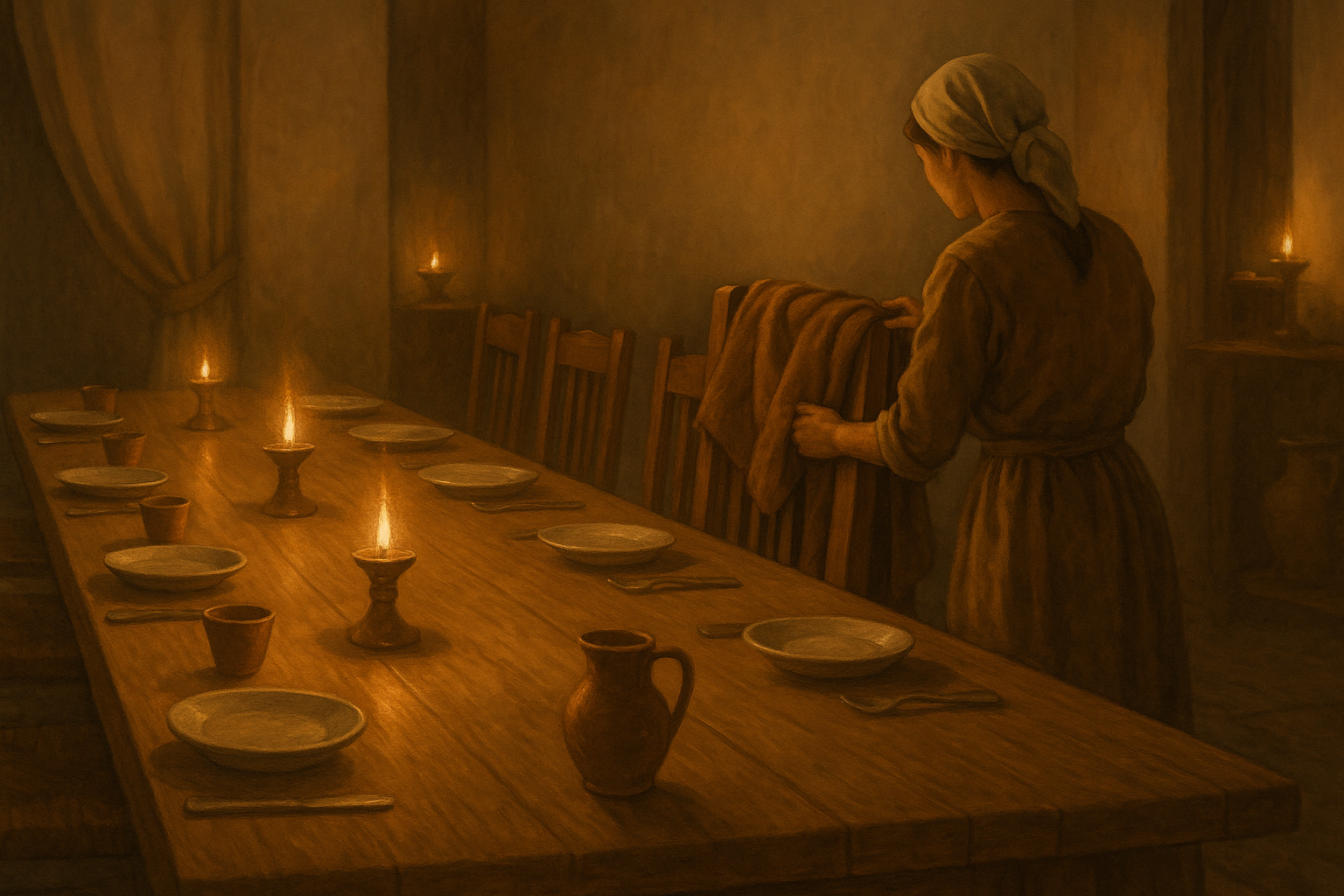
The table stretched the length of the room, its polished surface glowing under the soft light of oil lamps set along its center. Clay cups and shallow dishes waited in perfect order, the air faint with the fragrance of olive oil and fresh bread somewhere nearby. Servants moved quietly, adjusting linens, setting pitchers of water and wine within reach. The table awaited them—prepared but untouched, a still life awaiting its moment.
Linora stood in the doorway a long moment, unsure if she belonged among such order. Hours ago she'd been ankle-deep in ash, binding wounds in the street; now she stood before a table gleaming with oil lamps and polished wood. The shift was dizzying, stepping from one world into another. The beauty before her was impossible beside the ruin she'd left behind.
The servant gestured to an open seat near the end of the table. Linora stepped forward, her footsteps soft against the tiled floor. She took her place as instructed, beside an empty chair at the head, draped with a folded cloak—its presence commanding even in absence. Tirzah, Lirit, and Omri sat farther down, small and grateful, their hands folded in silence that resembled prayer. Each in new tunics matching their size with freshly washed faces.
Opposite Linora sat a man she had not yet met: tall, sun-darkened, his hands the color of earth and worn at the knuckles. His hair fell unkempt about his temples, his gaze steady, unreadable. He said nothing when she sat, only inclined his head slightly, studying her the way one might study a horse—judging not its beauty, but its temperament.
His posture was relaxed but purposeful—nothing he did was ever wasted. Something in him held her attention—not interest—but awareness. She dismissed it as fatigue, or perhaps simple stirrings after a chaotic day.
"How long before my brother is back on his feet?" the man asked. Before Linora could answer, all the servants' heads turned toward the doorway.
Nahala entered last. She moved with focus, the long folds of her linen robe brushing the stone floor. When she took her place at the far end, conversation ceased. A servant poured wine into a clay cup at her right hand, and all bowed their heads.
"Let us give thanks," she said, voice low but carrying. "For what remains to us, and for those who found the gate before it fell."
At her nod the servants came forth in practiced rhythm—laying down loaves still warm from the oven, bowls of lentils and herbs, roasted vegetables gleaming with oil, figs, and goat cheese. The fragrance rose like incense, filling the hall. For a moment, no one spoke. Each took a slow, reverent bite, grounding themselves in the simple act of eating after a day that had devoured everything familiar.
It was Nahala who broke the silence. Her tone was gentle, though it left no room for evasion.
"You came from Shuruppak," she said. "Tell me, what remains?"
Linora's throat tightened. The bread in her hand suddenly felt heavy. She spoke of the Nephites, the chanting, the burning sheep, the fire that ran faster than thought. She told them of Samuel crushed beneath the beam, of Serah's warning, of the flight through the western gate. Her voice trembled, but she did not stop. Nahala listened without interruption, her face still as carved stone. Once or twice her eyes closed—not from disbelief, but the weary recognition of a prophecy fulfilled.
When Linora finished, the room was quiet again except for the soft hiss of a lamp. Nahala's shoulders settled, her gaze turning to its flame.
"Then it is as I feared," she said at last, her voice slow and heavy. "One by one they fall—Ur to fever, Uruk to its own bloodlust. Adab was taken by drought, Isin by rebellion. Even Lagas, once proud and sacred, has turned to idols that eat its children. Evil ripens faster than grain now; the world grows too heavy with it."
She sat back, her hands folding in her lap. "The great cities of the plain were meant to outlast us, but now they crumble as though made of sand. It isn't the fires alone that end them. It's the rot underneath—pride, hunger, the refusal to repent."
Her eyes dimmed as she looked toward the shuttered window. "There was one city I prayed would hold—a river town farther north called Sippar. They said it was struck not by sword or famine, but by a sickness of the lungs." She gestured to the man across from Linora, his gaze still on his plate. "Loshim's grandfather perished there before word could reach us."
Loshim's head lifted, his jaw tightening. "Samuel doesn't know," he said quietly. "Best let him find his strength before that sorrow finds him."
Nahala gave a slow nod. "Then may the Lord give him mercy enough to bear it."
She went on, her tone distant, reflective. "A city takes years to build, yet burns in an hour. My husband says wood and stone are patient—but men are not. They destroy what they envy."
Linora looked up, her voice quiet. "He builds?"
A faint light came into Nahala's eyes, the first warmth of the evening.
"He's a master builder," she said. "Right now he's in Nippur, overseeing a project for the king of Kish. But his heart belongs to his own work—his wooden city."
"A city of wood?" Linora asked, half in wonder.
Nahala's smile softened. "Every project leaves good beams behind—pieces too fine to discard. He gathers them all. He's been building since the day Loshim was born."
Linora's gaze drifted, her mind painting what her eyes had never seen. She imagined Shuruppak—but every wall, every step, every tower made of wood. Streets that creaked beneath bare feet, a marketplace lined with polished beams instead of stone, the scent of sap and resin thick in the air. She saw doorways carved with patient hands, rooftops fitted like puzzle pieces, sunlight caught in honey-colored grain.
As she took another drink of wine, she turned to the silent man across from her, still lost in the vision—the sound of saws, the echo of hammers, the shaping of beams beneath a craftsman's patience.
Loshim met her gaze at last. "It stores our grain," he said simply, dashing the grandeur she had conjured. "Keeps the foals dry. Houses what the world forgets. It's ideal for breeding."
Linora had lifted her cup when Loshim said it. Ideal for breeding. The phrase struck her so abruptly that the sip went down wrong. She stifled a laugh behind the rim, coughing once, eyes watering as she fought to keep composure.
His voice had been low and even, the cadence of a man long accustomed to silence. Yet something in it—something steady and sure—lingered with her. He was speaking of more than storage, though she couldn't name why she was certain of this.
The meal slowed into a calm rhythm of eating and low conversation. Servants passed quietly between them, replacing emptied bowls with figs and fresh bread. Her shoulders eased for the first time in days.
Nahala's gaze softened as she gestured toward the man across her shoulder. "You know why he's called Loshim?" she asked.
Linora's eyes brightened with curiosity, ready for a story to wash the heaviness from the room.
"When he was a boy, he named every creature born on this land," Nahala said, her voice carrying that faint note of affection reserved for those one respects. "Goats, doves, calves—even the mice in the grain bins."
Loshim did not look up, only spoke in a steady tone, like a man reciting a record rather than a memory. "One lush, the births came faster than I could count. I missed one lamb—didn't name her. Somehow, my brothers thought that was amusing." A faint shrug. "So they called me Loshim. 'No name.' I tried to tell them the lamb's name was 'Ann', but that didn't matter, the name stuck."
A small ripple of laughter passed around the table—gentle, grateful, the sort that rises more from shared relief than humor itself. The corners of her mouth softened in spite of herself. It was strange—how easily she could laugh with a man she'd only met that evening, while the one she'd rescued from death lay sleeping down the hall. The thought unsettled her, though she couldn't say why.
For a moment, the hall fell still—the warmth of lamps flickering against wood, the hush of full bellies and softened hearts. Nahala's smile was small but knowing. She lifted her cup, and it was refilled without a word. Linora watched the motion—simple, seamless, practiced—and astonishment rose again at what surrounded her.
The meal dwindled into quiet satisfaction. Servants cleared dishes with soft, practiced movements; conversation faded into the gentle clatter of pottery and the rustle of linen. Tirzah and her children were led away toward the servants' quarters, their small figures vanishing down the corridor with sleepy obedience.
Linora excused herself to check on Samuel. The care room was dim but calm. He slept soundly now, his chest rising and falling in steady rhythm under fresh bandages. She brushed a strand of hair from his forehead and whispered a small prayer of thanks.
Stepping out the main door overlooking the courtyard, coolness washed over her skin—the night rich with the scent of grass and distant dew. The stars glittered sharp above the trees, clearer than she had grown accustomed to above the city. Somewhere beyond the fencing, a donkey brayed, answered by the low murmur of cattle.
Movement caught her eye: Loshim, crossing the pasture with an oil lamp in hand. He checked the enclosures one by one, pausing to run his hand along a gatepost or murmur something to an unseen animal. He didn't look back, but Linora suspected he knew she was watching. There was a patience in his gait that belonged wholly to the land.
A servant appeared behind her, bowing slightly. "Your room is ready."
Linora followed the servant up the broad stone steps, each one worn smooth from years of careful use. She had never lived in a house with an upper floor; the rise itself felt regal, her hand brushing the cool wall as lamplight shimmered along the stairwell.
At the landing, the servant opened a heavy wooden door carved with quiet mastery—the grain polished with care. Inside, the guest chamber glowed with lamplight. A bed stood in the center—wide, draped in woven linen. A basin of water waited nearby, still rippling from where it had been poured.
As Linora circled the room in disbelief, Nahala reached the landing, on her way toward her own chambers. She paused briefly at the threshold, her expression gentled by candlelight. "Rest while you can, healer," she said softly. "Tonight was a gift from God. The world may not give us many more like this."
Linora bowed her head in quiet acknowledgment. She walked to the bedside and ran her fingers along the woven linen, marveling at its softness. Never in her life had she felt fabric so fine, nor a fleece bed atop a fold of wool. The faint scent of pressed herbs rose from the sheets, clean and inviting.
When she finally lay down, the bed cradled her completely, swallowing the ache from her shoulders and the dust from her thoughts. For the first time in days—perhaps in years—she was safe enough to sleep. And when sleep came, it was deep and dreamless—even her mind had been granted rest.