Chapter 8 - Refuge
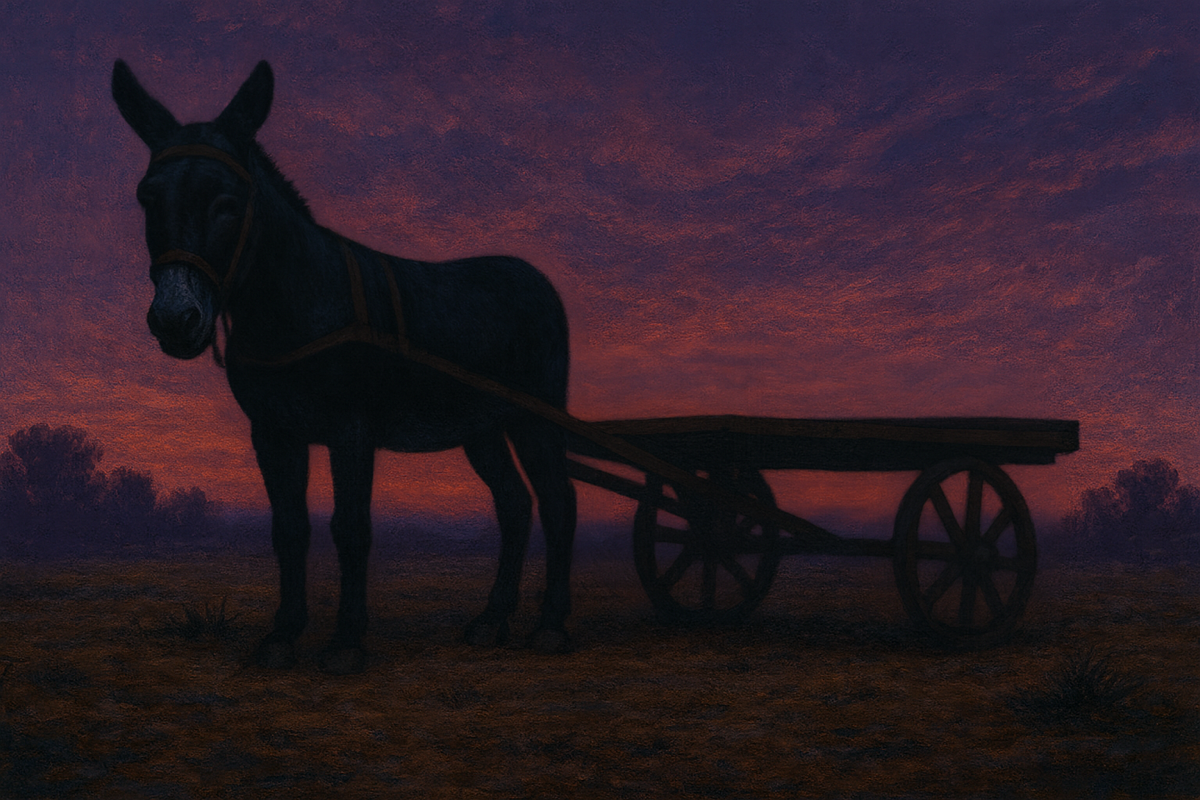
The city's glow burned behind them long after the gate was lost to sight. The donkey's hooves struck the dirt in a desperate rhythm, the cart lurching over every rut and stone. Linora kept one hand on the reins, the other steadying Samuel's limp body with each jolt. His head rolled with the motion, his pulse threading weak and uneven beneath her fingertips. The air stank of smoke, singed wool, and fear.
She knew he needed tending—every bump pressed a low sound from his throat—but stopping this near the city was dangerous. Behind her rose the ruin's echo: the crackle of fires, the cries of the trapped, the unholy chants that carried on the wind. Ahead stretched open plain, vast and indifferent. Linora eased the donkey to a slower pace, judging distance, terrain, chance.
"Not yet," she murmured.
"He's strong," the woman said softly, voice thin with dust. "Strong enough, at least."
Linora nodded—unsure whether she meant the man or the beast. Looking at the woman, she said, "A little farther. Then I treat him. You'll have to walk too, or the donkey will break."
The woman met her eyes, one hand bracing her rounded belly. "I can manage," she said, and climbed down without protest. The cart tottered but held. Together they moved on—Linora on one side, the woman on the other—both silent now except for the weary creak of wood, the soft click of reins, and the donkey's heavy steps that bound their fragile trust.
Another mile. Then another. The noise behind them dimmed to nothing more than a low hum beneath the wind. No shouts, no drumming—only the sound of other refugees moving along the path and the woman's faint hiss of steading her burden within. It would have to do.
She steered toward a low rise where a few twisted trees broke the horizon. The donkey stopped willingly, sides heaving. The stillness pressed close, sudden and weighty. The woman winced as a sudden movement rippled beneath her ribs.
Linora noticed. "That one's restless too?"
"Always when I stop," the woman said, one hand pressed to her side.
Linora climbed onto the cart. The children made room, their eyes wide, their faces streaked with soot. She brushed ash from Samuel's cheek and felt the heat of his skin. Too hot. "Don't you give out on me," she whispered. "Not after all this time."
The loose wraps she made using one free arm were already dark with seepage and grime. "I have to see," she said quietly. The mother nodded and prepared her children for the coming sight.
Linora cut the linen with her small-blade, unraveling it strip by strip. The sun was high now, pressing down on her shoulders like a weight. Sweat stung her eyes and turned the dust to paste on her arms. Beneath the wrappings, Samuel's legs told the story of fire—angry red flesh, blistered and cracked, the skin swollen tight as bark. Worse were the bruises: deep, livid marks where the beam had pinned him. He had survived by strength and stubbornness alone.
Flies gathered; Linora waved them away and worked quickly. She rinsed the wounds with the last of her clean water, then poured from the woman's waterskin. The water hissed faintly on the heat of his skin and steamed in the dry air. From her medical bag Linora drew herbs—comfrey for swelling, thyme for infection—and crushed them against the flat of her blade, mixing in oil until the paste turned green and fragrant.
"Keep this cloth up—shade him," she said, and the boy lifted his mother's shawl to block the sun. The world shimmered in the heat, wavering above the cart.
Linora spread the salve in slow circles, whispering a prayer, half to steady her hands, half to bargain with whatever mercy still watched them. Take the pain from him, give it to me instead. Keep your mercy on him.
When the last of the paste was used, she tore her own shawl into long strips, barely soaking them with water, and wrapped his legs anew—loose enough to breathe, firm enough to hold.
Once finished, she brushed the back of her hand against his face again. His pulse had steadied, faint but rhythmic. She sat back on her heels, her shoulders dropping for the first time since leaving the city.
The woman offered a drink; Linora shook her head. "Let the donkey drink. We'll move again soon."
She looked eastward. The smoke still rose there, thin but unbroken, drifting like a dark veil against the pale sky. She could see it in her mind—the walls still standing, the gates still closed, the people still alive. But ash and ruin still hung over everything, and she knew better.
She climbed down, took the reins once more, and pressed her forehead briefly against the donkey's flank. "You did well," she reassured. "Now we keep moving."
The two children huddled near Samuel's legs. Neither woman rode. To do so felt wrong—the donkey already gave more than it should. So they walked, mile after mile, the sun turning the road to copper beneath their feet. The woman moved slowly, one hand supporting the small of her back, her stride careful but steady, her eyes fixed on the path ahead. Each rise in the road drew a pause, a quiet swallow of strength before she pressed on.
The next hour blurred into the steady rhythm of hooves and creaking wheels. The sun had begun its slow tilt westward, casting long shadows that rippled over the uneven land. The children hadn't spoken since the city fell; their silence felt sacred—words might summon the fire back. Linora's hands ached from gripping the reins, her throat raw from dust. Still she drove on, watching the road ahead with the dull focus of survival.
She slowed the cart, scanning the horizon. A faint shimmer wavered in the heat—a thin, uncertain glint that might have been water. She blinked, rubbed her eyes, and saw it again: a narrow stream, perhaps a hundred paces off. No smoke. No glint of metal. Only wind, and the drone of flies in the heat of the day.
Still, she waited a long moment before stopping. The mother hunched over, resting her weight on the wheel.
"The beast won't make another mile without water," Linora said at last. "But I don't fetch alone."
The woman's jaw tightened. "Nor I."
That was all. Agreement enough. Before unfastening the harness, Linora looped one of the shafts around a tree trunk and tied it tight. The cart held steady as she released the donkey and passed the reins. Together they led it toward the small stream. The children stayed on the cart, the girl holding Samuel's wrist as if that single point of touch could keep him tethered to life.
They walked in silence, the donkey's halter rope stretched between them like a drawn line. Neither looked away from the animal. The water glimmered just ahead, shallow and brown-green, rimmed with smooth stones.
When they reached it, Linora knelt on one side, the woman lowering herself carefully on the other. The donkey plunged its nose into the stream with a grateful snort, drinking deep. Ripples spread, breaking their reflections in the current.
"It's good water," Linora said, cupping a handful for herself.
The woman hesitated, then did the same. "Yes," she murmured. "Feels stolen."
Linora met her eyes across the beast's back, then glanced at the cart. "Everything feels stolen today."
They both fell quiet again, the sound of the donkey drinking filling the space between them.
After a while, Linora said softly, "You have strong children. They've kept their calm."
The woman gave a tired smile. "They learned early. Crying brings wolves."
Linora nodded. It passed for small talk, but both women knew what it was—a gentle test of trust, a way to name their fear without speaking it aloud.
Then the donkey lifted its head, dripping and satisfied. The woman finished filling her waterskin, keeping one hand on the rope.
The walk back carried a quiet relief. Behind them, the water stilled, leaving only the faint prints of their feet and the shallow grooves of the donkey's hooves in the mud—two trails that met, then drifted apart.
Linora fastened the donkey to the cart, removed the knot around the tree, and turned toward the woman. "If the road stays clear, we'll reach the estate before dusk."
"A kind estate?" the woman asked, settling her stomach.
"Yes," Linora murmured, glancing toward the horizon. "You'll find favor with Nahala—after treating Samuel."
The woman smiled wearily. "Samuel. Funny—living through all this, I forgot to introduce myself. I'm Tirzah. These two are Omri and Lirit."
"Linora," she replied simply.
Those names hung there, fragile and fleeting, soon to be lost to the rattling wheels.
The donkey brayed once, and Tirzah took her spot beside. The cart creaked forward again, carrying their treasured souls along the path.
Another hour passed—two miles, perhaps—before a sound behind her broke the monotony: a low groan, half sigh, half question. Linora turned, startled, just as Samuel stirred. His eyelids fluttered open, unfocused, and the first thing he saw were small faces staring back—two children, wide-eyed and silent. For a long moment he only blinked at them, bewildered, caught between waking and dream.
"Good!" Linora said, the word sharp with relief. "I thought I'd have to wake you myself." She reached over, brushing the edge of his bandage to check for bleeding. "We change paths soon—what was the landmark again?"
Samuel took a moment to take in the situation. He swallowed, his voice rough and faint. "Twin... stones," he managed. His words mended something in her she hadn't realized was breaking. He was still there. Still hers to save.
The memory returned in a rush—one of their talks years ago, when he'd bragged about his father's estate. "Easy to find," she remembered. "Four hours to stones, hour south. Estate in the forest."
He tried to say more but slumped back against the boards, the motion soothed his ailing body. Linora watched his chest rise and fall, steady once more, and turned her eyes back to the road. The stones waited somewhere ahead—and beyond them, she hoped, rest. They stopped briefly to water the donkey, pouring water into a small rut beside the road, then pressed on another mile.
When she finally saw them, her heart lifted: two great boulders rising modestly from the earth, their shadows meeting like open arms. Between them ran a narrow trickle of water, threading through reeds before vanishing into the haze. The donkey's ears twitched at the sound, and it gave a weary bray.
Hope flared, bright and sudden—God himself had granted them this sign. This would be their final rest before pursuing the forest. The donkey could drink its fill at the twin stones, and though Tirzah's feet were raw with blisters, her face spread into a faint smile. With aid so near, the pain no longer mattered.
The sun was sinking behind the hills when the road finally bent into a shallow valley. The air shifted before she saw it—the scent of resin and damp earth, the faint hum of insects, and a coolness that carried through the trees. Before them rose a forest unlike any she had ever seen. The trunks soared thirty cubits or more, straight and pale, their crowns woven into a canopy that caught the last light like threads of gold. The undergrowth was deep green and hushed, filled with drifting motes of pollen and the sweet musk of sap.
The path wound gently among the roots, half shaded, half aglow where the light slipped through the leaves. It was not wild but ancient—each bend revealing another stretch of towering timber that looked carved by deliberate hand. The donkey's steps softened to a respectful pace, and no one spoke; even the children stared upward in awe.
When the path at last opened, it did so suddenly, spilling them into a broad clearing at the forest's heart. There stood the villa: a great house of timber and stone, framed by vineyards and pastures that stretched into the green. Gardens ringed the clearing's edge, and beyond them, the trees stood like sentinels guarding what human hands had made.
A man working the vineyard saw them and stopped midstride. His bundling of grapes dropped from his shoulder as he sprinted toward the main gate, shouting for others. Within moments, two more servants appeared, carrying lamps. Their faces showed worry, not suspicion.
One pointed at the cart. "Is that—?"
Samuel stirred weakly and lifted his head. He nodded without a word.
Recognition flashed in their eyes. "Quickly! Tell the mistress." They hurried toward the house.
Reaching the courtyard, Linora slowed, struck by the sight of it—a true two-story dwelling, more grand than any she'd seen. Its upper windows glowed with lamplight, the cedar beams carved with faint spirals that caught the evening's gold. Broad steps led up to the double doorway, framed in pale stone, where a woman stood waiting. The air smelled of oil and warm wood, and to her delight, Linora felt the weight of a master's hand in every line of the place—strength married to grace, like the promise of shelter that was fit for a king.
Nahala was tall and composed, her garments simple yet finely woven, cloth that spoke of quiet wealth rather than vanity. The lamplight caught the pale sheen of her skin—neither dark nor fair—and the faint bronze hue in her hair was both regal and timeless.
Her eyes went first to Samuel. She took in the bandages, the ashen skin, the tremor in his voice, and for a heartbeat her composure slipped—a flicker of concern crossing her face. "Bring him inside," she said, her voice calm but carrying authority that needed no volume. The servants obeyed at once, moving with the speed of those long accustomed to her command, lifting him with care.
Linora stepped forward. "I can tend him."
Nahala's gaze found her—sharp at first, then steady. A look that weighed truth without needing words.
"Yes... please," Samuel murmured, managing a faint smile even as the servants carried him inside. Pain hadn't taken his gratitude.
Without breaking eye contact, Linora said, "I fear Shuruppak has fallen."
The words settled heavy between them. Nahala's expression didn't crumble, but something in her shoulders changed—a tension released, then gathered again. "And these others?"
Tirzah stepped forward, head bowed, both hands cupping her belly. "If you will have us, kind mistress."
Nahala studied her—one glance at the dirt-streaked children, the life stirring inside her. Then she gave a single nod. "You will rest tonight," she said, voice gentle but final. "Tomorrow we'll find work that suits your hands. No one goes hungry here."
Her attention returned to Linora. "Thank you," she said, her tone softening with gratitude. "His father and I will not forget this. Come! You'll have the finest room the servants can ready. You must tell me everything—once we've eaten, of course."
Servants moved instantly, lamps lifted higher, doors thrown wide. In that warm spill of light, Linora saw the woman Nahala was—elegant, decisive, born to lead but not to be feared.
For the first time since the bells of Shuruppak, Linora felt peace. The journey had ended, but the weight of it remained.