Chapter 7 - Siege
As seen throughout all time, some men worship creation rather than Creator—drawn to the strength of flesh and the pride of stature.
From the Euphrates they marched, bodies painted in ash, their voices crying for superior ascent. Only when every blood was blended, they claimed, would mankind reach its highest form.
At their head was Drev, the great half-blood, leading his many children—born of slaves and wanderers alike. They were called the Nephites, believing they were the fire that joins stray embers into a single flame.
Their ranks swelled with famine, fear, and zealotry. They came to cleanse the lines of Adam, and they swore that Shuruppak would burn—and through its burning, be made free.
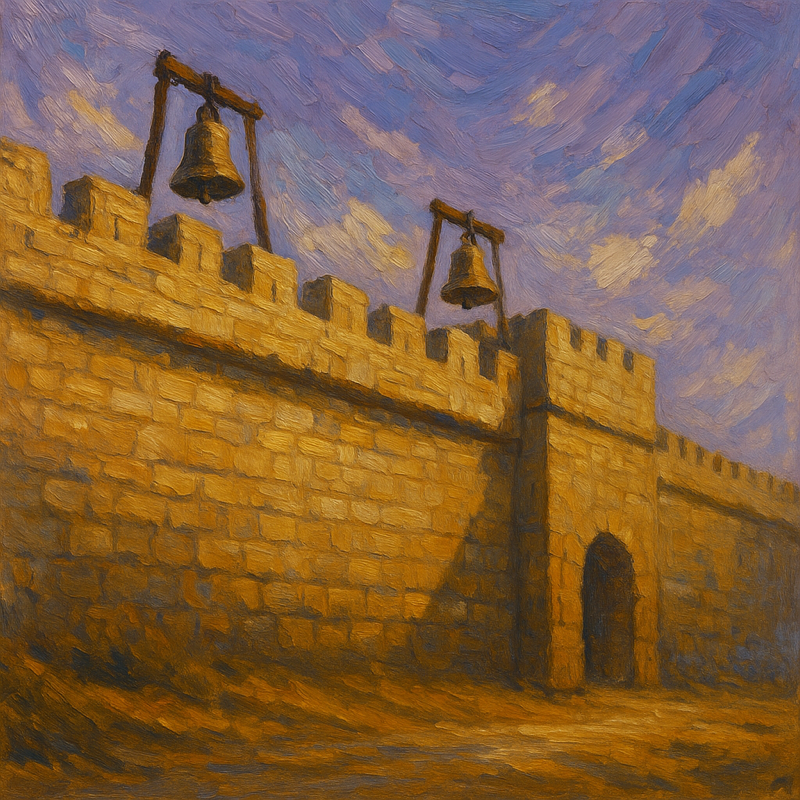
The bells were still ringing when Linora reached the door—deep, rolling, relentless. They shook the shutters, rattled the clay jars on their shelves. Outside, the streets surged like a river: women pulling children toward doorways, men overturning carts to make barricades, the air thick with the smell of dust and smoke.
Across the square, shopkeepers dragged their most precious wares inside—bolts of cloth, sacks of barley, silver tools—anything that could be carried before the gates closed. A flock of hens scattered through the crowd, their wings beating in panic as doors slammed and windows latched.
Inside the infirmary, Linora moved quickly, her hands steady though her heart pounded. She gathered what she could—chilled, boiled water in a small corked vase, clean linen, two small jars of oil, and a satchel of herbs crushed that morning. Every motion was muscle memory now, honed through years of tending the wounded.
"Serah!" she called.
"I'm here." Serah emerged from the next room. She held her assistant with a hand on each shoulder: "Take the back room—prepare cots. If the gates fall, they'll bring them here first."
The assistant nodded, her calm already fraying at the edges.
Linora slung her white linen sash over her shoulder, the fabric marked faintly with soot. She tucked sprigs of comfrey and hyssop into the fold, tightened the strap, and stepped into the light, Serah close behind.
Both made haste to the square, the city's defense still forming. The magistrate stood on the fountain's rim, still being instructed by a scout. A quick nod, then shouting orders above the murmurs, his voice hoarse but clear.
"Archers and throwers on the south wall! Attack on sight! Pikes and pitchforks, make a line two paces from the wall! Brace and hold!"
Men scrambled into place—smiths, farmers, tradesmen—most without armor, many without training. They picked up whatever weapons they could find. Fear pulsed through the streets, but the city moved with purpose.
Samuel closed in, awaiting instruction, sword held tight opposite his bandaged arm. Linora watched him as she weaved through the crowd, then matched his eyes and watched his face drain of color. For a moment, the chaos around them faded. Every time she'd patched an arm, every laugh they'd shared—all of it flashed like sparks before vanishing in smoke.
"Linora! You cannot be here! It's too dangerous."
"I live in the city," she said, her tone firm but even. "This isn't my first invasion. But don't worry," she said with a wink, adjusting her shoulder strap, "I'll keep an eye out for you."
He opened his mouth to argue, or so she thought. He stretched his neck, and Linora tasted the warmth of his breath. She wanted it to last longer. "For luck," he said with a smile. The magistrate's command cut through the air like a lion's roar—"Barricade!"
At once, any cart or stall unlucky enough to stand near the southern gate was seized, tipped, and rolled into place. Fruit spilled, cloth tore, and the marketplace that had been a scene of barter only minutes before became a wall of splintered wood and overturned wheels.
Linora climbed the nearest stair to the parapet, the stone warm beneath her hands. She needed a vantage point—a place to see when and where aid would be needed. From above, the city looked alive, each moving part preparing for what was to come.
Then the sound began—not the shout of men, but something deeper. A tremor beneath the earth, a low hum that rolled through the stones before any could see the dust. Voices followed, not cries of anger but chants—hundreds of them—rising and falling in a rhythm that crawled beneath the skin.
Linora squinted into the horizon. A haze of ash drifted before the sun, blurring its edge. Through that haze came torches, dozens at first, then hundreds, their flames twisting against the pale purple sky.
The force that advanced bore no emblems, only skins smeared in ash and ochre, banners stitched from hide, and faces masked with bone and horn. Armor made of threaded bones. They wielded firebrands, curved blades, and blackened pikes.
Ahead of the advancing force moved a herd of sheep. Their wool shone dark with oil and pitch, each tail wrapped with reeds. From a distance, they looked like a low, shifting cloud—a small black mass driven forward by whips and barking dogs, pressed toward the city walls.
Towering above the rest came Drev. His skin was marked in soot and streaks of copper dust, his hair bound tight with cords of sinew. The world recoiled from what he had become. His helmet and cuirass, dark and gleaming, were unlike any around him—iron refined and hammered smooth, heavy enough that Linora guessed it must weigh as much as a full anvil from her father's forge. He wore leather gauntlets, blackened and creased like those of a master smith.
He raised a staff tipped with the skull of a young beast, its jaw wired open, teeth glinting like broken glass. The whole force stopped and the chanting fell to silence.
"You who cling to the dust of your fathers!" Drev's voice thundered across the fields. "You hoard your blood as idols, calling it holy while the world starves for unity! The breath of the world will return—not by birth, but by fire! And through its flame, all flesh shall be made one!"
The crowd behind him answered in unison, a roar that broke the stillness of the plains. The sound of drums followed—not made of wood, but of hide stretched over bone. Each beat came like a heartbeat too large for the land to hold.
On the walls, the archers readied their arrows. Waiting for the Nephites to move into range.
Linora expected someone to ride forward—a herald, perhaps, to shout demands or offer parley. The magistrate would answer, there would be words, terms, some way to turn them back. That was how these things were supposed to go.
But no one came. The maddening roar didn't cease.
Drev gave no signal of peace, no pause for talk. The Nephites began to move again, slow, the drums guiding their pace. The sheep surged ahead in a thick wave, driven harder by the handlers' whips and the dogs snapping at their heels.
Once in range, the lead archer's arrow cut through the air, glinting once in the light before finding its mark, hitting the arm of a front Nephite. Then dozens more followed.
The first volley fell unevenly. Some shafts struck dirt; others clattered harmlessly against the bone-braided armor of the advancing men. A few struck truer—finding a shoulder or a thigh. Sheep tumbled mid-step, squealing, their dark wool shuddering under the impact. The line wavered but did not break.
Drev lifted his staff high, the beast skull gleaming with firelight and let out a screech.
From among the Nephites, torches dropped to the ground, falling in arcs of red and gold. The oil-soaked reeds tied around each sheep tail caught at once. Suddenly, the herd became a rolling mass of flame.
Panic rippled through the field—dogs barking, men shouting and cracking their whips as the burning animals bolted forward, blinded by terror, straight toward the line of soldiers bravely guarding the wall.
Linora's mouth fell open. Her veins hammered in her ears, drowned by the roar that followed—a single, collective gasp turned scream as fire and flesh and fury moved in chaotic patterns like a swarm of wasps stirred from their nest.
Archers scrambled to find their aim, shouting to one another over the noise below.
"Hit the beasts! Stop them before the gate!"
Arrows flew in desperate volleys. Some struck true, most missed entirely, vanishing into the smoke. The sheep, slick with pitch, moved too quickly—bolts of living flame darting across the field. Each one that fell only fanned the fire wider.
Below, the pikemen braced themselves, thrusting into the blur of fire and motion. The long spears caught a few of the creatures mid-stride, but too many slipped through, their burning wool brushing men's legs and igniting splinters along the gate. The air filled with the stench of scorched hide and hair.
And in that chaos, the Nephites charged.
Behind the stampede, the first ranks of infantry surged forward, bone masks glinting, torches held high. A dozen of them pushed a great timber between them—its head shod in iron, the trunk bound in leather and soaked in oil.
One of the archers turned back toward the magistrate, "Battering ram!"
The Nephites broke into a run, the chant returning louder than before. Drev's voice rose above them, saying something about the breath of the world being reclaimed. He seized boulders from the cart behind him, tossing them like clay jars, each one striking the wall with enough force to feel it shake. One broke through the upper part of the southern gate, above the barricade.
The magistrate shouted toward the wall, his voice nearly lost in the fire's roar. "To the gate! Brace the hinges! Swords—now!"
Linora caught sight of Samuel already moving, weapon drawn. The flames ahead reflected in his eyes, and for the briefest second, she could not tell whether it was courage or fear that carried him forward.
Linora looked back toward the plain. Archers and stone-throwers unleashed what strength they had left, their volleys hissing through the smoke in a futile attempt to thin the ranks. A cart of boulders, now emptied, lay abandoned behind the front line.
Then came Drev's new weapon.
He seized a fallen sheep—its body still smoldering, dark resin burning along its flank—and lifted it with one leather-bound hand. With effortless motion, he hurled it high over the wall. It struck a merchant's awning and burst into flame. Another followed. Then another.
Within moments, fire leapt from stall to stall, and the city was alive with screams.
Women clutched their children, running barefoot through alleys as sparks rained down. The stench of burnt wool and pitch clawed at Linora's throat. What once protected them had become a prison—the walls sealing in the fire like a furnace.
She ran.
Tearing her sling loose, she pressed it over her mouth and nose, forcing her way toward the southern barricade where she'd last seen Samuel. Through the haze, she spotted him—half-buried beneath a fallen, burning beam, one arm still reaching for the sword he'd dropped.
Linora screamed his name and stumbled toward him. In that instant, every lesson, every oath as a healer was forgotten—there was only him, broken and burning, and the terror of losing what they shared.
Every searing breath came with ash. She pulled at the beam, but it barely shifted. Samuel's eyes fluttered, his lips blackened by smoke. "Go," he rasped. "Get clear."
She shook her head, tears carving clean streaks down her soot-covered cheeks. A shadow moved through the smoke—Serah, her face streaked with sweat and soot, her arms steady. She levered the beam enough for Linora to drag him free. His legs hung limp, the flesh blistered and raw.
Linora's hand went for the cord at her belt before she could think—a tourniquet, the reflex of old failure. But the blood wasn't gushing this time; it was trapped beneath the skin, dark and swelling. She froze, her fingers trembling. To bind it now would kill the leg outright. She forced her hand away.
Serah's eyes were already scanning. She spotted a flat merchant's cart overturned nearby, a donkey still tethered and braying in panic. She seized the reins, dragged the beast around, settled the cart and heaved Samuel onto it. He lay there, lifeless, stretched out across the full length, his feet slightly lifted by the low rim wrapping its edge. Linora climbed as well, next to him, fumbling for bandages. "I'll get him to—"
But Serah caught her wrist. Her voice rose above the roar of the flames—sharp, desperate.
"No! Not the infirmary. He's pure, he won't survive there," she insisted, then shifted her voice—calm and steady, like a surgeon giving direction. "The eastern gate's also fallen—you have to go west and flee the city."
Linora blinked through smoke and tears. "Flee? I can't—there are wounded everywhere, I—"
"There's no time." Serah's tone softened, though her grip did not. "Drev is my father. He takes every pure woman he finds—and kills the pure men. If you stay, you'll be next."
The words struck harder than the fire itself. Linora stared at her, uncomprehending for a heartbeat, then looked toward the burning rooftops—the city she had healed, now devouring itself. She slid back down to her feet, her gaze dropping to Samuel's face, pale and still, his pulse faint against her trembling fingers. "Then I'll save at least one. But you—"
Serah's eyes glimmered with fierce resolve. "Go! That's my final order."
The donkey brayed and lurched forward. The wheel caught on a stone, then rolled free. Linora, walking briskly with reins in hand, joined the flood of people fleeing through the northwestern gate. A woman lifted two small children onto the cart near Samuel's knees, then climbed up herself beside his core, one hand resting protectively over her rounded belly. Linora gave no objection.
Once beyond the walls, gripping the reins harder still, she set a brisk pace beside the donkey. All around them, the road seethed with motion—carts creaking, hooves striking stone, voices shouting over one another. A man stumbled past dragging a goat by a rope. The air was thick with smoke and dust, tasting of ash and sweat.
The tide of people carried her westward, not in panic now, but in that strange, steady drift that comes after terror has done its work. The cart rattled; Samuel groaned, half-conscious, as the woman held her children close. They fled together with the rest, carrying them farther from the city's glow. Behind her, the bells had fallen silent—replaced by the crackle of fire and the distant chorus of screams. Beside her, the fated man still tied her to its memory.
She did not look back.