Chapter 6 - Freeman
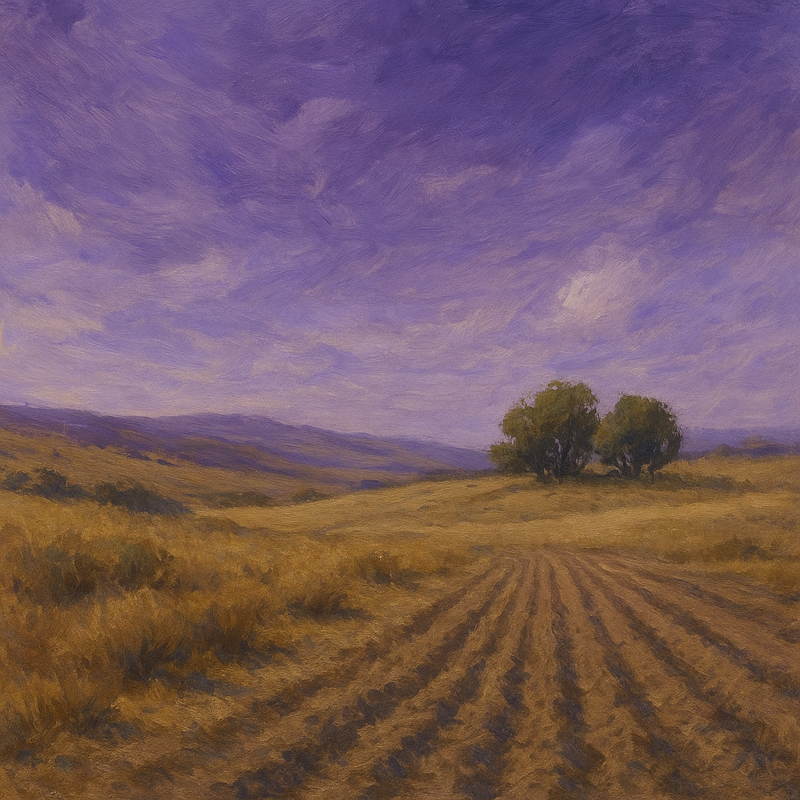
Six and a half years passed beneath the unbroken sky. The lush season had given way to the lean, as it always did—though no rain had ever fallen in the memory of man. In those days, the rhythm of the earth rose and fell like the tide, unseen but faithful. During the lush season, the ground exhaled its bounty—roots drank deep, leaves thickened, and livestock grew fat in the fields, harvest. But in the lean, the breath drew inward. The mists thinned, the colors waned, farmers sowed, and the earth rested from its labor.
So it was marked in the keeping of time: six moons for plenty, six for patience. And as the waters above the firmament shimmered pale and still, the season turned quietly, the world prepared once more for its next becoming.
The market hummed with life—hawkers calling from shaded stalls, donkeys braying under carts heavy with goods and seed, the air thick with the scent of crushed herbs and warm bread. Linora moved through the crowd with the sure-footed grace of someone who'd learned its pattern, her white sling of linen draped across her shoulder, a small basket looped at her wrist. She was halfway to the apothecary's stand when a familiar voice caught her ear. Her mother gently haggled with a vendor over lentils.
Keziah moved on to a nearby fabric stall, holding two lengths of dyed wool to the light, her face creased in her usual soft determination. She wore the colorful necklace Linora had made for her as a child, each bead a different hue scavenged from the market streets. A few stalls down, in the open-sellers section stood a broad-shouldered, clean-shaven man leaning against his cart, arms folded thick, the sun glinting off the iron wares piled behind him. The years had served him well.
"Mother," Linora said, weaving closer. "You didn't tell me you'd be here today."
Keziah smiled without surprise. "That's because this marks Samuel's first full cart. Your father promoted him to freeman, so he has to start selling his own things. It also gets him out of the forge long enough for the fires to cool."
Linora's eyes found him at once. He had a surer stance, a jaw sharpened with age. Even his grin, once boyish, now carried a quiet ease that drew more notice than he probably realized. "I almost didn't recognize him," she said, lightly blushing. "Those arms look dangerously swollen—should I check him for fever?"
Samuel turned at the sound of her voice, like his heart had been searching for it. For a moment, everything stopped. The world narrowed to the fleck of sunlight caught in his hair. He caught himself mid-sentence, paused, and said, perhaps a little too quickly, "Linora, come! I've got something big to tell you!"
Linora approached with folded arms, half-hiding the flutter in her chest. It was absurd, really—they'd known each other for years now, seeing one another at least once a month, yet something about the way he said her name made it sound newly minted. Feigning deep thought, "Let me guess. Father says you're proven now, which makes you the quickest apprentice he's ever trained. Am I right?"
His mouth fell open. "You told!" He turned to Keziah, who was already laughing.
"She didn't need telling," Keziah said, handing Linora a strip of cloth. "She knows you too well. He's been talking about it since dawn. Oren used the words 'proven hand' before we set off—and that was enough to fill the road with his boasting."
Linora laughed, shaking her head. "Samuel, if you keep training at this pace, you'll be as good as Father in, oh, two hundred and fifty years."
"Sounds about right," he said, still grinning. "But everything on this cart is mine—every piece forged and finished." He gestured toward a small stack of gleaming horseshoes, their curves neat and clean. "Go on, look. You think the magistrate's stables will want these?"
He reached across the cart to straighten one, but the motion caught at his arm. His smile faltered—a faint wince quickly hidden.
Linora's eyes narrowed. There, under the sleeve, she caught sight of a rough linen band about his forearm—too tight, too old, browned at the edges.
Her voice softened. "Samuel... what happened to your arm?"
"Really, it's nothing," he said, forcing a small laugh. "A foolish slip of the hammer. Your mother wrapped it—said it would hold until it healed."
Linora stepped closer, her brow furrowing as she traced the edge of the bandage with her fingertips. "It's held too long."
Keziah waved a dismissive hand. "It was clean when I bound it. He's impatient—couldn't wait to be back at the anvil."
But Linora had already drawn a small knife from her belt and began carefully loosening the wrap. The linen peeled away in stiff layers, the smell of old salve rising with it. Samuel didn't protest. He sat on the edge of the cart, silent, watching her hands work—steady, sure, nothing of the girl he once knew.
Her fingers brushed the warm skin of his arm, firm beneath the swelling. He'd grown into himself—the easy strength of a man who knew his craft and his place in the world. She tried to focus on the wound, not on his warmth.
When the last of the cloth fell away, the wound showed itself—the skin swollen and warm to the touch, a faint greenish hue spreading beneath the surface. A thin line of discoloration trailed along the veins down his arm.
She looked up, catching Samuel's head cocked as he studied her face.
"Copper fever," Linora murmured. "How long have you been working through it?"
Samuel shrugged with a half-grin. "About six days, I think. There's always work to do."
She popped her head up, looked at Keziah. "Watch the cart for him. He'll be back once fit to use both hands again."
Keziah sighed but smiled, accustomed to her daughter's tone. "Try not to lecture him too hard."
"I'll do my best," Linora said, already guiding Samuel through the market toward the infirmary at the end of the square.
Inside was humid and warm from boiled water and scented herbs. Linora rolled up her sleeves, lit a small lamp, and poured steaming water into a clay bowl. From her pouch she drew sprigs of thyme and crushed comfrey leaves, mixing them into a poultice until the scent filled the room.
"Hold still," she said softly.
He obeyed. The steam rose between them as she pressed the mixture gently over the wound, her fingers moving with precision and care. For a moment, the forge-worker and the healer shared the same rhythm—his pulse steady beneath her touch, her hands deliberate—the quiet understanding of two crafts bound by patience.
Samuel's arm flexed once, not from pain but from her nearness. The scent of thyme and oil clung to her skin. The steam thinned as Linora finished pressing the solution into place. Her movements slowed, measured and certain. Samuel watched her hands for a while before speaking.
"I've been meaning to ask you," he said quietly, breaking the silence. "How do you manage in the city? I hear the stories—the noise, the markets, the men who prowl when lamps go out. You walk these streets alone?"
Linora didn't look up right away. "Not often," she said, tightening the knot in the fresh bandage. "But when I do, I'm careful."
He frowned slightly. "Careful doesn't stop wicked men."
"It does if they recognize you," she said, glancing up with a faint smile. "Most people know a healer when they see one."
Samuel tilted his head. "How?"
Linora slid her hands along her sling, the corner of her mouth curving. "I always wear a healer's mantle—white linen across my shoulder. No scarf, certainly no jewelry. This marks me. They see the herbs tucked into the fold, smell the oil on my skin, and step aside. There's a kind of rule among the wicked: harm a healer, and you might die untended later."
"So they fear you."
She shook her head. "Self-preservation. They respect the boundary. It isn't me they honor—it's what I stand for. And in return, I don't ask what they were doing before they came to my care."
Samuel was quiet for a moment, his brow furrowed. "It still doesn't sit right with me," he said, his voice careful, almost gentle. "All this... danger, just to tend strangers in the dark. The city's no place for a woman alone, Linora. Not really." He looked at her directly, his eyes earnest. "Why not come home? You could tend people near the forge—they need healers too. You could build something that's truly yours. Something... safer."
Linora's hands stilled on the bandage. She met his gaze, her voice quiet but firm. "This is my home, Samuel."
"I didn't mean—" he started, but she cut him off, a note of steel beneath her calm.
"And I'm not alone. I have Master Serah. I have patients." She tilted her head slightly, "I have a life I chose."
Samuel's face flushed. He looked away, jaw working. "Right. Of course. I—" He exhaled slowly, shaking his head. "Forgive me. I only meant... I worry. That's all."
She didn't answer right away. Her hands resumed their work, pressing the bandage smooth with perhaps more pressure than necessary. The silence stretched between them, no longer comfortable. The lamplight caught the faint sheen of her skin, the herbal steam curling between them. "Strange, isn't it?" she said softly. "You hammer iron. I mend flesh. Both keep the city from falling apart."
Their eyes met—hers curious, his unreadable. The room felt smaller, the distance between crafts and callings collapsing into one simple awareness.
Samuel's lips lifted in a grin. "One with sparks, one with stitches."
That earned a quiet laugh from her—small, genuine, easing the tension between them. For a moment neither spoke. Only the sound of the lamp and the faint crackle of cooling water filled the space, two craftsmen bound by work and history.
Linora tied the final knot and gave the linen a small tug, testing its hold. Satisfied, she stepped back. "There," she said. "You'll keep your arm."
Samuel flexed his fingers, the pain easing under her careful wrapping. "I was hoping as much," he said, a grin tugging at the corner of his mouth. "The forge would miss me."
Linora looked up, meeting Samuel's gaze—steady, kind, reliable. "Then try to keep your accidents to a minimum," she said. "I charge double for fools."
He bellowed out a laugh, deep and familiar, filling the small room with warmth—his own, though distinctly marked by Oren. Linora smiled despite herself—it reminded her of childhood evenings by the forge, of a world that once felt simpler. Yet beneath that comfort stirred something she couldn't quite name—the faintest awareness that time had carried them farther apart and somehow nearer all at once.
They stepped outside to the humming market. She guided him by hand back to the cart.
Upon reaching Keziah's relieved smile, the air split with a sound that froze every conversation—the tolling of the To Arms bell. Not the distant summons of a hunt, but the deep, insistent call of defense. The crowd changed at once. Mothers pulled children close, merchants slammed their shutters, and men looked to one another with grim resolve. Samuel rose, his bandaged arm forgotten, his eyes bright with fire and determination.
Keziah threw a cloth over the iron goods on the cart as Samuel picked a blade forged by his own hand.
Linora sprinted back to the infirmary.