Chapter 5 - Shabbat
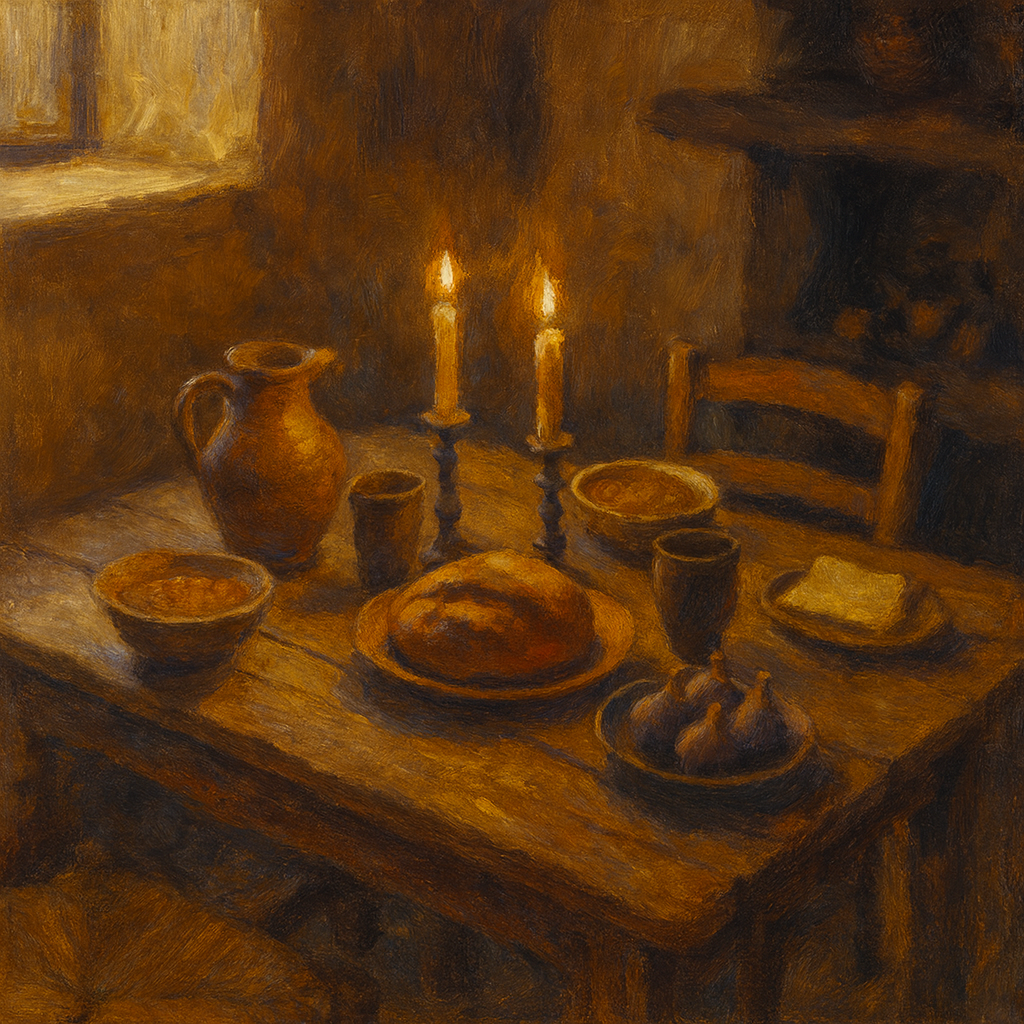
Since the days of Eden, the hours of man were counted by the turning of light and dark, but the day itself was born of night. So the elders taught: there was evening, and there was morning.
From the first story told by the first fathers, passed down through generations, the sun's setting marked the beginning of a new cycle. And thus, when the seventh day drew near, the wise ceased their labors before the stars appeared, saying, Shabbat begins at the fall of light.
The pounding came again at the door—heavy, hurried. Linora startled awake, half tangled in her blanket. Outside, a voice called her name. Another patient, taken ill in the night. She pushed herself up, already reaching for her shawl.
She moved on instinct: lighting the lamp, rinsing her hands in the basin, following the messenger barefoot across the courtyard. The air was cool and thick with the smell of herbs that never faded. Within the infirmary, the lamps burned low, their light soft on rows of sleeping figures.
Time had blurred. Day and night no longer belonged to her; she rose when called, slept when she could. Sometimes she forgot whether she had eaten. Bread would harden beside her on the table, water left untouched. Her hands bore the faint stains of salve and soot that no washing could remove.
The days ran together—a blur of motion and murmurs. She bound wounds, cooled fevers, carried basins of water until her arms ached. She learned the difference between silence and death, between rest and surrender. She had stopped counting how many she had tended.
Serah watched her with the quiet understanding of one who had lived through the same fever of duty. "Even God rested, pupil," she said as the day leaned toward its end. Linora straightened a cot, still unwilling to stop. "You'll do no good to the living if you join the dying."
Linora looked up, blinking through her fatigue. "I'm fine. There's still more to do."
"There always is," Serah said. "But there's a time for setting tools aside. Better get running if you want to be home before nightfall."
Linora hesitated. "You're sending me away? I don't understand."
"I'm releasing you," Serah corrected, smiling faintly. "One night and one day. No tending, no mending. Eat your mother's bread, sleep where the walls remember you. Enjoy your Shabbat." Serah said with a small wink, "I've got this place covered."
It wasn't until she stepped outside that Linora realized what day it was. The streets were hushing, shutters being drawn, and the smell of baked bread drifted from every home. Bells from the upper quarter marked the coming of evening. Shabbat.
She laughed softly—she had completely forgotten. The thought filled her with sudden energy. Her weariness fell away as she began to run, sandals slapping against the eastward packed road. The sun hung low behind her, the light deepening into gold. Fields on the outskirts shimmered, dotted with grazing beasts and the faint smoke of hearths.
By the time she reached the forge, her braid had come loose. The yard was quiet, the usual clang of hammer and anvil replaced by the soft crackle of a banked fire. Oren sat on a bench, bare-armed, sharpening a chisel more from habit than need. Keziah knelt beside the hearth, packing cooled coals into a clay jar for reuse—the last of her work before the sun disappeared.
They both looked up at once.
"Linora!" Keziah said, setting the jar aside.
Oren's expression softened. He leaped from his seat and ran to greet her. "You came!"
Linora steadied herself, smiling. "Serah made me leave early, so I came!"
After setting Linora back down to earth, Oren softened his hug, looking puzzled. "Serah..." he said slowly.
"The master healer! She's a quad! I have so much to tell you both."
Keziah's eyes glistened as she wedged herself between the two of them, her smile held steady. "A master healer! Oh, you've always had a healer's heart. I suspected the forge wouldn't be enough. You belong where real pain lives."
Linora laughed softly. "I couldn't have done any of this without you."
"Nonsense," Keziah interjected. "I merely opened the door you walked through."
Linora hesitated, the laughter dimming from her lips. "Mother, about what happened in Shuruppak—"
But Keziah raised a hand, gentle yet firm. "No apologies. You found your path, Linora. Every healer must—either in peace or through fire. You did what the moment demanded."
Her gaze softened, searching Linora's face. "And you came through knowing who you are."
Linora paused, couldn't speak. The words steadied her more than comfort could. She reached out and took her mother's hand, pressing it lightly to her heart.
They shared a simple meal together as the light faded—bread, figs, lentils, and olive oil. The forge's fire glowed faintly in the next room, its warmth flickering across the table as the first stars appeared outside.
After the meal, Linora rose to stretch her legs and wandered toward her old room. The curtain moved softly as she entered. It smelled faintly of oil and metal instead of lavender. The straw palette was neatly made, but on it lay a folded leather apron and a set of tongs resting against the wall. A few of her things still remained—a carved wooden sparrow Keziah made for her as a girl, a cracked clay lamp—but they looked more like memories than possessions now.
Oren appeared behind her, his voice low. "Samuel stays here most nights," he said. "Learns faster when he doesn't lose the hours walking."
Linora traced her fingers over the cool metal, then smiled. "It suits him," she said. "And the forge will never be short of good hands."
Oren nodded. "He's quick. Picks things up before I've finished explaining them." He motioned toward the workshop. "Come. I'll show you what he's been working on."
They stepped into the forge together, not for work but for something quieter—pride, maybe, or the need to share what still bound them. The fire glowed low and steady, casting long orange lines across the floor. On the anvil rested a half-finished piece of iron, curved and gleaming faintly in the lamplight. Oren turned it once with his tongs, the metal catching the fire's heart.
"He's learning the language of heat," Oren said, eyes bright in the dim light.
Linora smiled. "Then he's in good company."
Her eyes landed on a plowshare, like the one she tried to sell at the market. Linora remembered a question that had been gnawing at her. "How much am I worth?"
Oren looked up from the anvil, carefully resting the piece of iron. "What?"
"You know." She tried to sound casual but her voice cracked. "If you had to name a price, like a plowshare or a donkey. How much?"
His brow furrowed, then softened. He placed the tongs down. "You are worth more than all the silver in Shuruppak, Linora. More than the stars God hung over us."
Her chest tightened. "So I am never to be married, then? What man could live up to that price?"
The question hit him like a hammer. He wiped sweat from his forehead, searching for words. When he spoke, his voice had changed, less like a master speaking to an apprentice and more like a father to a grown daughter. "No price is worthy of you. All I can do is make sure the man who comes for you puts God first, loves you as much as I do, and will give everything he has to give you the life you deserve."
Linora tried to smile but it wobbled. "He has to love me as much as you do? I guess I really am doomed."
Oren chuckled softly, though there was a shadow in his eyes. "Then he'd better be a rare man indeed."
Linora leaned forward, her eyes narrowing playfully. "And how much did you pay for your first wife, what was her name again?"
Oren smirked. His voice was soft. "You know her name was Liyora. She was the light of my life." With a hint of sorrow, "She gave me two strong boys before... well, you know."
"I do," Linora whispered.
"Anyway, I was a couple decades older than you are now. Her father wanted no coin, no beasts. He wanted proof that I could shape the world with fire and iron. He asked me to forge the greatest sword I could make."
Linora's brow lifted. "And did you?"
Oren's eyes brightened. "I spent weeks at the forge! At first, I would pound in too much charcoal and the sword cracked like pottery. Then I wouldn't put in enough and the fire bent it like reeds. Dozens of blades were born and broken, melted back into the fire, until—until the folded steel sang in my hand. Every strike carried her name. I poured myself into that blade, and when it was done, I marked it with a flame—a candle burning against the dark. My first sigil." He drew the shape in the air with his leathered finger, a small flicker of pride in his eyes. "It was the best way I could honor her. My light."
For a moment, Linora went still, caught by the weight in her father's voice. She could hear the hammered chime echoing in his words. It was strange to think of him young, shaping steel for love.
"And her father accepted?" she asked softly, the words slipping out before she could stop them.
Oren chuckled softly. "He examined it, weighed it, tested the balance, then swung it into a boulder as hard as he could! The blade proved steady, so he hung it on his wall. He looked me in the eye, drew close to my face." Oren leaned close to Linora, noses nearly touching.
"He says, 'I accept. But if you ever lay a hand in anger on her, this little flame you forged, this one right here, will be the last thing you see.'"
Linora slipped back and exhaled. She looked around the forge, searching for the sword hanging on her great-uncle's wall. She grinned, eyes wide. "And it still hangs there?"
"As far as I know," Oren said, his gaze distant, seeing that house across the years.
She leaned back in, picturing the moment. "Why would he say that to you?" she asked. "We've seen your anger, but you're not violent."
Oren gave a low hummed laugh, though it carried no mirth. "Not anymore." He brushed a fleck of soot from his wrist. "When I was young, the drink was stronger than sense. I never struck Liyora, if that's what you're wondering—but I broke enough tables, and a few jaws besides."
Linora hesitated. "You?"
He nodded once, eyes distant. "I had a temper that didn't know its own weight. Liyora used to say the forge got into me—that I carried its fire where it didn't belong." He looked up then, the flame cutting across his face. "She wasn't wrong."
Linora said nothing, only watched him for a heartbeat—the strengthened muscles, the calloused hands, the tension still coiled in his shoulders. It was hard to picture that fire turned loose.
She hesitated before pressing further. "And what about Keziah?"
This time Oren barked a laugh. "Ah, by then I was no green apprentice. I was an established blacksmith, the city's best. Your grandfather knew it too. He named a price so high I thought I'd go mad."
"What was it?"
"He demanded three things: a suit of armor fit for a king, a full set of perfect weights with matching scale, and enough silver to buy a pasture fat with grass and heavy with sheep—the kind of land men defend with their lives. I pretended it was outrageous, but Keziah was more than worth it."
Linora shook her head in mock disbelief. "So... one sword for Liyora, and a king's ransom for Keziah."
Oren's smile softened as he looked at her. "The price doesn't matter. What matters is that both times, I gave the best I had. And when your time comes, the man who would have you must give no less."
For once, Linora slept through the night. No calls at the door, no footsteps in the hall—only the low whisper of wind through the shutters. When she woke, the sun was already high, and for a moment she didn't move at all, letting the warmth of the day sink into her.
Keziah had already been up, enjoying the morning in her own way. The scent of lentils and bread filled the house, and a small bundle sat waiting on the table—herbs wrapped in linen, a flask of water, fresh bandages tied with twine.
After a peaceful meal, trading stories of their time apart. Linora rose and gathered herself toward the doorway. Keziah met her, pressing the bundle into her hands along with the carved wooden sparrow. "Something to keep, to remember home."
Linora smiled, her throat tight but steady. "Thank you, mother. I'll make you proud."
"You already have." Keziah brushed a strand of hair from her daughter's face and held her close. No tears came—only the strength of two hearts that understood.
Oren stood beyond the doorway as she stepped into the yard. His gaze full of pride that needed no words. He gave a final hug, and she returned it.
Linora took three steps, turned back to her parents, and said, "Promise you'll stop by the infirmary every time you sell your wares." They both nodded.
The road was warm beneath her sandals as she started west, toward the city. For a while she walked, the hills rising and the wind at her back. Then, as the valley opened before her and the distant skyline caught the light, she broke into a run—robes brushing against her legs, hair streaming behind her.
She did not look back. The city was calling, and this time, she was ready to answer.