Chapter 4 - Infirmary
The morning came soft and gold over the city. The smell of smoke still lingered from the night before, but it was joined now by the hum of market life returning—bread baking, merchants sweeping their thresholds, a few bleary revelers asleep under awnings. The fires had burned low, and only ribbons of ash and wilted garlands told of the festival's height.
They found a small stall where a woman sold hot cakes of barley and honey. Samuel purchased one and tore it in half, offering her the larger piece with a faint smile. "Are you always this considerate?" Linora asked as she took a bite and sat on a half-wall. Warmth spread through her body as she soaked in the morning. He joined.
After a moment, Linora asked. "Where will you stay, now that you're apprenticed? The forge isn't exactly made for sleeping."
Samuel chuckled. "To be honest, I thought there'd be a room at your father's house. Maybe I'll tuck a reed mat behind the bellows."
"You were going to sleep in the forge!" She teased.
He shrugged, swallowing his bite of honeyed bread. "I've slept worse places. Father's house is too far for a daily walk—easy to find, though. Four hours west until you reach the twin stones. Then an hour south. Big estate in a giant forest. Can't miss it," he said braggingly.
Linora smiled. "So half your apprenticeship would be spent walking?"
"Unless I get really good at running," he said, grinning, "...I guess I'd better buy that reed mat."
They both laughed softly, enjoying the scent of boiled grain and roasting chickpeas that filled the air.
"Strange," Linora said, looking around. "After all the noise last night—it's like the city's waiting."
Samuel studied the stalls, the shopkeepers, the waking square. "I think it's waking up again. That's how cities are—they never rest long."
When they finished, they wandered the few stalls that had opened since dawn. Vendors called gently to passing buyers, trying to turn yesterday's celebration into today's profit. Linora lingered at one table of bronze trinkets, fresh reptile scales, and small pieces of armor—dented helms, broken buckles, half-finished plates. Her eye caught on one piece lying to the side: a bronze breastplate, stained but well-made, a red scarf tied loosely around the shoulder.
Her fingers brushed the edge, and she knew the work instantly—the curve of the metal, the tiny hammer marks near the clasp, the faint stamp above the heart: her father's sigil. It was the very one her mother had sold in the market the morning before.
"Your items tell tales. What's this one's story?" she asked.
The stall keeper looked up, chewing on a reed stem. "That one? Came through my supplier late last night. Said some poor mix fell in the hunt—couldn't tell one end of a spear from the other. Shame, too. Fine armor. But it's hard to sell a dead man's plate." He gestured toward the red scarf. "You can have it for three shekels if you've the stomach for it."
Linora hesitated. The story weighed heavy, yet the piece gleamed faintly beneath its grime, the craft too fine to leave to rust. She reached for her pouch—light now, only a little silver left. "I'll take it," she said.
Samuel joked, "What do you need armor for?"
"No," she said lightly, "it's for you! My protector."
Samuel grinned widely and watched as she handed over the last of her father's money, then lifted the piece himself. It was broad across the chest and a little loose at the shoulders, but when he fastened the straps and straightened, it sat well enough.
"It suits you," she said with a small smile. The bronze made him older, more refined. Hardened. She liked it. A good reminder of how her father's work shapes how people carry themselves.
Enjoying the gift, he touched the red scarf. "Maybe it'll bring me luck."
Linora laughed softly. "So that's how the city works—you walk in with coin and by morning you have none."
Samuel chuckled. "Then we'd better get you home before we owe the road something too."
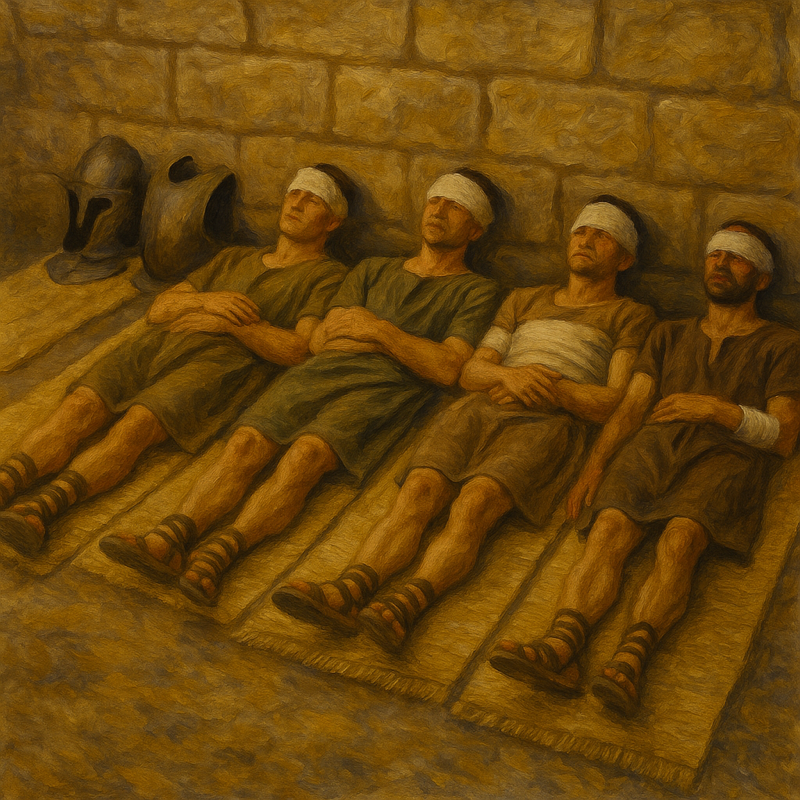
Nearing the city gates, they passed the infirmary—or what had spilled out of it. The doors stood open, and the walkway beyond was lined with grass mats where the wounded lay in neat rows. The smell of herbs and smoke lay heavy. Men dozed under the shade of makeshift awnings, bandaged and pale, their chests rising and falling evenly. Their armor marked each mat, dented and bloodstained.
The scene was orderly at first—the calm that follows hard work well done—until one man caught her eye, lying amidst the others, but different. His bandages were clean. Sweat slicked his neck despite the morning breeze. Where the others rested easy, his body trembled in small, uneven shivers. She slowed, fixed on him. Something was wrong. Not the pain of healing—but the sickness of the body turning against itself.
She went to him and knelt beside him. His lips had gone gray, and when he opened his mouth, his tongue was dry and cracked. A faint heat rose from him despite the cool morning. The cloth at his collar was damp, and the air carried a sharp metallic tang—not blood, not rot, but something harsher, like her father's forge when the metal burned too long.
Samuel stepped up behind her. "Linora, come on. He's tended already."
She shook her head slowly. "No," she murmured. "Something's wrong."
Her hand brushed his wrist—the pulse fluttered weakly, then vanished. She looked over her shoulder, raising her voice. "Someone's dying here!"
A clean-shaven man in bloodstained robes turned, eyes rimmed red, his voice was thin with fatigue. "If he's quiet, he's not the worst of them. Keep him still—I'll come when I can."
Linora turned back to the soldier. "You need to speak up," she whispered urgently. "They save the ones who cry out loudest." When he didn't stir, she added, "Death takes those who wait quietly."
Samuel touched her shoulder. "Linora, we have to go. You've done what you can."
But she didn't move. She studied him again—the clean bandages, the stillness beneath them. No swelling, no bleeding, yet each shallow gasp barely stirred his chest. Too much sweat.
Then she saw it: a faint green stain along his fingernails, the same color smudged on his sleeves. Beside him lay a cup of water, spilled and shimmering with an oily sheen. The sharp smell coiled in her nostrils, pressing against her memory until it struck.
Her mother's voice echoed in her mind: "It isn't the flame that gets them, it's the fumes."
In a flash, the pieces fell together. "He's poisoned," she said quietly. "Not by drink—by his tools. The metal's in his blood."
Samuel frowned. "How could you possibly know that?"
"Because I've seen my father's apprentices take ill the same way," she said. "Look! They grew pale, they trembled, lost control of their lungs." Her hands were already moving—loosening his collar, fanning his face. "He can't be left like this. I need milk. Or ash—anything to draw the poison out."
Samuel hesitated only a heartbeat, then sprinted toward the nearest stall. Linora eased the man's head onto her shawl, whispering for him to stay with her. Samuel returned, carrying a small clay cup of watered milk, and she stirred in a pinch of soot from a nearby brazier. "It's not clean," she muttered, "but it will have to do."
She poured the mixture between the man's lips. He coughed, sputtered, and for a moment Linora feared she had lost him. Then his body convulsed; a faint gray bile expelled onto the ground beside them. She kept him gently on his side and wiped his mouth, steadying him until the spasms eased.
Samuel watched her, torn by duty. "Linora," he said softly, "your heart is in the right place. But I promised your father. We have to g—."
"Then go!" she said without looking up. "But I am not leaving him. Oh, and give the breastplate back to my father."
Samuel stood a moment longer, tightened the armor, then turned toward the east gate and ran.
The man's trembling eased by the time the sun crept high over the rooftops. His pulse was faint but sure, the fever cooling little by little under Linora's care. Her shawl was stained and her hands blackened with soot and milk, but she didn't leave his side until another healer brought fresh water and a band of linen to rebind his wound.
She rose at last, stiff and light-headed, only then seeing how thin the ranks of healers had become. The beds inside were full, and the walkway was worse—men groaning softly, a few calling for water no one had time to bring. Linora counted only three healers moved among them now, their sleeves dark with sweat and blood, their faces drawn tight from a night without sleep.
A woman stepped out from the infirmary, tall and steady, taking lead shift from the clean-shaven man seen before. Her hair was bound high, her robe stained at the cuffs, her movements precise. Linora recognized her at once—the quad healer she had seen before in the market.
The woman paused when she saw Linora kneeling among the wounded. "You," she said, her voice rough but not unkind. "You've been working?"
Linora nodded. "Since morning."
The healer glanced at the ailing men around her, then back to Linora. "Then you'll keep at it," she said. "We're short of hands."
Linora stayed through the day, replacing cloth, fetching water, cleaning instruments until her arms ached and her back burned. The quad gave no praise and no teaching—only simple tasks. She watched, quietly measuring resolve, treating Linora like another assistant.
The sun hung low, though the day was still warm. An assistant brought out rounds of flatbread with a bit of olive paste, handing them wordlessly to each healer, Linora among them. With bread in hand, she sat on the edge of the bed that now held the man she had saved, gently adjusting his bandages. His hands no longer trembled, the fever already easing.
The healer approached again, her face unreadable. "Tell me," she said, "who taught you to see what others do not?"
Linora hesitated, wiping her hands on her apron. "No one," she lied softly. "I only listened."
In truth, it was her mother who had taught her how to steady a pulse, how to read a fever from a man's eyes, how to bind a wound without flinching. Keziah should have been the one sitting here, earning this woman's regard. She thought of her mother's hands, steady and sure, and a small ache of guilt surfaced; she swallowed it. In the city, it was better to be no one's daughter.
The healer studied her a moment longer, then gave a faint, knowing smile. "Well done," she said, moving on to another patient. This was the first praise Linora had heard all day. It meant more than she wanted to admit.
The light dimmed beyond the gate. The day's heat had finally broken, and the infirmary walls held the dry scent of herbs and smoke.
"You've worked hard," the healer said, her voice quieter now. "Harder than most who start here." She held out a small pouch containing grain-sized silver. "Twenty barley for you—ten more than typical days. You've earned it."
Linora stared at the pouch, then at the healer.
"Or," the woman said, lowering her hand, "you can take nothing, and stay. A fair trade—your work for my teaching."
Linora hesitated. The choice weighed heavy. She imagined her father at the forge, waiting for her return. She imagined her mother, this very moment, setting the table for four. Then she looked around the infirmary—the rows of mats, the weary bodies slowly mending, the quiet murmur of those tending them.
The healer watched her patiently. "I am Serah," she said at last. "If you stay, you'll answer to me. You'll sleep here, rise at dawn, eat when we can. There's space enough for you in the back room—a mat and a roof, nothing more. And," her voice changed with an eye wink, "I'll teach you to listen deeper."
Linora declined the pouch. "I'll stay."
Serah nodded, and for the first time that day, allowed herself a small smile. "Good," she said. "The world always needs one more who can listen."
And so Linora stayed—not for glory, nor defiance, but because a voice within her had finally spoken up.