Chapter 3 - Festival
The road home wound through low hills where the grass had gone pale under the sun. The donkeys took turns pulling the cart, which rattled with each stone under the shifting weight of charcoal and ore. Oren walked alongside, explaining as he traveled—how the red streaks meant good iron, how the darker veins held the promise of strength if tempered right. Samuel listened with full attention, turning the rocks over in his hands one by one. Every ridge, every line of color was a secret waiting to be read. By the time they reached the forge path, his palms were gray with dust and his mind was bursting with questions.
When the house came into view, Samuel's youthful steps quickened. He could already smell the faint metallic tang drifting from the forge and hear the creak of the bellows where Oren had left them. The boy's eyes darted everywhere—the trough, the tools, the heap of slag glinting like dull glass in the yard. These were the things he had imagined while Oren spoke of metal's moods and temperaments, of how fire and patience together could make stone sing. Now, standing before it all, Samuel could hardly decide what to study first.
Keziah wasted no time, advancing to the hearth when they arrived. She had laid out flatbread dough before they'd left that morning and now returned to it, patting it down with deft, rhythmic slaps. "You'll want food before you speak of anything else," she said, setting a clay pot over the coals. She diced onions and crushed garlic in quick, sharp motions, tossing them into a simmering broth with a pinch of salt and the last of their lentils. The scent filled the house in moments—earthy, steadying, good. Linora fetched a jug of water while her mother ladled soup into wooden bowls, adding shreds of dried fish that softened as the steam rose. They ate cross-legged, grateful for the simple meal, each bite washing away the noise of the city and the roar that had shaken it.
Samuel barely ate his meal, his attention fixed on the forge beside the house. He gazed toward the glow like a moth. "You made all this yourself?" he asked, eyes darting between the bellows, the anvil, the water trough, and the racks of tools. His voice carried a barely restrained excitement, questions piling up before he could finish any of them. "Do you smelt the ore too? What mixture do you use for the bronze? How do you keep the edge true after tempering? And that there—" he pointed toward a massive pair of tongs, "—did you shape those too?"
"You'll have the whole place memorized by morning," Linora said, laughing.
Oren chuckled, half amused, half weary. "One question at a time, lad," he said, wiping his mouth on his dining cloth. But Samuel couldn't stop; his curiosity tumbled over itself. Linora caught herself smiling too, not at the words, but at the brightness in Samuel's eyes—like a spark caught from the forge. He crouched to see how the air channels fed into the coals, tapped the edge of a hammer to feel its balance, and marveled at the fine seam where metal met wood. He asked about heat, about sparks, about the way the color of the steel told its own story.
When the last of the bread was gone, Linora slipped into the kitchen quietly and Keziah began clearing the bowls. "If you give him another hour," she said softly, "he'll forget supper and eat coal for dessert."
Oren shook his head with a grin, yet there was warmth in it. "Let him ask," he said. "Better a youth full of questions than a man empty of them."
Linora returned to the table with a modest treat—figs pressed with honey and dusted in ground barley. It was a small luxury she saved for days when everyone had come home safe. Samuel grinned, took one between his fingers, and said he didn't deserve all this. Oren smiled faintly but his eyes stayed thoughtful, his hand still resting on the edge of the table. Samuel had been asking questions all through the meal—and with a mouthful of sweets, finally fell quiet long enough for Linora to ask her own.
"Father," she said, her voice light but curious, "was that really a dragon they killed? The men in the square said it was taller than a cabin and had teeth the length of a hand."
Oren leaned back, wiping his fingers on a cloth. "It was a beast, that's certain. It's been a hundred years since the last one got this close. I remember because it was after I married your mother and before you were born."
Keziah nodded slowly. "It was a dark season. Men made heroes of themselves with blood. Celebrated wildly."
Samuel did a double-take, glanced between them. "There was a festival?"
Oren's expression tightened. He looked toward the window where the dusk carried old memories. "Ugh. There was dancing, feasting, more drink than sense. Offerings laid at stone altars—though not to the Lord. They called it giving thanks, but it was vanity. A beast's death turned into a celebration of their own strength."
Linora frowned, her curiosity not yet dimmed. "Will they hold another now?"
He hesitated, and that alone was answer enough. "It would not surprise me," he said at last. "But you'll both keep far from it. Such gatherings grow wild after dark. And when men fill themselves with pride and mead, they forget what's holy."
Keziah could finally gather Samuel's empty bowl and added softly, "We're blessed to be here, far from that noise. Let them have their games and their idols. We'll thank the Lord in peace."
Oren nodded, but his daughter's gaze had already drifted toward the door, where the night wind brushed the curtain.
The conversation stalled now that the table was cleared, the warmth of the hearth soft against the growing dusk. Keziah dried her hands on her apron, glancing uneasily toward the window where the last of the light was thinning. "It's a foolish thing," she said. "Men slaying beasts and calling it righteousness, then turning their thanks into drunken laughter. Nothing good comes from it. There's always trouble when men forget Who rules over life and death."
Oren nodded faintly, his gaze steady but far away. Whatever he remembered, he kept behind his eyes. Linora only saw the way his jaw tightened, the way his hand paused over the bowl before putting it away. He said nothing more. Instead, he poured a little water over the embers in the hearth—a quiet act that closed the evening.
Linora was still thinking of the lights and the music, the laughter she imagined just beyond her reach. "Do they truly build fires as tall as the gate towers?" she asked, trying to sound idle, though her voice trembled with wonder.
Keziah gave her a look, one that could still her daughter faster than any shout. "You'll keep your mind on better things," she said. "There's work to be done here. Let the city burn its oil without us."
Samuel caught Linora's eye across the table, and for a heartbeat they both smiled—half guilty, half conspiratorial. He hid it by gathering his cloak from the peg near the door. "I should be heading back before dark," he said. "But I'll return after breakfast, Master Oren, if you'll have me. I want to try that hammer you spoke of—the one that sings true."
Oren nodded, still watching the last hiss of steam where the doused coals smoked. "Come then," he said. "You'll earn your blisters before you earn your craft."
Linora stood and walked him to the door, her shawl drawn close around her shoulders. "Goodnight, Samuel," she said, her tone bright and innocent. But her eyes lingered longer than they should, following him down the path until the twilight swallowed his figure.
Behind her, Keziah sighed softly and finished cleaning up. "Curiosity," she murmured, almost to herself. "It's a fire that never stays small."
The house grew still after supper. Oren's tools were set aside, and the forge, for once, was silent. Keziah hummed softly as she folded a bit of mending by the light of the small hearth flame, and Linora sat nearby, feigning drowsiness. She rubbed her eyes, stifled a yawn, and rose to her feet. "I think I'll sleep early tonight," she said, her tone perfectly mild. "It's been a long day."
Her mother smiled. "A wise choice. Tomorrow will come quickly."
Oren only grunted his agreement, already half-lost in his thoughts. Linora kissed her mother's cheek, said goodnight, and slipped behind the curtain to her room. The moment the murmur of her parents' voices faded, she opened her eyes wide. Her heart drummed fast—not from fear, but from the thrill of it.
She pulled on her cloak, grabbed a stashed purse, took her shawl from the peg, and waited until she heard the soft creak of her father's chair, then the hush of the hearth being banked. When the house was still, she lifted the latch with careful fingers and slipped outside. The air met her cool and sharp, heavy with the scent of smoke and dew. The path was dim, torches burning low along the road that curved toward the city. She started at a brisk walk, then quickened to a run, her sandals scuffing softly against the packed earth.
About twenty minutes at full pace, she spotted the figure ahead of her, walking steadily with his cloak drawn close. "Samuel!" she called in a voice that carried farther than she meant. He turned, startled, and she caught up to him, laughing amidst her racing heart.
"Linora?" His eyes widened. "What are you doing out here?"
"Father says we may attend the festival together," she said quickly, her face glowing with the cold and her own boldness. "But you must watch over me the whole time, and we'll stay in separate rooms. See? He even gave me silver for breakfast tomorrow." She pulled a small pouch from her cloak and shook it with a grin.
Samuel blinked, trying to make sense of it all. "He said this?"
"Of course he did," she said, feigning offense at the doubt. "He trusts you, Samuel. And so do I."
He hesitated only a moment before nodding, his sense of duty outweighing suspicion. "Very well. We'll go together, and I'll see that no harm comes to you."
"Good," Linora said brightly. "Then hurry—before we miss another minute!"
And with that, she ran toward the flickering glow on the horizon, where the sound of distant laughter and music drifted on the night sky. Samuel matched pace with her, unaware that he had stepped into her scheme.
The road curved under the pale stars. Their shoulders brushed once, then again, until it stopped feeling like accident. "You run faster than I expected," Samuel said, catching her grin. "You just don't know how to keep up," she shot back.
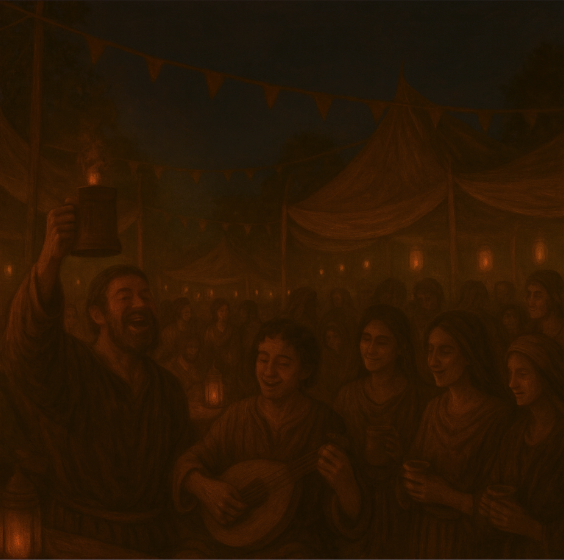
The road widened as they neared the city, and the first sounds of music reached them—a low hum of string and drum, drifting through the night like smoke. Torches lined the path ahead, their flames tossing light across the road. People passed them in twos and threes, carrying baskets of bread, small jugs of mead, and masks painted with broad, smiling faces. By the time Linora and Samuel reached the outer gate, the festival was alive with mirth.
Laughter spilled into the streets. Children darted through the crowd with ribbons tied to their wrists. Dancers moved in circles around small fires, their shadows leaping up the walls. Merchants shouted over one another, hawking roasted nuts and sugared figs. The smell of spice and smoke and sweet wine hung heavy in the air. To Linora, it felt alive and harmless—a city shaking off its fear, turning death into celebration.
"Come on!" she said, tugging Samuel's sleeve. "It's wonderful."
He smiled faintly but held back from the crowd. His eyes were steady, his shoulders squared against the press of bodies—many scarcely clothed, casting him glances sweet as honey and twice as dangerous. "Wonderful, maybe," he said, "but not holy. Stay close."
"You mean close enough to protect, or close enough to talk?" she teased, stepping ahead of him anyway. He answered with a grin, "Both!"
Her eyes darted everywhere—the jugglers tossing torches, the musicians plucking at lyres and mandolins, the painted masks that looked both foolish and strangely alive in the firelight. A reveler pressed a small cup of sweet mead into her hand. She drank deeply, laughing at the taste, and offered the rest to her chaperone. Samuel passed the cup to someone else without a taste.
When a drunken patron lost his footing, he nearly fell into Linora. Samuel's arms came up instinctively to steady her. For a heartbeat, they just looked at each other. "Thank you," she said softly, her pulse jumping at his touch.
"Now, where do I get to taste dragon meat?" Linora's excitement was contagious. Samuel pointed her to one of the many open meat piles. They each took a piece. "This is amazing!" she said, eyes wide. Samuel noticed the official nearby and paid the festival tribute for the two of them.
As the night deepened, the crowd grew louder. The songs grew bolder, the dancing wilder. Torches were raised high, and paper effigies shaped like the slain beast were carried through the streets, their painted eyes catching the light. Linora clapped with the others, her laughter carried off by the music. Samuel stood beside her, close enough to guard her from jostling strangers. He caught her smile—bright, careless, full of wonder—and something inside him shifted, an ache he didn't yet understand.
When the fires started to fade and the laughter softened to murmurs, Samuel began guiding her toward a quiet inn near the outer wall.
"I didn't think it would be like this," Linora said, her voice getting tired.
"What did you think it would be?" Samuel asked. Linora thought about the things her parents had said.
"Louder. Wilder. Less..." she hesitated. "Nice."
"Nice?" he echoed, grinning. "You call fire-roasted eel and drunken dancers nice?"
She laughed. "Well, except for the honeyed locust skewers. I still don't believe that was food."
"Maybe next time, we'll be brave enough to try the wild things."
Upon reaching the inn, the keeper gave them two small rooms under the eaves, each with a straw bed and a single lamp. Linora thanked Samuel sweetly and pressed the coin pouch into his hand. She kissed him on the cheek before she thought much of it. Before he could react, she closed the door.
Backing herself against the door, something short of panic but more than instinct, she wondered what possessed her to steal a kiss from a near-stranger. Her thoughts were interrupted by a short knock on the shared wall between their rooms. "Sleep well," Samuel's voice spoke, low.
"You too," she returned, smiling, unsure whether or not he could hear.
That night, Linora drifted into dreams of lights and laughter, of painted masks that smiled kindly and never bit. She slept peacefully under the watchful guard of her new friend next door, and of the fires that burned too long into the night.