Chapter 2 - Hunt
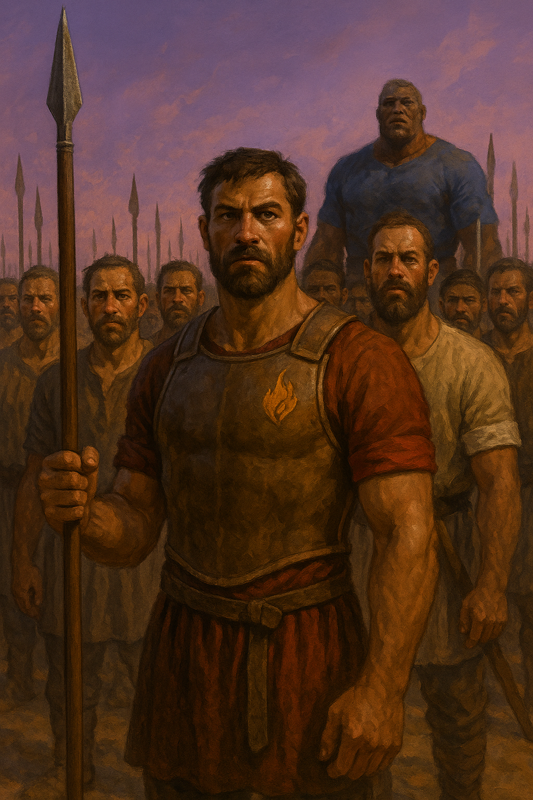
Beasts still roamed the earth, as they had since Eden—vast and terrible. Some grazed peaceably at the river's edge; others kept to the wild places, far from men. But when hunger or chance drove them too near the walls of a city, the people of Mesopotamia took up arms. For though men feared the great lizards, they feared more to lose their flocks, their fields, and their children.
The bell still rang in Kadon's ears as he joined the press of men funneling toward the square. The weight of his new breastplate clung to his chest, conspicuous and heavy. The metal glowed in the sun, warm and golden, the small flame sigil etched above his heart catching the light with a molten shimmer.
The magistrate stood high on a wooden platform, a crate of marked scarves placed at his feet. His voice cracked out like a whip:
"Step forward! Be counted by blood and by courage! No man will hunt without a mark."
One by one, the line inched forward. Men jostled, some muttering boasts to steady their nerves, others pale with fear. Kadon carefully fitted his new spearhead tight against the haft, testing the balance, folding his reassurance into the wood itself.
He remembered his first muster, when his father wouldn't let him come home without a scarf. Families need coin, men need courage, and Shuruppak must be protected. Fear was no excuse—for who else but the afraid would ever choose to stand against a beast?
The magistrate's assistants worked fast, practiced as priests at an altar. Each man was sized up by blood.
- Pures were given white scarves, plain as sackcloth, knotted on the arm. A pure earned a shekel of silver if he lived, nothing if he died.
- Mixes like Kadon received red scarves, dyed with madder root, vivid as a wound. Their pay was one shekel and twenty barley—better than pure, worse than quad.
- Quads were handed blue scarves, deep and bold, the mark of strength. Two shekels, no questions asked.
The line grew tense when a man stepped forward claiming quad blood. The assistant eyed him, skeptical, then ordered him to lift a large amphora filled with water above his head. The man faltered at the strain, arms shaking. "A mix," the assistant spat, and tossed him a red scarf instead. Those nearby laughed cruelly, but the magistrate's hand silenced them.
"Lie about your blood, and you'll be buried with none."
The words rang in Kadon's ears as his turn came. He thrust his arm out. No question was asked. The assistant slapped a red strip into his palm. Kadon tied it tight across his bicep, the knot digging deep, a mark of what he was and nothing more.
The square shifted. A hush spread like fire in dry grass. A shadow fell over the platform.
And then he appeared. Ashurak, the Lion-Blood. Kadon knew the face before the man spoke—every soldier did. He was a story walking in flesh, a half-blood whose name had filled campfires and marketplaces since Kadon was a boy. To see him here, standing among them, was enough to make some men straighten and others falter. He strode to the front, his size alone parting the crowd.
"I lead the hunt," the half-blood said simply. His voice was gravel, unshaken. "Ten shekels."
No man objected. The magistrate, clearly grateful, opened his coffer and counted silver into the giant's hand. Half-bloods were always paid in advance, no scarf necessary.
"And these two," Ashurak added, jerking a thumb toward two young quads who swaggered forward, eyes alight with the thrill of command. "My sons. They'll lead the ranks."
A ripple of unease stirred, but none dared protest. Kadon only tightened the knot of his red scarf. That was the order of things: power to the half-bloods. Ashurak's presence alone could steady a line, save men from panic, maybe even turn the beast's charge.
The magistrate lifted his hands. "Last call! We've got a half-blood now—easy money!"
The effect was instant. Where hesitation had lingered, resolve surged. The muster line swelled, men shoving forward to be counted. Archers and pikemen, swordsmen with battered shields, even medics with bandage satchels—all eager to share the risk now that Ashurak stood among them. What had been a trickle of conscripts became a flood of volunteers, the promise of coin and survival pulling them in.
The gates groaned wide and the militia spilled onto the plain, a shifting mass of white and red scarves, with the occasional blue. Kadon counted as he walked, a soldier's habit he'd never shaken: a dozen archers strung their bows with steady hands, twenty pikes gleamed in the sun, another twenty swordsmen dragged battered shields into place. Five medics trailed at the rear, satchels swinging against their hips. Two quads carrying heavy ropes. Sixty men in all, with one half-blood to command them.
A scout returned at a run, his sandals black with dust. He bent low, voice quick and tight:
"It's about four cubits at the hip; reared up I'd guess around seven cubits. Length with tail roughly thirty paces. Thick-shouldered, feeding on sheep beyond the grazing fields. Not yet moving toward the city—but close enough."
Ashurak stood high above the rest, his bulk alone enough to silence chatter. His voice carried like stone on stone. He pointed high in the city, "Yes. I want you there, looking out. When everyone is in position, you light a candle."
"We drive it toward the carrion pit." He pointed north, where the ground dipped to a hollow choked with smoke and flies—the place where the city threw its unclaimed dead, bones and refuse piled high, left for jackals. The stench hung faint but steady even here.
The giant spread his arms wide, his plan clear, ritual.
"Pikemen, form a wall. Archers, behind and above if you can—shoot for the eyes when I give the signal. Not too high, or you'll hit your own men. Swords, make your line in the east. My eldest commands you. You drive the beast forward, toward the pit. And you—" he pointed to the medics, "hold to the flanks. You move too soon, you'll die. You move too late, your brothers will."
He thrust a fist into the air. "Steady men! When the flame lights, swordsmen will make their thunder—sword to shields. Loud enough to shake the marrow of every bone. The beast will flee from the noise, and when it does, pikes hold steady, archers release. Once blinded, ropes will charge in on each flank. The creature will stumble, and when it does, swords and pikes take its throat!"
A murmur of assent rippled through the line. Kadon tested the haft of his spear, the new head tight and sharp, its weight balanced in his palm. He tugged his red scarf, knot biting into skin. The plan was simple, brutal, and it might even work. But he knew the truth: beasts don't follow plans.
The militia filed out of Shuruppak's gate in grim stoicism. Dust rose around their sandals, muffling the drum of footsteps. Not a man spoke. Even the commander, whose presence was usually a storm, raised his hand only in signal. Kadon swallowed hard as they neared the carrion pit—the stench of rot rising so thick it made his eyes water. Unclaimed bodies, beasts and men alike, had been thrown there for decades. Today, it was bait.
Kadon stood shoulder to shoulder with the other pikemen, he found comfort in the sole blue scarf in front. He set the butt of his spear into the earth and adjusted the new bronze breastplate on his chest. The flame sigil over his heart strengthened his resolve. He gripped the shaft harder than he meant to, jaw tight. He told himself it was only sweat on his palms.
Archers clambered up a ridge to the left, settling their quivers and drawing arrows to the string. Kadon could not hear or see the swordsmen spreading out in the east, but he saw the medics following behind them from the city, water skins and bandages ready. He counted again, seventeen pikemen, ten archers, all in position waiting for the candle.
The clearing held still. Trees swayed in the distance, then stilled again. A low rustle carried across the field. Every eye turned upward. Finally, on the tower above the gate, a thin candleflame winked to life. The signal.
A deafening roar of shields erupted. Swordsmen hammered metal on metal, a crashing wave of noise so violent Kadon's teeth rang. The din drowned out all thought. His heart pounded, eyes fixed forward, ready for the beast to break from cover and charge the pit. Ready to brace with all his weight.
While the pit stayed ready, the roar came from the trees.
The monster burst from the undergrowth, its hide striped with mud and scars, taller than a house when it reared. A goat hung limp from its hooked claws, ribs split, blood spattering its chest as it moved, the ground shaking under its stride. It took four huge steps toward Kadon and the carrion pit. Then, as the swordsmen emerged from the wood, the creature spun around and barreled away from the pikes. Straight toward the clamoring swordmen!
"NOW!" Ashurak's voice split the air, louder than the clash of shields. Arrows flew, dark streaks against the sky. Too many fell uselessly short, thudding into the plain. Others glanced off the beast's hide or stuck with little effect. Not one hit the eyes. Cries went up as swordsmen collapsed, pierced by friendly arrows or crushed by terrible jaws. Blood spattered bronze and earth alike.
"CHARGE!" bellowed the commander's son leading the pikes.
Kadon lurched forward with the line, legs pounding. The ground quaked beneath them. The monster charged, each step breaking the soil like sand. Hot, foul breath poured from its jaws, teeth glinting wet as it snapped through men like twigs. Light rolled over scales dark as bronze, every plate alive with motion. Arrows sparked against its hide; the tail swept the field clear. The roar that followed cracked through Kadon's chest and left his ears ringing. Still he ran, spear low, the smell of iron and ash thick in his throat.
When the line met the beast, the battle narrowed to sound and impact—metal against flesh, sparks against scale. Kadon thrust with all his strength and felt, at last, the spearhead bite through. Beside him, the pikemen punched forward, shafts bracing, pinning.
Then the war-cry came—not from the men, but from Ashurak. A sound more beast than human. He leapt, broad swords flashing in both fists—daggers in his massive hands. He drove them into the creature's back, to the hilt, and clung to them like reins. Each time the beast bucked, he stabbed again, tearing ragged wounds down its spine.
"ROPES!" he thundered. Two blue-scarf soldiers darted in, racing opposite ways, cords whipping as they wound about the monster's legs. They crossed again, pulled hard, and the ground answered with a quake as the beast crashed to the earth.
A howl of victory tore from every throat. Swordsmen and pikemen surged, stabbing again and again, until the earth ran dark and the roar died forever.
The cheer of victory rolled from the militia to the city walls like fire leaping to dry grass. And then the walls broke open. Shuruppak poured itself into the field. Men, women, children—even the crippled—rushing forward in wild jubilation.
The medics were quickly losing opportunity to shout orders. They threw themselves at the wounded, sleeves rolled, blades and cloth flashing red as they pulled men free of the heap. Health carts rattled in, planks smeared with pitch to keep the blood from soaking in. The living were hauled off for treatment, the silent ignored for the death cart. Kadon saw one boy still twitching; the medic barked and he was swiftly carried to a health cart.
But around the carcass, order gave way to frenzy. Butchers swarmed with cleavers and knives, hacking slabs of steaming flesh before the beast had even cooled. Fires sprang up, wood stolen from carts, from fences, from whatever would burn. The smell of smoke and meat hit like a storm. Many didn't wait for flame at all—they tore into strips raw, teeth red, eyes wild.
Others pried at the bones, clipping the massive talons, wrenching teeth out with pliers, sawing off scales as trinkets. Merchants filled jars under the dripping gore, carrying off wicked wine, sloshing dark trails behind them. One man laughed as he filled a basket with entrails, boasting he'd sell it as potion by morning.
Children danced around the tail, drumming on it with sticks. Women plucked tufts of hide for amulets. A man raised a severed claw high, already drunk on the glory, and the crowd cheered as he presented it to Ashurak like tribute to a king.
Kadon wiped his face with a shaking hand, his scarf soaked and sticky. He watched the jubilation rise, the raw joy of survival, of meat and victory. But beneath it, something soured in his gut. The way they clamored, desperate to taste, to own, to wear some piece of the fallen beast—the monster transformed from enemy into prize.
By nightfall, the fires burned high, music clattered from drums and pipes, and the city feasted on blood and flesh.
The magistrate's men moved through the crowd, scales and tallies in hand. "Festival tribute! Four barley!" they barked, shaking purses until silver clinked. For some, payment was taken; for others, reward given—one shekel for pures, more for mixes and quads. They paid cooks who dutifully served meat to anyone and everyone.
The festival carried on and on; morning was a distant thought. Fires roared, spilling sparks into the night sky. Music rose in uneven bursts—flutes shrilling, lyres strummed, men shouting songs older than the city itself.
Kadon's reward was meager, yet it weighed enough to buy him relief. He didn't join for reward or glory, but duty. He turned from the roaring fires, the gnawed bones, the dripping talons held like trophies, and sought a tavern within the walls. Inside, the air was thick with sweat and smoke.
"Let me buy you a drink, soldier!" a broad-faced man called, flagon already raised. "You're a hero tonight!"
Kadon was pulled into a bench before he could answer. Mead foamed in cups, sweet and heavy, passed from hand to hand. Two men leaned close, eager, their words tumbling over one another.
"Tell us—did you see it bite a man in two?"
"How many times did you strike it before the end?"
"Was it true, Ashurak rode its back?"
Kadon told them. At first carefully, then freely, the mead loosening his tongue. Every detail they pressed from him was answered with another cup. His voice blurred, the world tilting warmly around him.
His head grew heavy. He pushed the cup aside. "Enough. I need— need to get home."
"Of course," said one of the men smoothly, gripping his arm. "We'll see you there. You've earned rest." The other rose, smiling wide. "A breastplate like that deserves to be carried safe."
Kadon staggered with them into the night, the street spinning. They guided him through torchlit lanes, voices low and easy, until the noise of the festival dulled behind them. The air grew still, rank with alley stench.
He blinked, frowning. "This... this isn't the way. An alley." He looked down, swaying, then noticed: his hands were empty. No spear. He had left it.
"Ah," said the broad-faced man, and his tone turned sharp. "So you noticed."
The blows came quick—a fist, then another. Kadon hit the dirt. The impact drove through his ribs as knees pinned him down. Hands tore away his breastplate, tugged loose his sash, even stripped the red scarf from his arm. He tried to cry out, but a sandal pressed his face into the dust.
Then came a pain he knew too well—his own spear driven beneath his ribs, then wrenched free. He clutched his side, blood seeping through his fingers, the world narrowing to sound and dust. Laughter. Footsteps. Then darkness swelled, heavy and absolute, swallowing everything.