Chapter 1 - Market
Fifty-five years had passed since that fateful day in 2394 BCE.
It was now high lush season, the year 2359 BCE.
In the ancient cities of Mesopotamia, records were kept in cuneiform, and trade was spoken in weights long before minted coins. A shekel of silver—about the weight of a modern AAA battery—was the measure of a simple man's month: the sweat of his brow, the strain of his back. For others, such sums were heavy. Most lived by the smaller reckonings, the barley weight—one-sixtieth of a shekel: a few hours of labor, enough to buy a bandage, a day's loaf of bread, or refill a jug of vinegar.
It was in barley and shekels that markets thrived and quarrels rose, for worth was reckoned not only in iron or beasts, but in the patience to haggle and the sharpness of a woman's tongue.
The morning broke heavy and humid. Oren hitched the cart, its wheels creaking under the load of freshly finished work—plowshares stacked three large, spearheads bundled in twine, a bronze breastplate, and a neat row of chisels laid flat across a linen cloth.
"Ready out!" Oren grunted, tightening the yoke strap. "The cart will go faster if I haul it myself. We need a new donkey anyway. Two hours to the market, unless this is when my back finally goes soft."
Keziah shook her head, lips curved in the smile of a woman who had heard this too many times. "Your back is harder than oak, husband. But the oak still splits when the years bite it."
Linora walked beside them, watching her father lean into the harness, muscles rolling under his tunic. She admired him, stubborn and strong—but she also saw what he tried to hide. His hands trembled faintly at the joints when he adjusted the straps. Age was creeping in, and it unsettled her.
"Are you going to find a new apprentice?" Linora asked, a hint of tease in her voice.
"God willing," Oren said with a small grin. "I've arranged to meet one of my regular customers at the market—a man's been buying my axes and saws for decades. Says his son's ready to learn the trade. If the boy's built anything like his father's word, he'll do fine."
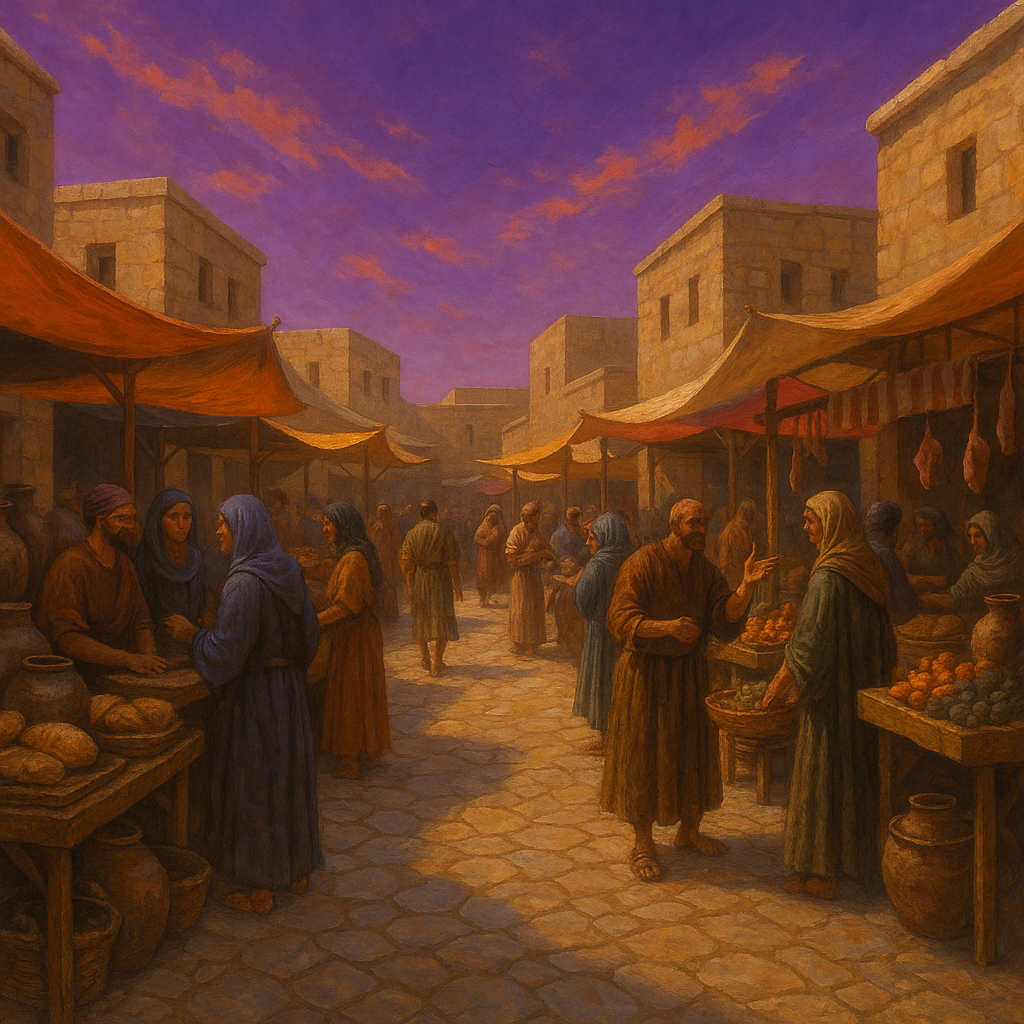
The market of Shuruppak was already roaring when they arrived. Noisy, hot, alive—fish sizzling on braziers, copper pans clanging, goats bleating as men pulled them to the trade lines. The air carried a confusion of smells: spice and sweat, sweet figs crushed underfoot, manure, and smoke. Hawkers shouted over each other, dice rattled against wood, brightly painted women whistled, and barefoot boys darted between stalls carrying jugs of water.
Oren staked their place in the open-sellers' section, wedging the cart into the best shade he could find near two brick pillars, then set off on his own mission. There was no official stall but the cart worked well. Here, every hand's reach and loud voice determined space.
Keziah took command like a general. She spread Oren's wares in neat rows. She had rehearsed the pitch for each along the journey—"Feel the balance of this spear, light enough for a youth, sharp enough for a half-blood. The breastplate rings like a cymbal but will turn aside even the mightiest axe!"
A small, thick man moved at once to examine the largest plowshare with suspicious care.
"How much for this one?"
Keziah stepped forward, wiping her palms on her apron. Her voice was steady, polite, but firm.
"Six shekels—or a donkey. We'll need one for the trip home."
The man barked a laugh, nudging his companion who trailed close behind.
"Six? That's more than I paid for my first bride!"
His friend grinned wide. "Yeah, but still more than YOU were worth!"
Both men walked off shaking their heads, still chuckling at their own wit.
Unease stirred in Linora's chest at the splintering words. More than a bride. She trailed her hand along a stack of linen bandages on the cart next to theirs, tracing the weave with her fingertips. She glanced at her mother, searching her face for a reaction. But Keziah had already turned to greet another buyer, her expression smooth, her voice rising strong and sure above the noise of the market.
Eyes down, the laughter still rang in her ears. How does a father put a price on his daughter?
Over a century of hawking iron honed Keziah into a merchant of rare skill. She sized up customers from their gaze alone.
A mason stopped, his eyes narrowing on the chisels laid in neat rows. Before he spoke, Keziah had already taken four in her hands—narrow, broad, and two in-between.
"The whole set. Balanced steel, truer than stone itself. One shekel for the lot."
The man blinked, caught off guard by her certainty. "Fifty barley," he countered flatly, testing her resolve.
Keziah didn't pause. "One shekel will do nicely. Thank you." She held the chisels steady, unblinking.
The mason's jaw worked, a protest half-formed, but her tone left no ground to stand on. With a grunt, he dropped the silver into her palm. Muttering under his breath, he shouldered the chisels into his satchel and stalked off, his silence conceding what his pride could not.
Moments later, a soldier in full kit, his arms crisscrossed with scars, paused at the breastplate gleaming on the cart. Keziah tilted her chin, meeting his stare before he spoke.
"That one's worth eight shekels—or two goats. You'll not find its equal this side of Tigris."
The soldier contemplated, running his hand along the edge, testing its weight, gave it a flick to hear the ring. The way his shoulders squared told Linora he wanted it. After a long pause, he unbuckled his own dented plate and let it fall heavy onto the cart. "You could mend this one. Take it, and two shekels besides."
Keziah's smile was quick and sharp. "Make it three, and I'll throw in your choice of spearhead," she said, gesturing towards the one he held tight in hand, "Yours looks...shall we say, well-loved."
The soldier's mouth twitched at the corner, half a smirk, ready to tell her precisely what sights that spear had seen. But not here. Not now. No time for stories in a market. He dutifully counted out the money, clinking hard against the wood. Keziah slid them into her sash with practiced ease, already turning to the next customer, her voice smooth, unbroken.
Linora watched with awe and envy. Every sale, every glance, the flattery—her mother could weigh the truth in their eyes like silver on a scale.
She then tried her own hand at barking out a sale, mimicking the confidence she'd heard from her mother all morning. A farmer pressed hard, haggling for a plowshare, and Linora's resolve faltered. She nearly agreed to three shekels when Keziah cut in, her voice quick and polished.
"Five, and not a barley less," Keziah said, smiling with sharpness and poise. The farmer scowled in frustration at not getting the deal he expected.
When the man left, Keziah's peaceful grin turned serious at Linora. "The materials alone cost your father three shekels. You honor his craft by holding its worth, Linora. Remember that."
Linora looked down, cheeks hot, wishing her mother's words weren't an embarrassing correction.
Remember that. Always a lesson, always before others. What if that farmer needed those shekels? Did you think of that?
Keziah handed her a small purse. "Go on—fetch supplies. Fresh bandages, willow bark, comfrey, honey, vinegar, herbs. You know what we need."
Linora welcomed the task. She drifted into the throng, eyes wide, drinking in the city's wild tapestry.
Quad men carried amphorae strapped to their backs, their shoulders straining like oxen. A dice game ended with a man shouting curses as he lost even his sandals. Perfume smoke curled from one alley, and from another, colorful prostitutes leaned down from awnings, calling out sweet names with bitter eyes.
Near a stall of copper scales, a merchant crouched over a slab of damp clay. He held a thin reed cut to a sharp edge that flicked with quick precision, pressing marks into the soft surface. Each stroke was tally more than language, a pattern of wedges and lines that caught the light. When a runner brought him a sealed lump from another booth, he studied it, nodded once, and pressed his own sign beside it before setting it in the sun to dry.
Linora slowed, watching in quiet fascination. She had seen marks like these before—her father traded with men who trusted them above spoken oaths. She marveled at how they turned numbers into permanence, remembering what men owed or inventory for a storehouse. The idea unsettled her, that clay could hold truth better than memory.
At one stall, bundles of herbs drew her close. The seller was a tall woman, shoulders broad, eyes sharp, her hair braided with beads of bone. Linora guessed she was a quad—child of a half-blood. It was a puzzle she couldn’t solve. Half-bloods were real enough, their size impossible to miss, yet surrounded by unbelievable myths. How could a woman bear a child sired by something unnatural? Did such children begin as infants at their mother’s breast and grow to giants?
The woman's gaze lingered. "You've got a healer's hands, girl," she said with a smirk. "But soft. Ever worked on a half-blood?"
Linora shook her head quickly.
The woman chuckled, low in her chest. "Then you've stitched nothing yet. Their skin is thicker, veins stronger, blood more stubborn. My father is a half-blood. I learned the hard way—his wounds never closed easy. You need strength in your hands and a mind that doesn't flinch."
Linora swallowed. "I... I've never seen one up close."
"You will," the woman said. She leaned forward, lowering her voice to a conspiratorial whisper. "If you want to rise beyond village nursing, I can teach you. But it will cost more than coin."
The words branded deep into her chest, tempting and terrifying. She wanted to spill every question crowding her mind—about quad births, their fathers, whether any of the myths were true—but heat crept up her neck. Better to keep her ignorance hidden.
She forced her eyes to the bundles of herbs. "How much for these?"
The quad straightened, amused by the sudden deflection. "Quality, no doubt. Seven barley for the handful."
Linora fumbled the small weights, counted them out, and turned away with her bundle. But the woman's words clung to her, like smoke she couldn't wash off.
When she returned, the cart sagged under new weight. Two sacks of grain rested on top of the dented breastplate. The remaining space humped like a camel's back: one mound of charcoal and the other a heap of dull red stones streaked with black—hematite, her father's prize. Each one, heavy as a hammer-head, promised iron if fire and patience did their work.
Two donkeys stood tied beside the load, stamping and flicking their ears. Beside them stood a young man, mid-eighties perhaps, broad-shouldered, dark hair plastered to his forehead with sweat. He shifted awkwardly as Oren clapped a hand to his back.
"Linora," Oren boomed. "Meet Samuel. His father offered me two donkeys for the apprenticeship! One for the cart, one for your mother. Strong, loyal, God-fearing, fast learner. If he lives up to all that, he'll do well."
Samuel gave a sheepish grin, uncertain whether to bow or joke.
Keziah looked pleased. Linora only nodded, cautious. This one stood straighter than her father's usual apprentices—no bent back, no half-toothed grin. Young, sun-worn, and—though she wouldn't admit it aloud—pleasant to look at. His clumsy stance and overeager smile were both charming and unpredictable.
The market buzz halted by a sound no one could ignore. A deep, resonant roar rolled across the valley, so vast it rattled the stones beneath their feet. The clamor died. Merchants froze mid-word, children clutched their mothers' skirts. Heads turned northeast, toward the hills and forest.
"That's no lion," a shepherd muttered. "That's a reptile to be sure."
The silence stretched, brittle and sharp. Then, without acknowledgement, the bargaining resumed. Dice rattled again, goats bleated.
But Linora's heart still pounded.