The year was 2394 BCE, about sixteen centuries since Eden.
The world had already birthed more than five hundred million souls, though only a small fraction still lived—roughly sixty million endured the violence of their age.
Women rarely bore children after their second century, most were fertile between seventy and one hundred eighty years; men, however, could sire offspring more than twice as long. Few died in peace; most perished by sword, beast, or fever long before gray hairs could claim them. Though the strong might see six or seven centuries, the weak seldom reached half that.
The Tigris river swelled high and restless, fed by fountains deep beneath the earth. Mist curled across the lowlands each morning, laying a blanket of dew thick enough to wet the sandals of early risers. In those months, fields greened without labor, and orchards bent heavy with fruit. Livestock fattened quickly, and children splashed in canals until their skin wrinkled.
Shuruppak, a thriving city in Mesopotamia—modern-day Al Budayr, Iraq—stood fifteen miles southwest of the river's bend. Late in the lush season it was a feast of sound and scent: freshly roasted grain on open hearths, the trill of flutes in the marketplaces, and laughter rising through the streets.
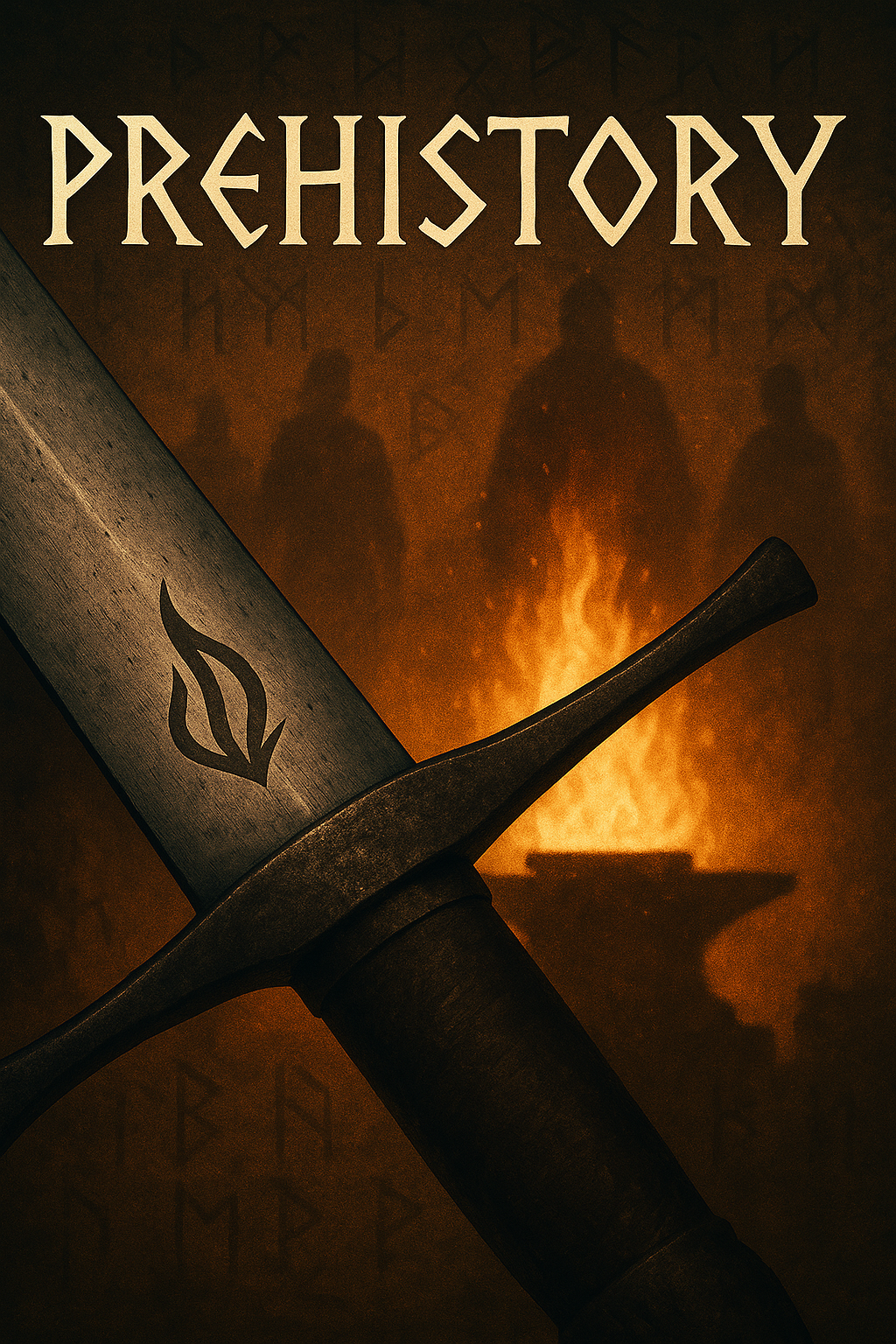
On a grassy hilltop two hours by foot beyond the eastern walls, a forge burned bright—a place whose fire and stories would soon shape the fate of nations.
Linora, a young woman of forty-five, lingered outside the doorway, her eyes lifted to the sky stretched wide over the fields. The heavens burned a deep violet, with streaks of copper light pouring across the horizon. Every color blazed alive, painted by a hand greater than her father's hammer or her mother's needle. She thought it must be God's way of reminding His children of beauty, even in a world gone hard and cruel.
The forge clattered behind her, the sound of iron striking iron. She sighed, lowered her gaze from the heavens, and turned back toward the fire that ruled their days. Sparks hissed, ringing off shields propped against the wall, blades laid out in neat rows, and a plowshare cooling in the sand. Smoke clung to every beam, staining the rafters black. Linora loved it. That smell of iron, oil, and fire—the smell of her father's craft—made her proud.
The hammering slowed, then ceased. A grunt, and then Oren's voice filled the forge, deep as a drum.
"Linora, fetch me the quenching oil."
She stepped carefully between racks of half-finished work: spearheads stacked like feathers in a wing, chisels gleaming in neat bundles, and a cuirass waiting to be fitted with straps. Every piece bore her father's mark—a small sigil pressed into the iron, one he had used since the day he first claimed his own shop.
That was more than two centuries ago, back when Oren had broken from his father's shadow and sworn he would match even the legends of Tubal-cain. He had been training since boyhood, striking steel until his arms swelled and his lungs burned, and after four hard decades, his father had nodded once and said: "Now the craft is yours."
Linora lifted the jug from its shelf, heavy with dark oil, and carried it to him. Her father's chest glistened with sweat, his beard streaked with ash. He looked up only long enough to see the jug in her hands, then bent back over the glowing blade with steady, patient care. He was an ox of a man, but it was his patience, not his strength, that made his work last longer than the men who carried it.
Precaution ruled the shop. Water was always ready for stray embers. Sand waited for spills. Leather wraps shielded hands from the hottest grips. And Linora stood dutifully near a basket of her mother's finest healing supplies.
Her hands still carried the scent of thyme and vinegar, the scent of Mother's craft. She could recall the lesson as clearly as the moment itself—Keziah leaning over a clay bowl, explaining how burns healed not from haste, but from balance.
"Too much honey and the wound won't breathe," her mother said, stirring the mixture with the blunt end of a wooden spoon. "Too little, and the pain will never ease."
She crushed dried yarrow between her palms, mixed it with olive oil and ash, and added a few drops of water until it turned the color of river clay. "This will draw out the heat," she said, pressing Linora's young hand to the cool surface. "And this one—" pointing to a jar of clean water, green with steeped herbs—"keeps rot away. Never wrap it too tight. The body must feel its own blood if it's to remember how to live."
Those words came to Linora often in the forge. She could hear her mother's voice beneath the hiss of the bellows, the rhythm of it blending with the clink of Father's tools and soft instruction.
Oren never went long without an apprentice. "The forge needs hands, not heroes," he liked to say. Linora sometimes joked that her father collected rejects and strays more than smiths—boys who swung too wide or daydreamed too long. There had been one, Kura, who stayed nine years and never managed a blade fit for market. When Oren finally sent him away, the whole house sighed as if releasing a bad spirit.
"Your father sees ore in every stone," Keziah said that evening, "but some things turn to dust, leaving no gem behind."
Linora laughed, teasing that she and her mother spent more time tending Kura than Oren did training him. And now, watching this latest trainee—dreams too big for his own good—she wondered if he would last longer than the others, or merely leave behind more scars for her to dress.
Turik was too young. His arms too thin for the weight of the tongs. But pride had brought him here, and pride wouldn't let him back away. He staggered, the iron rod glowing white in his grip, while the master began tempering the blade.
"Steady," Oren warned. "Keep it flat."
The young apprentice strained, sweat running down his temple as he sat and tried to hold the glowing bar steady on the anvil. He shifted, too fast, and the iron slipped. In a blink, the sharp edge met his thigh like a hot knife through butter. A scream split the air as he collapsed, clutching his nearly severed leg. Blood pulsed bright and fast across the packed earth, each beat of his heart spraying crimson. The smell of burned flesh and iron filled the shop.
Chaos erupted. The boy's falling weight knocked a basket into the firepit; dried straw caught instantly, flames leaping up the wall. Oren lunged for a wool blanket, overturning a rack of pitchforks with a clatter. Sparks shot like arrows into the air, some landing in Turik's spreading blood where they hissed into black smoke.
"Linora!" Oren roared. "Help him! Now!"
Her body moved before her mind did. She grabbed fistfuls of rags, pressed hard against the two parts of his leg that lay open like an overripe fig split in the middle. Blood seeped between her fingers, warm and slick, but the flow was slowing. Though frantic, this is what she trained for. No time had passed when she remembered the next step. Stitches!
Turik writhed, screaming, eyes wide with terror. Linora's hands trembled but she threaded the needle, leaning close. "You'll live," she whispered, forcing the words steady, like her mother had taught her. "Hold on. Just a little longer." The mind can play tricks on a patient, so her words were medicine when nothing else could be.
Oren roared the name "Keziah," his voice muffled by smoke as he stamped at the flames. Sparks rained, the forge howled with heat.
The boy's cries weakened. His eyes rolled back and he passed out. The pain was unbearable. Linora kept stitching. It was easier now that he was asleep. The bleeding had nearly stopped. Her hands shook, but she kept sewing; a smith-apprentice needs two working legs.
Behind her, Oren smothered the last fire, coughing, his chest heaving. For the first time in minutes, the forge breathed again. Linora sat back, shaking, her hands sticky with blood and sweat.
The door opened. Keziah swept in, huffing, placing a basket of freshly purchased herbs. She froze, then rushed forward, eyes blazing as she took in the bloody floor.
Linora's voice was small, desperate: "I saved the leg. The bleeding's stopped."
Keziah's face went cold. She pressed two fingers to Turik's throat, then looked at her daughter with eyes that could cut stone.
"It only stopped because there's nothing left in him. Check his pulse and tell me again how his 'leg is saved.'" Her voice rose, sharp as a blade. "A tight band, above the wound—that would have kept his blood in his body! A tourniquet, Linora! That's all it would have tak—"
"ENOUGH!" Oren's voice thundered, halting her words. His hammer-arm hung limp at his side, his face gray with grief. "Keziah, you weren't here. Linora's a child. I'm the one to blame. He couldn't—he wasn't...ready."
The word cut deeper than her mother's fury. A child. Oren hadn't called her that in nearly a decade. She'd worked at his side, tended his tools, bound his cuts, carried herself with pride. But now, with blood still warm on her hands, she was a child who had failed.
Linora slowly rose to her feet and realized the sight before her. "No, Mother, there's still—" Her words failed. She turned, took three steps and vomited into a haloxylon bush.
Keziah's voice softened, but it did not let go. "Fear blinded you, Linora. And a boy is dead."
Linora pressed her bloody palms into the dirt, choking back a sob. She wanted to somehow reclaim this moment, but everything felt futile.
She could not tell how long she sat there after the boy's chest went still. Minutes, hours—time had no measure. Her ears rang with the echo of her mother's voice, with the sharp word child on her father's lips.
The forge felt foreign, but order crept back slowly, her body moving without her mind. Oren, jaw set and silent, lifted Turik's still form and carried him outside. "I'll tell 'em," he said, and his footsteps faded down the path. Keziah washed the blood from the boy's lifeless face, combing back his hair, preparing him for the wrap.
Linora stared at the floor. Her mother's words echoed again and again, each time a little more distorted: Blood goes IN the body, girl.
Her whimpering hands fetched a pail of sand. She scattered it wide to encompass the spread, then pressed soil over the crimson pool, listening to the squish as liquid blended to mud. She scraped with a trowel, shoveling the clotted mix into a clay dump pan. She rinsed the forge stones with water, again and again, until the stains thinned to brown streaks. Then she laid fresh earth across the place and tamped it down with the heel of her hand, sealing away all evidence.
When at last she leaned back, the forge looked the way it had that morning: tools hung straight, fire steady, shields stacked neatly in the corner. All was as it had been—except for the shrouded body resting outside in the dust.
An agonizing cry, first distant, now pronounced, came from outside. A woman's voice, ragged, breaking. Linora froze as the boy's mother fell to her knees over the wrapped form, keening until her throat cracked. Her grief filled the doorway, a weight pressing against Linora's chest.
Oren's heavy steps passed behind her, slow and deliberate, the weight of them shaking the packed floor. He didn't look at the weeping mother or at Linora as he crossed the threshold into the house. A cupboard door thudded open, then the faint slosh of liquid—a sound she dreaded.
Keziah's voice followed hard after, clear enough to pierce through grief. "Don't you dare take a drink, Oren! Not after this. I won't lose you again to madness."
Linora didn't move. The words fell on her like dust after a collapse—soft, endless, impossible to brush away. Her throat closed tight, her pulse hammering in her temples. Her hands were slick with lye and water. She pressed her fingers into the tender flesh above her left elbow, deeper and deeper, until her nails left crescents. It wasn't painful.
She squeezed harder. Veins bulged under her thumb and the flesh below her grip began to drain, first pale, then bluish, wringing the life from her own arm. She stared at it, fascinated and horrified. Tourniquet ABOVE, little girl.
Her fingers shook but she pushed harder. The tingling started, then the pins and needles, then a dull ache she had never known in herself. She held it longer, trying to imagine what Turik had endured. Then release.
Warmth surged back down her arm in a rush, the skin flushing red as life returned. It burned, sharp and hot, and she gasped at the force of it. She wiped her face with the back of her wrist, noticing a faint streak of blood across her cheek, and whispered into the empty shop, her words heavy as iron:
Never again. God help me, I will be the greatest healer in Shuruppak.