Chapter 12 - Sanctuary
With current advancements, Tirzah's symptoms would be recognized immediately as placenta previa, a condition in which the placenta implants low in the uterus. It is typically diagnosed in the mid-third trimester. Even with modern monitoring, surgical intervention, and access to blood transfusions, placenta previa is considered high risk.
In ancient Mesopotamia, where none of these options existed, the distinction between partial and full previa determined survival. For partial previa, the mortality rate for both mother and child was extremely high due to hemorrhage. For full previa—where the cervix was completely blocked—there was no chance of maternal survival, though the baby could sometimes be retrieved.
By morning, a pattern had taken hold in Tirzah's room—simple, steady, and unmistakably intentional. The shock of the previous day had passed, replaced by structure. No one said it aloud, but the fear of losing them to childbirth still hovered close enough that no one dared to leave Tirzah unattended, not even for an hour. Nahala even had her fine chair brought in, the one with its cushion packed full of down—light, warm, and costly.
Lirit kept the longest stretch, from first light until mid-morning. Linora often arrived to find her moving through the room with bright energy, refilling water or adjusting pillows, keeping Tirzah entertained with some story or another. When Linora relieved her, she urged Lirit to wash, eat, and step into the sun long enough to remember the earth was still turning. Lirit protested at first, but it didn't take long for her to admit the break helped.
After the noon meal, Nahala stepped in to take over for Linora. Linora didn't stay for those hours, but she heard how easily the conversation flowed—two women who understood loss, both having lost a husband taken by battle. The arrangement also freed Lirit to finish her chores before dark.
Evenings returned Tirzah to Lirit's care. By then the household settled into the slower pace of dusk, lamps lit and the heat of the day fading from the walls. Lirit brought a tray of choice leftovers from the meal, and Linora checked in to confirm there had been no return of bleeding. The steadiness all around—the brush of Lirit's fingers on her mother's arm, the muted sounds from the courtyard—made the evenings feel gentler.
Through the night, two maidservants alternated in shifts. Tirzah needed no tending—only company and caution—yet no one was willing to take chances. She felt well enough that she might try to do too much, and that alone made the watch necessary. The routine was working, a pattern of light care shaped by caution rather than crisis, and expected to continue until Nahala could arrange for a proper midwife to take over.
The next day, when Nahala arrived for her midday hours, she lingered at the doorway instead of taking her seat. Her face was calm, but not at rest. "I've sent word twice," she said quietly once Linora stepped close. "Shuruppak still hasn't opened its roads. I can't get someone here—not yet." Her eyes sharpened. "So tell me plainly: if she goes into labor... how bad could it be?"
Linora exhaled slowly, considering how much to say and how to say it. "If the bleeding starts again," she began, "it will not come like a wound you can see. It may come all at once. Fast. Too fast." Nahala said nothing, but her knuckles pressed hard into the frame. Linora continued, steady and careful. "If the child's exit from the womb is blocked, vessels will tear that should never tear. When that happens, the body loses blood quicker than it can replenish. A mother can pass within minutes. And if she does..." Linora hesitated with a long blink. "The only way to save the child is to cut directly into the womb."
Nahala's jaw tightened, but she did not look away. "How would we know it's begun?"
"You look for the color of the bleeding," Linora said. "If it's bright, not dark. If it comes in a rush or doesn't slow with rest. If her pulse races but her skin turns cool. Those are signs. There's no pain to warn us beforehand. That's why she must stay still. As much as possible."
"And if the child comes early?" Nahala asked, voice lower now. A question she already feared the answer to.
Linora didn't soften it. "If labor starts before a midwife arrives, we hold pressure on the bleeding and pray the child comes quickly. The danger is not the birth itself—it's what happens around it. If the bleeding is heavy, she won't survive. We do our best to keep her awake, keep her warm, keep her breathing. We watch her color. We listen for the strength in her voice. And we work fast."
For a long pause Nahala said nothing. Her gaze drifted toward Tirzah's doorway, where a soft laugh from Lirit drifted into the hall—light, unaware. When she finally spoke, her voice carried the weight of command softened by fear. "Then we must be ready long before anything begins."
"We will be," Linora said. "As ready as any house can be."
Linora stepped out into the courtyard the moment Nahala settled into the room. The space outside opened wider than the hall, but pressed down with equal weight. Her hands still trembled faintly from the weight of what she'd spoken—those terrible truths she wished she didn't know. She pressed her palms to her eyes, trying to still the tremor in her fingers. Spoke a small prayer for a safe delivery.
She crossed toward the outer shade, needing air that didn't smell of herbs or fear. Workers moved about the pasture with purpose, carrying baskets, drawing water, tending animals, but Linora barely saw them; until she saw him.
Loshim stood near the fence line, adjusting a rope along one of the young posts, sleeves pushed to his elbows, hair tied back loosely. Nothing uncommon—Loshim doing the simple work he always did—but something in her loosened the moment her eyes found him. It had happened like this more than once these past days: the heaviness in her mind dimming the instant he was near, as though his presence alone could ease the knot in her chest.
He noticed her before she reached him, straightening with a half-smile that warmed his face. Not a big grin, not a beckon—an ease that made the tension in her shoulders fall away as though it had been waiting for his permission.
"You look like you've run a mile," he said gently. "Or fought one."
"I had a difficult talk with Nahala," Linora admitted. Her voice came out softer than she intended.
He nodded—not pressing, not prying—opening space. With a quick click of his teeth, he called Eshka over; the young mare lifted her head from the grass and trotted to his side—the most familiar command in the world. "Stand here a moment," he said gently.
The courtyard noise faded; the sun warmed her skin with new tenderness. Being near him didn't solve anything, but it steadied her. She didn't know how he did it—how a man who said so little could change everything around her—but he had, again.
She closed her eyes, head tilted upward, and gave a deep exhale. "I don't know how you do that."
Loshim tilted his head. "Do what? Call Eshka?"
"Make everything feel... less sharp."
He shrugged lightly, eyes warm. "Maybe it's because you always look like someone carrying more than you let on."
Her heart flickered at that—small, startled, grateful. The knot inside her loosened another inch.
It wasn't new. For days now, whenever the worry grew too loud, Loshim had this way of reducing its volume simply by being present. She didn't understand it, but she didn't question it either. She let it sit between them, soft and unhurried.
"Thank you," she said, barely above a whisper.
Loshim didn't answer—gave a small nod and waited beside her, offering his presence without cost.
He leaned back on his palms, looking out toward the high forest. His voice came low, unhurried. "So you've been patient," he said at last, "why haven't you asked to see it yet?"
Linora turned toward him, frowning slightly. "See what?"
He laughed—an easy, genuine sound that broke the long quiet. "The wooden city," he said. "I saw it in your eyes the first time Nahala mentioned it. What are you waiting for?"
She brushed a strand of hair from her face, pretending to focus on the horse instead of him. "No one ever offered. What was I to do, go searching the woods?"
"Then I'll do the honors," he said, standing and reaching for the reins. "Come on. It's not far. You'll like it better before the light goes."
He mounted and reached for her, an easy, strong lift. She settled before him, his forearm a steady brace at her waist, his warmth solid against her back. They moved as one down the slope; grass brushed the horse's fetlocks; shadows deepened with every step. With each stride, her body answered the rhythm without thinking.
The fields fell behind, and the path slipped into deep forest—trunks rising high, their crowns knitted into a living roof that sifted the last light. The air cooled and smelled of resin, sap sweet on the tongue. They wound through the giants in a hush, entering a sanctuary.
Then the trees broke off all at once—a great hand had pressed a circle into the wood. Twilight poured in. The land was bare but not empty—a rough clearing, stumps everywhere, some fresh and bright with wet rings, others dark and hardened, all cut chest‑high where the saws had bitten clean. Chips lay in drifts against the bases, and long drag‑marks scored the earth where trunks had been hauled away. Piles of squared timbers stood in ranks, pegs and dowels bundled in baskets, coils of rope waiting beside cauldrons blackened with pitch.
At the clearing's heart rose the wooden city. Its cedar bones set end to end until the length dwarfed the eye, its height nearly as tall as the neighboring trees. A long, wooden slanted scaffold made a ramp along the side of the enormous building.
A quiet, incredulous laugh escaped Linora. Not only at the largest store house she'd ever seen, but also the astonishment of the forest itself made visible by absence. She could feel the number of trees it had taken, a silence counted in stumps. The scent of sap and dark pitch hung like incense.
She was still unable to speak.
"You'll see it even better tomorrow," Loshim said quietly, taking in her reaction. "And once you've seen it," he added, glancing toward the towering shape, "you'll dream of it either way."
He started up the long ramp, when they reached the top, he dismounted, then helped her down. He lit a small lamp hung on the side of the huge open door. The flame swelled against the deepening dusk. The lamp's glow dancing against the massive wooden beams. Linora followed without a word, her heart thudding with awe as the scent of pitch and timber surrounded them in the growing shade.
The floor groaned softly beneath their steps, the horse led inside, its breath fogging in the cool air. Loshim eagerly lit several lamps. Light bloomed against the walls—gold on gold, catching in the polished beams and seams of pitch that bound them. The air smelled of cedar and dust, and something older still, unrecognizable.
Linora's jaw fell open. "The ceiling—it could hold a beast twice a man's height."
Loshim removed the saddle, then the blanket, and reached for a grooming brush, the handle smooth from years of use. He hesitated, turning it toward her. "Here," he said softly. "Evening work—Eshka must be brushed before she can rest."
Their hands met as she took it, his calloused fingers guiding hers along the first few strokes. The motion was slow, steady, settling into an easy rhythm. When he let go, she kept brushing, finding the cadence herself as he began to speak of the stables around them.
His voice echoed upward, low and steady. "Below us—grain sealed tight, wood stacked by scent and season, tools. The breath of the city," he said, and his words stirred faint echoes in the timber themselves. "We keep our stores down there, and the forges. Every beam cut, every board shaped—nothing wasted. Even the dust from the saws has its use."
He gestured toward the floor beneath their feet. "My father calls it the belly. It feeds the rest. When the grain's full and the bins sealed, you can walk down there and smell the harvest."
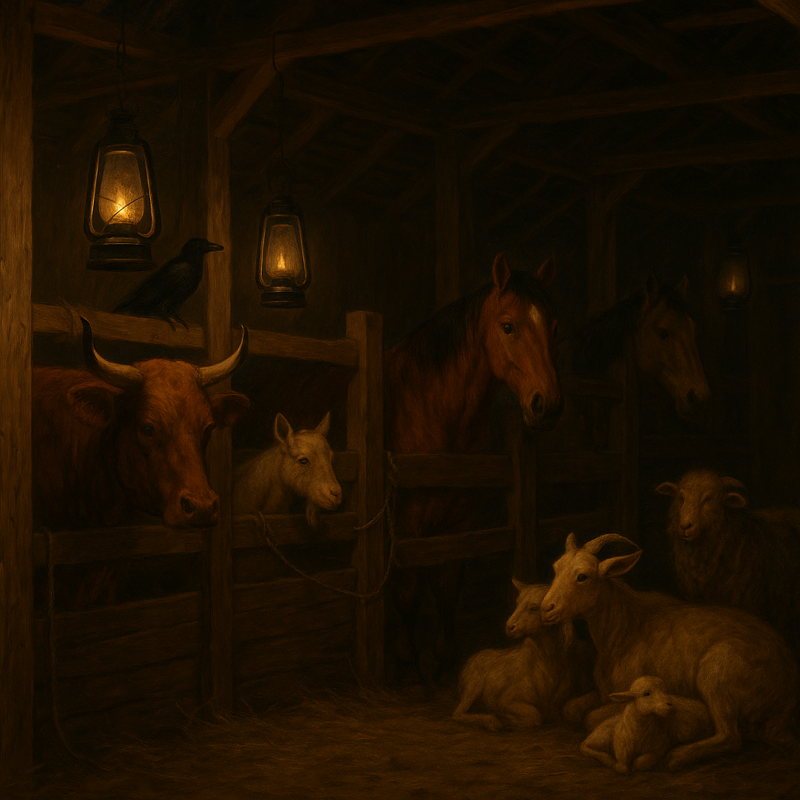
He turned, leading her deeper into the center of the vast space. "Here," he said, touching the railing where a few doves nested in the beams, "this is the heart—stables and pens. Every creature bred or born on this land finds its place here. In spring, the sound of them carries clear up to the rafters. Goats calling to kids, foals testing their legs, cattle shifting in their stalls. Whether it eats, bleats, neighs, or sleeps—each has a place. You'd think the structure itself was alive," his words soft, inviting, as he began preparing a stall for the horse.
Linora tilted her head back, still brushing the horse, taking in the wooden arches soaring overhead. The scale of it pressed softly against her chest—neither oppressive nor cold, but immense, purposeful, calling her in.
Loshim followed her gaze. "And above us," he went on, "along with more animal housing, we have human quarters. Small rooms, but they hold warmth. There's even a hearth for cooking. I've spent more nights here than I could count. You get used to the sound of the beams. They gently creak like old friends talking."
He trailed his hand along a post as he walked. The wood's grain caught the lamplight like rippling water. "Some of these boards were part of his first house, before I was born. He says the wood remembers. I think it remembers hands."
He ran a calloused hand across another beam, palm tracing the grain—greeting a friend. "Every scrap my father ever saved has a place here. Nothing is thrown away if it can be taught to serve."
Linora turned slowly, taking it all in—the vast arcs of shadow, the smell of pitch and oil, the sense of purpose humming through the wood. "It's more than a city," she murmured. "It's amazing."
Loshim smiled faintly, catching her eyes. "I couldn't agree more." Linora turned to hide a slight blush.
She looked around more and realized the wonder wasn't only in the walls. It was in the way he belonged inside them—quiet, sure, necessary. The thought arrived like a truth she had been walking toward all day: she wanted to belong in this world he built.
The air grew warmer as they walked deeper in the middle stables—settling the mare in the prepared stall, the scent of hay and musk thick around them. Loshim lifted a lantern from its hook and held it high, the flame threw gentle halos over the wood beams.
"Here," he said softly, guiding her between the stalls. "I call her Yaruna—born by moonlight, and she prefers the peaceful shadows."
He stopped before a quiet corner enclosure where a ewe lay curled in straw, her breath slow, her wool rising and falling in deep rhythm. The animal's belly was wide, trembling faintly with movement from within.
"She's heavy with twins," Loshim said, kneeling beside the gate. "Any hour now, I think. She's a stubborn one—won't settle near the others. The darkness calms her."
Linora crouched beside him, watching as the ewe blinked at the light, then turned her head back into the dimness. "You keep her separate on purpose?"
He shrugged. "A mother picks her place better than we do. Who am I to say otherwise?"
The ewe shifted, exhaling a low, contented sound. Peace spread through the stall—warm, slow, full.
"She trusts you," she said quietly.
Loshim smiled without looking up. "Trust is simple. Feed, listen, let them rest—not much to it. She may give birth before dawn," Loshim said, rising. "Best let her dream of open fields while she still can."
He lowered the lantern again, and they stepped back into the corridor, the smell of hay and milk following them like a benediction.
After about sixty paces, she looked at the great door, still open, moonlight pooling at its threshold. A faint breeze stirred the straw.
Linora paused. "Should we close it? The air feels cold."
Loshim shook his head, still watching the light. "Let them come and go as they please," he said softly, guiding her to the interior ramp.
They climbed to a higher floor, where the roof rose steeply above them—two vast panels of timber hinged like wings. Through the open gap, moonlight poured in silver streams, painting the upper beams and glinting along the curve of the walls.
Loshim set a small fire in a metal basin, its glow soft against the planks. He warmed bread, split figs, poured wine into clay cups. The meal was simple, but the space around them had changed—still, sheltered, threaded now with laughter that came without effort.
"You did well today," he said.
"So did Eshka," Linora answered.
"She'll demand a second lesson," Loshim said. "I might, too." Linora meant to laugh, but she instead sat quietly, taking in this moment. A dream—and she didn't want to wake. So she asked for more wine.
When the last of the light faded, Loshim leaned back, listening to the wind outside and the murmur of animals below. "Too dark to ride back," he said at last, a small smile tugging his mouth. "Stay. You can have the finest room."
Linora hesitated, not from doubt, but from the weight of something she could not name. Then she nodded.
He rose and crossed to a corner where a pole held the rafters apart. He gripped it near the base and eased it free. The great shutters began to descend, groaning with age and weight. The two halves drew together until they met in the middle with a slow, heavy sigh, sealing the light to a narrow seam.
The room closed and grew warm again, Loshim lit another lamp, and led her down a narrow passage to a cozy chamber—clean, warm, walls glowing amber in the lamplight. Linora noticed fresh linens, a clay lamp, a stool carved with careful hands.
"This is the one," he said lightly, stopping at the threshold.
They stood there a few seconds too long. The lamp's glow made a small, shrinking island between them, a warm, inviting island of trust. She found herself holding Loshim, neither pulling away.
"Thank you," Linora said, voice low.
Loshim nodded, but didn't part—only reached for her, fingers tracing the line of her arm, memorizing it. His hand found her face, steady and warm, and he drew her closer. Their breaths met first, then their lips. The kiss was slow, searching, soothing thought and quickening the heart.
His hands slowly guided down. She drank in every moment while anticipating the next. Her hands mirrored on his, traversing his chest. She could feel the tremor of restraint in him—not hesitation, but reverence. When he drew her closer, their embrace deepened until words had no place between them.
He drew back, slightly, the silence between them pulsed with everything neither dared to say. She felt his heartbeat against her own and, for a moment, the weight of the world lifted. It was not reckless but inevitable—the meeting of two souls who had waited too long to name what had already taken root.
"Shhh," he murmured, the word more comfort than command. They kissed again, deeply, their hearts beating as one, not in desire alone but in recognition. He was slow, rhythmic and gentle. His touch elevated her, lifting her skyward—time paused to give them this single wrap of peace.
"Good night, Loshim," she whispered into his ear. "Rest."
He held her gaze, the hint of a smile softening the line of his mouth.
She eased the door toward its jamb. The wood met wood with a gentle touch, and the latch settled without a sound. On the other side, after a pause, his footsteps faded down the passage.
Inside, the room kept its warm hush. Linora leaned her back against the door and exhaled. The nearness still trembled in her chest, bright and clean. She set the lamp on the stool, unwound her hair, and sat on the edge of the bed.
The night comforted her, quiet and pure, as if to guard what love had only begun to understand.