Chapter 13 - Forge
At dawn, the morning of the siege on Shuruppak, before Linora escaped the city with Samuel, citizens still believed themselves secure. The walls stood unbroken, the forges hummed, and the scent of cedar and spice carried through the early haze of lean season.
No prophecy was spoken, no warning given—only the steady rhythm of life, which fools the living into thinking today will be much the same as yesterday.
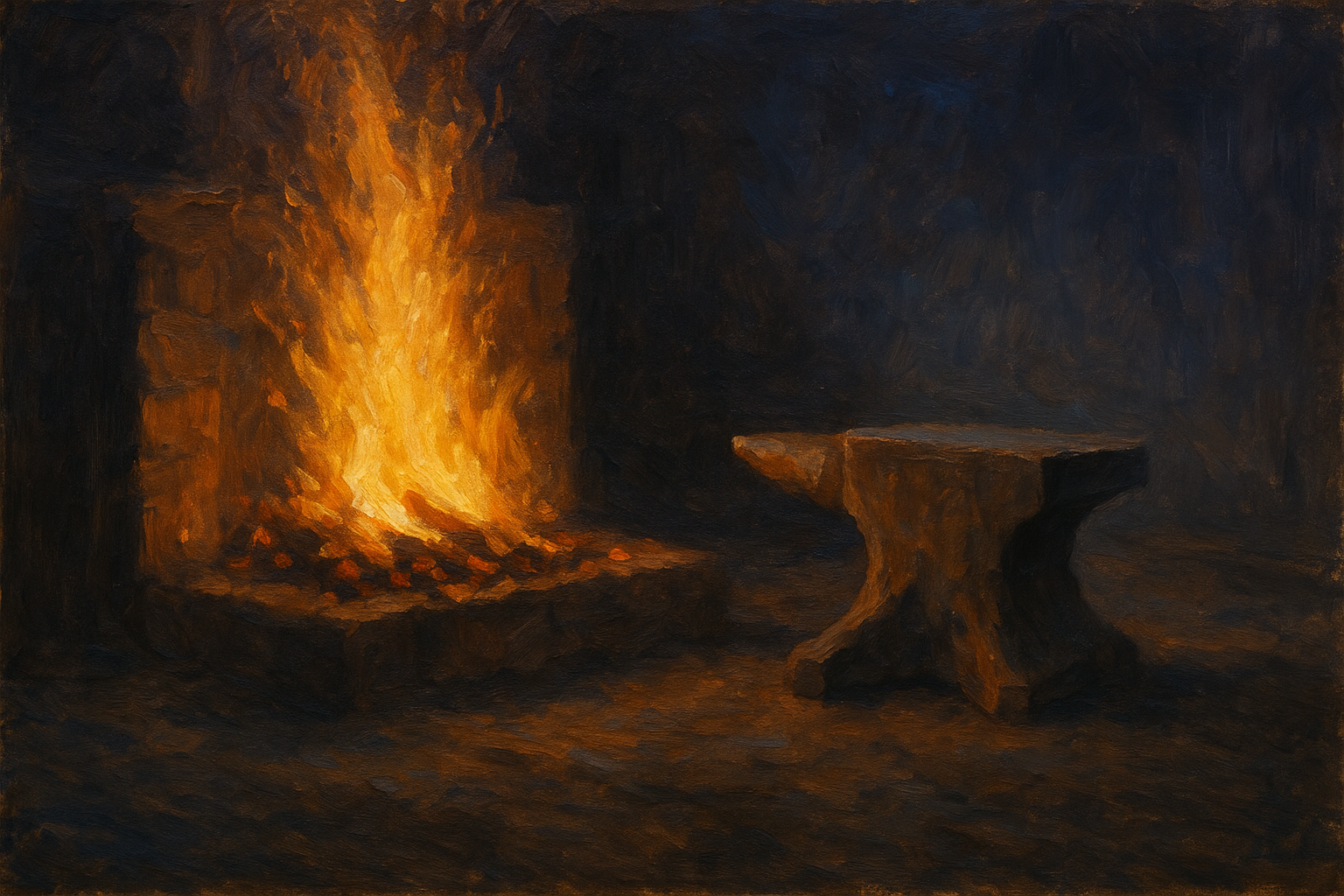
The forge hummed with quiet purpose. Coals glowed steady in the morning light, smoke curling lazily toward the vent. Oren stood alone beside the anvil, sleeves rolled, sweat gleaming on his brow as he proudly watched Samuel's cart filling in the yard.
Keziah was already outside, fastening down the last of the bundles of hinges, chisels, nails, and Samuel's pride—bright horseshoes wrapped in linen. Around her neck hung the small woven cord threaded with colored beads, faded from years of wear. Keziah usually wore it on days she'd see Linora. It glinted faintly now against her collarbone as she leaned over the cart. Samuel's broad shoulders moved beside her, steady with the easy strength of youth tempered by years of labor.
Oren approached him, ready to deliver the words he had silently rehearsed. "You're a proven hand now. You have free access to the forge and can choose your own tasks. And, importantly, you sell your own work this time."
Samuel's chiseled jaw fell open, visibly shocked and pleased. "Yes, of course, Master Oren. I'll sell it!"
Keziah smiled at the exchange, then stood beside the heavy load. The donkey stirred, and the wheels creaked against the packed earth.
Oren didn't follow—doing so would insult the promotion he had given. No, Samuel had to face this task without him. "Say 'hello' to Linora for me!"
He watched as the two waved back and set off down the lane, his arms folded, the morning light framing him with silhouette. Pride and peace rested together in his eyes.
When they vanished past the trees, he turned back to the forge and stoked the coals. The fire gave a soft, contented sigh.
The day stretched long and golden. Oren worked without hurry, content to let the forge hum beside him while he shaped a set of small tools—nothing urgent, something to keep his hands moving. Hours passed unnoticed until he finally leaned back and felt the emptiness in his stomach.
He smiled to himself. Keziah's stew would be ready by now—he could smell it. But there was only smoke, the faint scent of coal and distant fields.
He stepped outside, wiping his hands on a cloth. The sun was nearly gone, warm on the edge of the hills. In the far distance, beyond the groves, the sky had taken on a strange color—a dull, rising haze that smudged the horizon.
"Another festival," he murmured, half aloud. It wasn't the first time Shuruppak had filled the night with lingering light and cheer. He let the thought comfort him.
That night, the forge dimmed early. He ate a little bread, then sat near the coals until they burned low, waiting for the familiar sound of wheels on the road. None came.
By morning, everything had changed. The smell of smoke was heavier now, the taste of it faint on his tongue. He stepped outside again, expecting to see the first glint of the cart cresting the hill, but only saw the same grey veil over the horizon.
He told himself it was nothing. Keziah was careful; Samuel, capable. They had likely stayed for trade or found friends to visit. Still, something sat uneasily in his chest.
By noon he could not focus. His hammer missed its mark, his rhythm faltered. He caught himself staring toward the distant road, imagining the shape of the cart, the flash of Keziah's shawl.
As the sun fell, hunger returned—sharper now, joined by a slow, growing dread. He hadn't eaten all day. The silence pressed in.
When darkness came, Oren lit a single lamp beside the forge and whispered, "Tomorrow. I'll see for myself."
The lamp burned steady for a long time, until the last coal in the forge went dark.
The next morning came cold and colorless. Oren rose before the sun, the forge still dark behind him. He packed nothing—no bread, no tools—only his coin bag and a skin of water. His feet moved with purpose, though his mind was still half-hopeful, half-afraid to name what he feared.
The road toward Shuruppak felt longer than he remembered. Each bend showed a little more of the sky's dim haze, thickening as he neared the lowlands. He passed a scatter of broken pottery along the way. The silence was wrong—no traders, no laughter, only the soft rasp of wind through the grass.
Near the city's outer fields, he saw an old man sitting against a fallen wall, wrapped in rags. The sight stopped him. No beggar ever lingered this far from the gates; there was nothing here to beg from.
Oren stepped closer and drew two barley pieces from his pouch. "Old father," he said, offering them, "what's happened in Shuruppak?"
The beggar looked up, his eyes red-rimmed, his voice raspy. "Shuruppak is no more. You're looking at Drevibad now."
Oren frowned, not understanding.
The man nodded toward the distant haze. "I stay far back. They'd kill me if I went nearer—too pure. Any younger, and I'd already be dead. Tell me, son... are you of mixed blood?"
Oren hesitated. "No."
The beggar leaned forward, his tone low and urgent. "Today, you are. With your size, none will question it. But a pure-blood such as you would not live to see the gate. Remember your lineage—say you're the grandson of Ashurak. Speak little. Tread with caution."
Oren's hand tightened around his coin bag. The name of Ashurak hung between them, heavy as iron. He nodded once.
"May the Nephites spare you," the beggar said, bowing his head.
Oren continued toward the smoke. His eyes stung now, watering against the ash, but he did not slow.
He entered the city through the eastern gate, the same road he had taken a hundred times before, though now he crossed into another world. He kept his head low and his mouth careful, invoking the name of Ashurak more times than he cared to count. The name carried weight here—a relic of power the new king dared not profane. Each time he spoke it, guards and prowlers turned their eyes away.
The streets stank of smoke and tallow. Candle altars lined the alleys, built from skulls of beasts and men alike, their hollow sockets glowing with trembling light.
He passed the place where used to park his cart—once alive with the clang of wares, the hiss of water over hot iron. The sign marking the open-sellers lot was gone, replaced by a spear rack and the stench of blood. His feet remembered every stone, yet the path recoiled from him. The baker's awning where Keziah had bartered for honey bread had collapsed into ash. The tavern that once spilled laughter into the street now spilled only smoke through its open rafters.
A metalworker's brazier lay overturned, the coals fused into black glass. Oren's eye caught a set of tongs half-buried in soot—his own design. He picked them up, still instinctively testing their hinge, then dropped them when he noticed the rusted stains along the grip.
The further he went, the more the city echoed its own death. A wall mural he remembered, painted for the festival of storms, had been scorched beyond recognition. The old well where travelers once gathered was filled with rubble. The cries of the market had been replaced by the low drone of flies.
Near the square, he stopped short. A jackal carcass had been propped upright, a grotesque idol. Above its shoulders, impaled and half-rotten, hung the head of Shuruppak's magistrate—flies orbiting, maggots moving beneath the sunken eyes.
The infirmary stood ahead, its doors blackened by soot, the windows half-boarded. Outside, he saw Serah, her healer's sling greyed with ash.
He approached her cautiously, his voice low. "I'm the grandson of Ashurak," he said before she could speak.
Serah looked him over once and gave a faint nod, then stepped close enough that only he could hear. "You shouldn't be here. You have to go."
"Not without my family—my apprentice."
"Keep your voice down," she hissed. Her eyes darted toward the square, where a line of soldiers was dragging captives. "This way."
Serah motioned him inside the doorway, against the wall, voice hushed. "I saw Linora and Samuel flee west with other refugees. They escaped the worst of it."
Relief flared—and then faltered. "Then Kezi—"
Serah caught the word and silenced it with a look. There was no gentle way to say it. Serah's hands worked against each other, wringing at the edge of her shawl. Her voice softened, trembled once. "She was inside when the fires spread. Stayed to tend burns, even as the roof began to fall. When the Nephites swept through, they found her—said her courage pleased the king. They took her for one of his wives."
Oren's face hardened, the color draining from him. "No."
She continued, her words strained. "I spoke with her briefly through a cage. She said she wouldn't be Drev's vessel to bring more of his kind into the world. That her body was for... well, for you alone."
Serah's voice faltered. "She smiled when she said it. Told me she still had a choice, and asked for my small-blade. Her last act of devotion."
Oren's heart stopped.
Serah swallowed. "Before sunrise... she made sure no one could take away her dignity. I saw her there, huddled in that cage, lifeless. The blood had pooled near her hands—precise, deliberate, like she meant every motion."
Everything went still. Heat pressed down, flies droned, and somewhere far away a bell tolled, faint and hollow. Oren didn't move, didn't speak. His hand closed around the edge of the infirmary door, knuckles white.
Serah tried to go on, but the words withered in her throat. "She was brave," she whispered finally. "To the very end."
Oren said nothing—his jaw locked, a tremor running through his clenched teeth. The grief sat in him like molten iron, too heavy to move. His eyes lifted at last to the western wall, searching for something, or someone.
"I don't know where they went, but I know they are safe," Serah said, then slipped back into the infirmary.
A moment later, she returned, something small cupped in her palm—a carved wooden sparrow, its wings smoothed by time and touch. She placed it gently into Oren's hand.
"For Linora," Serah said.
Oren looked down at the bird, thumb tracing the faint grooves of its feathers. He nodded once, his throat tightening. "She's safe," he whispered. "It has to be true."
There he stood, the words clawing inside him. Serah's voice had already fallen quiet, but the echo of it rang like hammer on bone.
He turned away before she could say more. The streets he once knew closed around him—narrower now beneath the smoke, their stones blackened, their doors strangers. Yet his feet moved as if remembering for him. Past the square, past the broken awning, past the place where the brazier once burned bright on festival nights. He could have walked it blind. Every turn lived deep within his muscles.
By the time he became aware of his surroundings, he had reached the tavern threshold—a narrow place, its brown door swollen with age and groaning as it moved. The sign, once painted with a single flask, now scorched and broken between the hanging chains. He had come here countless times in his early years, when laughter and stories had filled the room. Now, only silence and ash greeted him. When he stepped inside, the smell of ale and charcoal clung like ghosts.
The owner looked up from behind the counter, eyes widening with recognition. He gave a single nod—not greeting, but allegiance. Then, wordlessly, he filled a clay flagon and set it down as Oren placed a shekel of silver on the counter, signaling he would be staying a while.
Oren drank. The first swallow burned; the second finished the cup. He asked for another. Around him, a few men hunched at their tables, silent, staring into cups that had long since lost their warmth. For a while there was only the creak of stools and the small hiss of the fire. After more large gulps and a single wave of his fingers, the empty flagon was refilled again.
The time passed slowly, maybe an hour before the door opened again, letting in laughter. Three members of the Nephites stumbled through—young, loud, still scented with the spoils of conquest. Their armor was half-polished, half-stained; one wore a woman's veil tied about his wrist like a trophy.
They ordered drinks, slapping the counter in lieu of payment, boasting about things Oren didn't care to hear.
The tavern keeper poured without a word, his eyes darting once toward Oren, a warning that said stay down.
Oren kept his head lowered. But their voices carried.
"Drev will have his fill before sunrise," one said, gulping. "He takes the best of them first. The rest—" he laughed.
"To us," another answered. "We have to share the plains. With all the good-looking ones going to the king's table, there's not enough to go around."
Oren's stomach turned at their words. He tried to lose them in the rim of his cup, but the more he willed himself not to listen, the clearer their voices became—carrying something darker beneath the jest.
The third leaned in, smirking through crooked teeth. "Not all of them. I had my way with one—oh, a sight to behold. Skin like milk, strong hips, and a face that could make a man forget the world. She was meant for Drev!"
The other two stared, half shocked, half amused. "You lie. A coward like you'd never cross Drev."
The first man only shrugged. "Didn't want her anymore. She'd done herself in, but her body was still warm."
Oren's grip on the cup tightened. Done herself in. The words stung deep. Too close. Too particular. His heart gave a slow, heavy thud, and for a moment he thought he might be mistaken—that the drink or grief had twisted his hearing.
The Nephite kept talking, his voice oily, crawling with termites—each word chewing its way into Oren's skull. "She had this string of beads round her neck—little colors. I held it like reins on a mare. When it snapped, I kept the one that stayed in my hand."
He grinned as he held up a yellow bead between his fingers. "A bloody mess, I admit—but a hole is a hole."
The sound in Oren's ears split open. The words struck a spark to dry wool, and the fire took hold. His hand closed around the flagon before thought could catch him. He rose.
The stool fell backward with a crack. The crooked-toothed Nephite turned—in time to see the clay flask through the lamplight shatter against his skull. The sound was thick, dull, final. The man went down without a cry.
The other two froze. The first dropped his cup; the other stumbled back, fumbling at his belt. Oren was already moving, the broken handle of the flagon still in his grip. He caught the nearer man by the throat and drove a fist into his jaw—once, twice—sending him reeling over the table. The bench toppled with him, and he hit the ground hard on the far side, out of reach.
The last Nephite had found his sword. He half drew it before Oren seized his forearm with both hands and wrenched. Bone gave with a muffled crack, sharp as a dried branch. The man's cry barely formed before Oren turned the broken arm and drove the blade home through his torso.
Oren stood over the first, lungs heaving, his hands slick with blood. The man groaned once. Oren dropped to his knees, pinning the chest beneath him, and struck again—not for justice, but because the body before him still belonged to the world that had taken hers.
The blows kept coming, faster now, until his knuckles met wood. The sound changed—from bone to floorboard—and still he swung, until the blood beneath him spread like slag from a crucible.
Oren stayed on his knees, rage dripping from his lips. Across the table, the second Nephite stirred. Their eyes met—a silent reckoning that lasted only a heartbeat. The man glanced at the bodies, then back at Oren.
With the table between them, Oren couldn't reach him. The Nephite staggered up, grabbed the edge for balance, and bolted through the door.
"Get out of here!" the keeper warned, gripping Oren's arm. "He'll come back with more—quads too."
Fire coursed through Oren's veins. He considered staying—to let his fury finish what it had begun, to die with the flames still inside. A fitting way to meet Keziah again.
But the man's words cut through.
Oren let his fists loosen, stepped over the fallen bodies, and pushed through the door.
Outside, the street had emptied. Only smoke moved, curling low along the stones. Somewhere far behind, a horn sounded—short, sharp, searching.
Tucking his bloodied hands beneath his cloak, he quickened his pace. The city's eastern gate stood open enough for him to slip through. He did not look back, fleeing Drevibad before his grief could betray him.
The old man's warning still echoed in his mind—speak little, live long—but now the words felt hollow. He kept his head low through the eastern fields until the haze thinned and the smell of death gave way to grass again.
By the time Oren reached the forge, night had fallen. The familiar walls greeted him in silence. He sank beside the anvil and let his bloodied hands hang limp. What use was a forge now? Why make anything—and for whom?
He thought of Keziah's last stand, of her courage, of her calm defiance. The image burned brighter than the coals. His chest ached with the need to follow her—to fall on his own blade and be done.
Oren grabbed a sword, his hand tight around the hilt, the motion raw and impulsive.
Then, another thought intruded: Linora's face, walking into the forge, finding him there. The vision froze him. He could not leave her that pain.
His free hand found the carved sparrow, now on the floor. The tiny bird weighed almost nothing, yet it anchored him.
He set the sword aside, clutching the sparrow instead, and whispered into the empty shop, "As long as it takes."
And so he stayed. Each evening, when the sun disappeared behind the valley, he lit the forge again—not to work, but to wait. He spoke to the empty room, to his absent family. He set three plates at the table: one for Keziah, one for Linora, even one for Samuel. Some nights he prayed. Others he talked until the words gave out.
Days bled into weeks. Hope thinned to a thread. His hair grew long; his beard, dirty. He tried to keep presentable for Linora's sake, should she ever come through the door, but most mornings he delayed until the day was gone.
Most evenings, when the light failed and the forge lay cold, he reached for the large fired flask beneath the table. One swallow of the black draught was for warmth. Then two for silence. Then until warmth and silence were the same thing. Once, he poured a little on the coals to hear it hiss—and watched the smoke twist up like her hair. After that, he couldn't light the fire without wanting another taste.
Sometimes, when he lifted for another sip, he could almost hear her voice again—"Don't you dare drink it, Oren." It might stop him once. It never stopped him twice.
He barely noticed the season change. It was evening in early lush season. The world smelled fresh, no longer of smoke, haze, and ash. He sat again at the table and stared at the untouched plate before him. The draught burned his throat, but the stories came easier that way—half prayer, half apology—until his words slurred into the silence and he slept beside the plates, dreaming they'd answer back.
"Master Oren."
He froze. The voice was faint—a trick of the mind, surely. Plates don't normally answer back.
Then again, ever slightly clearer this time. "Master Oren."
He froze. He turned his head sharply, intently. Listening.
A third time, louder still, from outside: "Master Oren!"
He stumbled to his feet, heart pounding, and ran to the doorway.
There, framed by the fading light, stood Samuel, cane in hand—older, scarred, smiling as bright as ever.
Speechless, Oren stepped forward, arms open in disbelief. Samuel's grin unshakable.
"Master Oren. I've got a question for you."
Oren wrapped up Samuel in a grip so tight, it produced a short cough before being placed back down. "Anything, my son! Name anything." Samuel tilted his head and looked up, deliberate.
"It's about Linora..."