Chapter 14 - Home
History seldom lingers on the mornings after joy. It remembers wars and floods, kings crowned and kingdoms ruined, but not the quiet hours when love first feels possible. Yet it is in such hours that the world seems most worth preserving. So it was for Linora. The night before had been laughter and discovery—the rhythm of hooves, the shimmer of lamplight, the warmth of a hand she hadn't expected to hold so long.
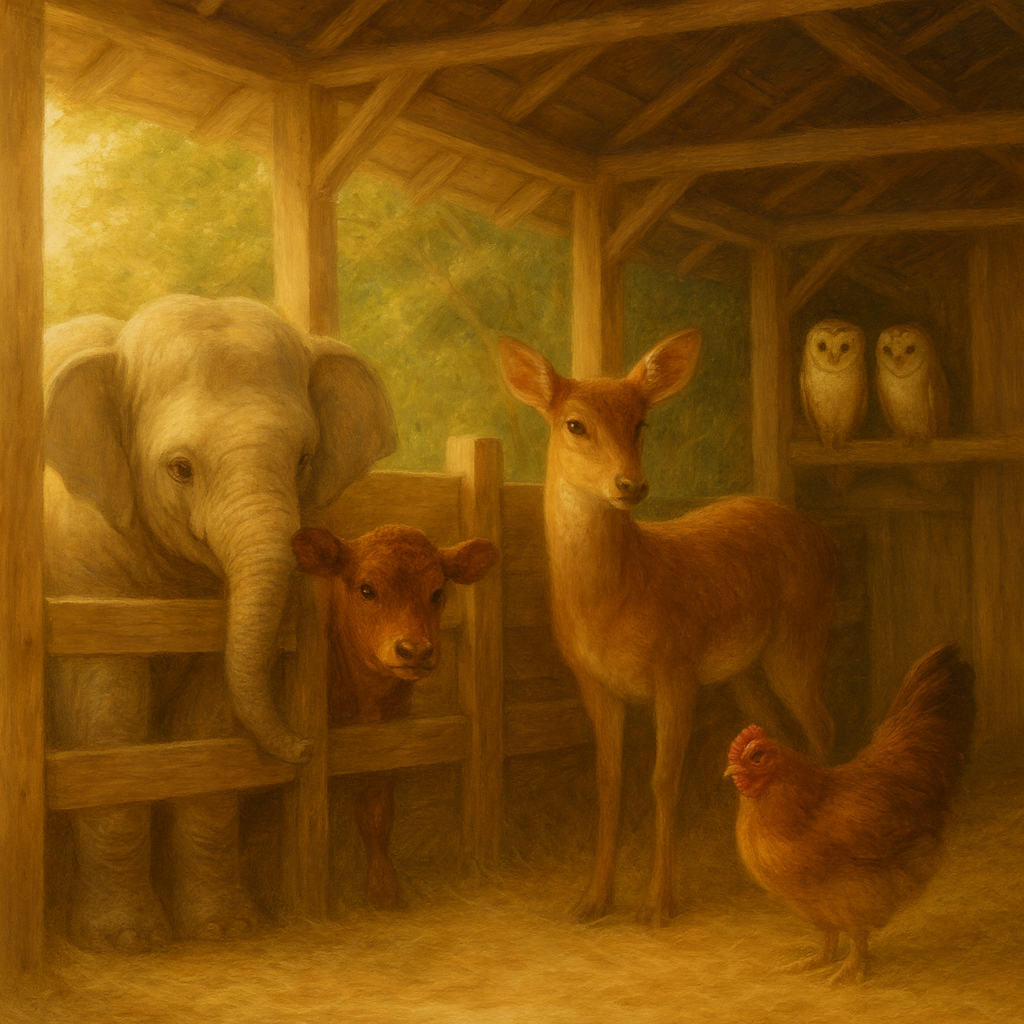
She stirred beneath a linen coverlet and blinked at the shape of the wooden curved wall. The timber glowed faintly gold where the sunlight filtered between its planks. Above her, doves rustled in the rafters, cooing softly as they shook the sleep from their feathers. The air smelled of sawdust, pitch, and fresh straw. It was the smell of work and of life—of something not yet finished but determined to endure.
Somewhere near the hearth, a pan scraped faintly. Then came the low hum of Loshim's voice, unhurried, tuneless but content. Linora lay still a moment longer, listening. Each sound—the soft strike of flint, the hiss of oil on iron—threaded itself into her heart. She wanted the moment to last and felt safe to keep her eyes closed.
When she rose, the floor was cool beneath her bare feet. Loshim looked up from his squatted legs near the small fire pit, a smile tugging at the corner of his mouth. "I was wondering how long the doves could out-sing your snoring," he said.
She grinned, brushing a stray curl from her cheek. "You're brave to tease the woman who keeps your bruises clean."
He gestured to the pan. "Then I'd best stay in your good graces. I make a fine breakfast when uninjured."
A comfortable ease settled between them. On the pan, thin cakes browned beside a clay bowl of crushed figs. Steam curled upward, carrying a sweetness that mingled with smoke.
She sat on the low bench across from him, tucking her legs beneath her tunic. "I didn't know the one who speaks the tongue of beasts can also cook."
He shrugged, turning one cake with a wooden slat. "We all learn what keeps us alive. Sometimes that's a word. Sometimes it's a meal."
Loshim handed her one of the cakes, warm and soft, the figs pressed within like hidden sunlight. She bit in and laughed. "You forgot salt."
He acted offended, but there was a hint of jest in his eyes. "Or you're spoiled by city markets and your mother's touch for spice."
Laughter lingered. For a little while, this place was home—wood and warmth and the quiet company of two souls who, through twisted fate, had found one another.
The morning had turned soft and bright, and the ravens in the rafters joined in like gossipers above them. Loshim sat cross-legged, a clay disk balanced on his knee, tearing his cake into small pieces.
For a long while, they spoke of simple things—the stubborn mare who refused her saddle, the odd way the sheep crowded at the ramp, jealous of human company. But when Linora reached for more figs, he stilled her hand with his own.
"I've been thinking," he said at last, his tone careful, subdued. The brightness in his eyes dimmed. "About... last night."
She drew back slightly, studying his face. "You didn't like it?"
He shook his head. "No. Not that. But..." His gaze drifted toward the light filtering through the beams. "Maybe we should've waited. My brother..." He stopped, exhaled through his nose. "His heart bends toward you. I pretended not to see it."
The words landed softly but carried weight. Linora stared at the table, tracing a finger through the dust on its surface. "That was too long ago," she said at last. "He was the first decent apprentice my age."
She looked in Loshim's eyes as she spoke. She could sense they held doubt.
"It was never much of anything. He's like a brother to me," she lied, partly to Loshim, partly to herself. She hoped this would put an end to it.
Loshim studied her quietly, then gave a small, tired laugh. "But he's like a brother to me too. If he truly seeks your hand, there'll be no easy way through that."
Silence stretched between them, thin as light through smoke. Then he sighed, the tension breaking. "Let's give him space to come to terms with it. No need to shout what's sacred."
She met his gaze again and found only kindness there—no demand, no pride, only care. "All right," she said. "For a time."
He smiled, and the weight between them eased. He leaned across the table and kissed her—not the fevered kind that sets the pulse racing, but a quiet seal, a promise shared without words.
As they cleaned up, the mood had shifted. Loshim reached for the flour bowl, flicking a white puff toward her sleeve. "There. Now you look like a proper cook."
Linora gasped, mock offended, and retaliated with a handful of straw from the stall behind him. It clung to his hair, the pieces catching light like gold. He laughed—an unguarded, young sound that echoed through the space and sent the birds scattering.
They strolled down the ramp and walked down the long corridor to check on the birthing stall before leaving. The stillness inside held a lingering warmth, rich with the scent of new milk. Yaruna lay curled in the straw, her sides rising slow but steady. Two lambs nuzzled at her belly—tiny, slick with the sheen of new life, their coats already drying into soft curls of white and gray.
Loshim crouched beside them, running a careful hand along each small spine. "Strong," he murmured. "Both of them. I'd say near a measure heavier than most." He lifted one briefly, testing the weight with a quiet nod before setting it back down. "You've done well, Yaruna."
The ewe turned her head, weary eyes half-lidded but alert, tongue brushing one of the lambs clean. Linora watched, heart swelling at the simple grace of it—how life arrived without ceremony, how care could look like exhaustion. Her fingers brushed the rough beam of the stall. "She's found the right home."
They lingered there a while, listening to the small sounds of life—breath, straw, the soft click of lamb hooves against wood. The light from the far door drifted faintly down the corridor, laying long bars across the floor.
When at last they turned to leave, the walk back felt slower, the distance marked by the steady echo of their steps. The light grew brighter with each one—Eshka waiting patiently at the end.
Loshim saddled the mare, handing the cord to Linora to lead outside, then paused by the open door. He looked back once, eyes traveling back to the birthing stall, then took hold of the great wooden plank and drew it shut. The hinges gave a low groan before settling into silence.
Linora's eyes squinted from the new morning light. "You wanted it open before," she said softly.
He rested his hand against the wood. "Yaruna will want her peace now," he answered. "Let her rest."
The latch settled into place with a dull click. The forest greeted them cool and sharp, smelling faintly of cedar. Linora stood beside the horse, her hand brushing its mane as Loshim adjusted the straps effortlessly.
"It's better this way," he said lightly. "Let them think we've come to check on the pens. Even Nahala can't argue with a bit of diligence."
Linora smiled, grateful for the pretense. She brushed a stray curl behind her ear, her voice soft but sure. "I should check on Tirzah soon. It's about my turn to sit with her, and if I don't show up, Lirit will come hunting for me."
Together they leaned back while Eshka descended the great ramp and crossed the slope toward the estate, the wooden city behind them slowly sank into the dense forest.
The courtyard was alive when they arrived—hens scattering near the troughs, a gruff man calling to Omri as he carried feed in a pail. Loshim moved to the stables and helped Linora down. While approaching the house, the animals turned toward Loshim, expecting a word or a touch. Linora followed close behind, her heart foolishly light. When others passed near, the young couple grew careful—their laughter soft, their glances stolen.
Inside the servant quarters, the room was warm and smelled of cinnamon. Tirzah lay propped on folded linens, Lirit beside her, telling some small story that made her mother smile in weary intervals. When they noticed Linora, Lirit rose at once.
"You're back," she squeaked. "She's the same. No bleeding."
Tirzah managed a soft exhale. "But you look refreshed," she smirked, one eye winking. "Like the morning agreed with you."
Linora's smile tilted. "Maybe it did. A change in scenery was pretty nice, actually." She nudged Lirit toward the door. "Go eat. I've got her."
Lirit squeezed her arm, grateful, and slipped out. Linora stayed, listening to Tirzah's breath—the same careful rise and fall as yesterday, and the day before.
She sat beside Tirzah and spoke softly, letting her voice fill the stillness. She told her about the wooden city waking at dawn, about Eshka's careful steps, and about the lambs born in the hidden pens—two little creatures wobbling on new legs, searching for milk. Tirzah smiled at that, eyes half-closed, and said she welcomed the distraction.
While they spoke, footsteps approached the doorway. Nahala eased inside, her shawl drawn around her shoulders in her usual way. She paused when she saw them—Tirzah resting, Linora seated at her side—and her expression softened.
"You seem to have found your smile again," Nahala said, a faint note of teasing smoothing the words.
Linora felt her cheeks warm. "Your home is full of good company," she said quickly, fussing with the edge of Tirzah's blanket though it needed no straightening.
Nahala's hum was soft and unconvinced. "So I see," she murmured, her eyes lingering a moment longer before taking a seat at the fine chair. "Go on. Find that good company."
The day stretched easily around her as she made her way back to the stables. Loshim showed her how to calm a restless calf by rubbing the space between its eyes, how to tell when harvest approached by the grain's weight in the hand. Linora listened, entranced not only by the lessons but by his honest delight in teaching them.
Each task felt unhurried, the day had agreed to pause for them alone. The noise of the estate softened to the rhythm of work—the slap of rope against wood, the rustle of straw, the low huff of animals dozing in shade.
Linora caught herself thinking that this must be peace—a world reborn. A life not of fire and ruin, but of tending and being tended to.
When the evening lamps were lit, she looked toward the trees where that chamber stood waiting, its dark silhouette against the fading light, and wondered what such a life might hold.
The estate glowed, the day refusing to end. Lamps flickered in the archways, throwing slow, golden light across the stones. Omri carried dishes from the kitchen, the scent of herbs and baked grain drifting through the courtyard.
At the long table, Nahala stood at the head, hands lifted in prayer. Her voice was calm and clear—not grand, but steady, making even the simplest words ceremony. Linora bowed her head beside the others, the rhythm of the prayer flowing through her like water. When they ate, laughter came easily. The heaviness of everything had receded.
Nahala broke a loaf of bread and handed it toward Linora. "You've done well with the mare," she said, her tone half praise, half curiosity. "I hear she doesn't try to bite anymore."
"That's Loshim's doing," Linora said. "He says even the wildest creatures can be tamed if they trust your voice."
Loshim smirked. "Not tamed," he corrected, "reminded that gentleness isn't weakness."
Nahala's brow arched. "And does that wisdom work as well on people as it does on beasts?"
Loshim hesitated, long enough for Linora's laughter to fill the pause. "Still trying to figure that out," he said finally.
"Well," Nahala said, pouring more wine into her cup, "I hope your research continues under proper supervision."
Linora's cheeks warmed, but she kept smiling, biting a piece of bread to hide it.
After supper, talk softened into murmurs and stories. Nahala listened with her usual half-smile, the weight of her years like earned authority. Loshim sat across, as usual, half in shadow. He caught Linora's gaze once, then again, the space between them filled with a silence that said too much.
When the house began to settle, Linora excused herself to the servants' quarters. The lamps burned low in the hall, their smoke thin and fragrant. Tirzah had already taken to early sleep. A great way to pass the time. Sheets still white, clean, and healthy.
An hour passed and Lirit popped in, sleepy as well, but ready for her shift. Linora smiled and walked toward her room upstairs. Behind her door, she leaned against the frame, smiling before she even realized she was.
The room hadn't changed—woven mats, a folded blanket, the faint perfume of crushed myrrh clinging to the walls. Yet it was home, or the promise of one. She lay on her side, staring toward the dim light beyond the lattice.
Her thoughts drifted back to the courtyard, to Loshim's voice describing the twitch of a mare's ear, to his unguarded grin when she'd made the calf stand on its own. She pictured a life made of such things—mornings among animals, evenings of laughter and quiet warmth.
So this, she thought, is what it means to rest.
Sleep found her slowly, like tide returning to shore. Her dreams were full of doves and sunlight spilling through wooden beams, of Loshim's laughter echoing somewhere close—a sound both near and far, allowing her a quiet night.
The next day passed in a hush of ordinary grace. Morning came with mist along the fields, and Linora found comfort in the pattern of it all—water drawn from the well, grain measured for the hens, herbs gathered in tidy bundles. In Tirzah's room, the fresh sheets stayed clean, a small mercy—progress, even though nothing had changed. The estate moved in rhythm, each sound answering the next: the scrape of rakes, the low call of cattle, the hush of wind through the tamarisk.
By late afternoon, the sun had turned honey-warm. Across the courtyard, Loshim worked with a tug on his upper lip, threading leather through a worn buckle. Each time Linora passed toward the garden, he found a reason to straighten—brushing hair from his brow, shifting tools, stretching his shoulders. And every time he did, she caught him looking too long. Soon she stopped pretending not to notice. On her fourth pass, she lifted an eyebrow at him, the smallest challenge.
He pressed his lips together and scrunched his nose, trying—and failing—not to smile. The moment slipped between them like a private joke no one else had heard.
Nahala stood by the outer hall, giving instruction to the servants making final preparations for the evening meal. It was a moment so peaceful that Linora feared any sound might shatter it.
Then—a distant shout.
Not a cry of alarm, but sharp enough to still the courtyard. She turned. From beyond the wall came the groan of wheels and the labored snort of oxen. Metal clanked against wood, slow and heavy—the sound of travel, of burden, of arrival.
The servants began to murmur, shading their eyes toward the gate. Dust drifted over the wall, curling in the evening light. Linora felt her heart quicken before her mind caught up. Something in her already knew.
She stepped forward, placing down the basket at her feet. Through the haze, she saw the first cart crest the rise—a shape laden with bundles, bound with rope and cloth. Then another behind it, smaller, piled with what looked like tools and ore.
And walking beside them, leaning on a staff, was a man she knew better than her own heartbeat.
Oren.
His stride was steady though slower than she remembered, his clothes travel-worn but neat, his hair silvered with dust. He lifted a surveying hand, perhaps to see her more clearly.
For a long moment, Linora couldn't move. The ground shifted beneath her feet, sound fading to the pulse in her ears. She pressed a hand over her chest, feeling the thrum of it beneath her palm.
"Father?" she whispered, the word barely louder than a thought.
The world, for a moment, felt whole again.
Servants hurried forward, voices overlapping as they reached for the reins, but Linora was already moving. She crossed the courtyard without thought, skirts brushing dust, and when Oren saw her coming he opened his arms.
She fell against his chest, inhaling the scent of ash, travel, and iron that had always meant home. His hand came up, rough and trembling, resting against the back of her head.
"It's good to see you, my girl," he said. His voice was low, hoarse with distance and dust. "Better than I ever hoped."
She pulled back to see him—the new lines around his mouth, the gray in his beard, the exhaustion beneath his eyes—and smiled through tears. "You brought the whole forge," she whispered, glancing toward the carts. "Mother will say you emptied the house."
He tried to answer, but the words caught somewhere in his throat. The low rumble of oxen filled the space between them.
Then, slowly, Oren reached into his cloak pocket and drew out a small wooden sparrow. He turned it once in his hand before offering it to her.
Linora's smile faltered. Her eyes fell on the carving—the same one Keziah had given her long ago—and she froze.
"Father," she said softly, searching his face. "Where's Keziah?"