Chapter 19 - Curse
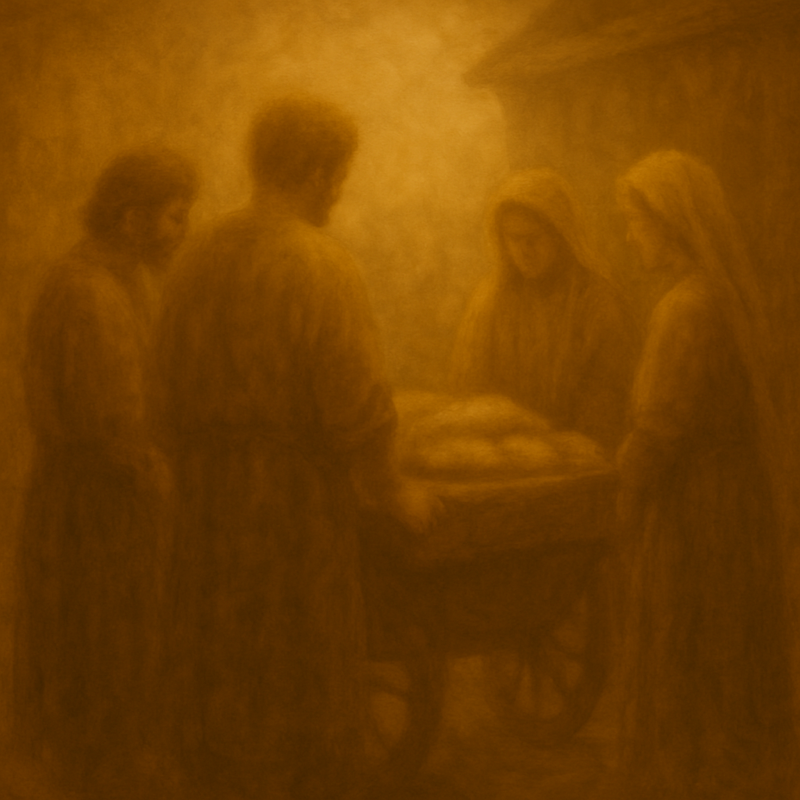
Evening settled over the estate and stars were appearing in the deep orange sky. The uneasiness pressed down, unmoving—the world itself hesitated to speak the thing it had seen. There was no wailing, no laughter, only that quiet ache that follows when something once full of life has gone suddenly still. Linora couldn't name the feeling—sorrow, yes, but threaded with something stranger, like the moment before a wound begins to sting.
They stood gathered in the courtyard, motionless around the handcart. Oren with his arms crossed, studying the shapes with grim focus. Nahala, shawl drawn close, leaned forward a step, her lips moving in a silent prayer. Samuel lingered behind, his good leg braced forward, the other back, torn between disgust and duty. Loshim apart from the others—shoulders low, eyes on the earth, a look of possible guilt in his face.
In the center lay Yaruna, the ewe who loved the dark, her twins pressed close against her flank. The last of the light caught in their glassy eyes, a cruel illusion of life—as though, at any moment, they might stir.
Oren knelt, pressing a hand to the ewe's belly. "No wound," he said, more to himself than anyone. "No swelling in the joints. Still soft through the legs—the shade's kept her right."
Nahala continued her prayer in a low murmur—a soft ripple of words half-lost to the evening sky.
Loshim stood, still looking at the ground, his face shadowed. "She was strong," he said quietly. "Full of milk. There's no reason for this."
The stablehand shifted uneasily and cleared his throat. "Better to butcher it now, before the meat spoils."
That single, practical line fractured the stillness.
Samuel nodded at once. "He's right. If it's still good, waste would be worse."
Oren exhaled through his nose, weary. "If it's not marked or swollen, the meat's clean enough. We've eaten worse in leaner years."
Linora stepped forward, eyes still on the ewe. "If there's sickness, we should know before anyone eats," she said. Her voice was steady, though her stomach turned at the thought.
Nahala's head lifted sharply. "You think it's sickness?" she asked, her voice low, uncertain. "Or... something worse?"
"Maybe," Linora said, keeping her tone, "but before we whisper of curses, we should rule out the natural ones. I've seen this before—not with animals, but with people."
The debate wavered there—between fear and reason, hunger and caution—until Linora knelt beside the cart. She brushed a hand along Yanura's side, her fingers lingering on the coarse wool, still faintly warm. Then she looked up, resolve glinting through the sorrow.
"Let me open her up," she said. "If death hides inside, I'll find it. At the infirmary, we learned that opening the body sometimes shows what the skin hides."
Samuel made a face, his tone sharp with disbelief. "You mean to carve into her? That's revolting." He laughed, alone, then stopped. "Make sure to keep the meat intact."
Loshim's gaze met Linora's across the cart. His voice came low and even, carrying enough for the others to hear. "I'll help her. The work's easier with two."
The courtyard fell silent—not from shock, but from a long pause when everyone begins to understand what must come next.
Oren straightened slowly, his expression unreadable. "Very well," he said at last. "But be quick. We'll not leave her to spoil."
Nahala gave a swift command, "Until we figure this out, nothing stays in the wooden city." Then reached for Linora's arm, searching her face. "Be careful, dear. And pray before you begin."
Linora nodded, though her thoughts were already elsewhere—on the stillness of the ewe's body, on the strange peace in its eyes, and on the pressing question: what kind of death leaves no trace?
They rolled the handcart to the cool stone chamber beside the outer kitchen, where butchering was typically carried out. The place smelled of salt, smoke, and faint iron—the residue of older killings. Loshim motioned for the servant to fetch a table, and together they heaved the ewe onto it, her wool matted with dust. One of the torches hissed as he lit it, the flame throwing long, uneasy shadows up the wall.
The stablehand lingered only a moment more, then gathered the two still lambs from the cart and turned the corner. Linora tied her hair back. "We'll need to see her chest first," she said, her voice steadier than her hands.
Loshim nodded. He drew his knife and made a clean, deep incision from womb to throat. At once, dark blood pooled along the groove of the table—sluggish, thicker than it should be. "That blood tells me she's been gone a few hours," he murmured.
The cook stepped out, wrinkled his nose, and presented a basin. "Should I take what's fit for the pot?"
"Not yet," Linora said. "We'll see what else she can still tell us."
They worked in near silence. Loshim's movements were careful, almost reverent—not the rhythm of a butcher, but of a man who'd loved the creature he was parting. Linora pressed gently at the lungs, her fingers tracing for abscess or swelling. "They're clear," she said softly. "Color looks good. No sign of sickness."
"Sometimes what kills us isn't in the body," Loshim said. His tone was low, rougher than before. "Yesterday you were going to tell him. I could see it in your eyes. And now you carry his promise like it was always meant for you."
Linora's hands froze above the wound. The torch hissed faintly, catching her eye. "You think I planned this?" she whispered.
He looked at her then—really looked. "I think we both said we'd face the truth. And now we... pretend there's nothing."
She swallowed hard, staring down at the ewe's open chest. "What difference does it make?" she said softly. "What would telling him accomplish at this point?" the words trembling between defense and longing.
A faint, humorless smile crossed his face. "I don't know. Either you are lying to me now or you are lying to my brother. I don't know whi—"
The cook walked back out and they both resumed their task. Steam lifted from the opened cavity as they moved deeper—the heart smooth, unblemished; the udders full of milk. Linora frowned, slicing carefully through the thin tissue walls. "No parasites, no rot," she murmured procedurally. "She was fed and feeding her young."
"If you're finished with the core, I can start trimming the sides," he offered, shifting his weight.
Loshim nodded once, and the man set to work, blade gliding through flesh. Linora and Loshim continued, hushed and hurried, avoiding each other's eyes, their words dwindling to nothing. The chamber grew heavy with the mingled scent of blood and torch smoke. They checked the brain, eyes, tongue, throat, joints, liver, kidneys—even the bowels. Every part told the same story: nothing wrong, nothing broken.
At last, Linora leaned back, wiping her brow with the back of her wrist. "Nothing," she said quietly. "No injury, no bugs, no hunger, no disease. She should be alive."
Loshim rested his hands on the table, eyes distant. "How could something so alive be gone a day later?" he said softly, more to himself than anyone.
The words lingered between them. Linora felt them settle somewhere deeper—not about Yaruna, but about her mother. How quickly the living could become still.
The torch flickered, and for a moment, the whole space contemplated with them—the quiet pulse of something half-understood, waiting in the dark.
The washbasin outside the kitchen steamed faintly under the torchlight. Linora scrubbed her hands until the smell of blood thinned to iron and smoke. Beside her, Loshim rinsed the knife and wiped it dry against his sleeve, saying nothing. When she glanced his way, he only nodded once—not coldly, but with that same quiet gravity that leaves things unresolved.
Inside, the dining hall glowed with warmth. Rich aromas of roasted meat and spice filled the space—scents that enticed the nose and promised comfort no matter what came before. Servants moved briskly between benches, laying out bowls of broth and small strips of mutton glistening with fat.
Oren sat next to the head of the table, shoulders eased, ready to eat. Nahala murmured something to him, and he smiled faintly. Samuel started eating first, carefully, then more with growing appetite.
For a long while, no one spoke. The sound of chewing, the scrape of cutlery, the clink of pottery filled the silence. Then Samuel leaned back with a satisfied sigh and said, "It's been a while since I've had cursed meat. I must've forgotten how amazing it tastes."
The joke caught them off guard. Nahala laughed first, the others following in uneven bursts—even Oren cracked a grin, shaking his head. "Don't tempt fate, son," he said, but his voice carried no real warning. That word, son, felt deliberate this time.
Linora smiled weakly, trying to match the others, but the sound barely reached her chest. The meat was tender, the flavor rich, yet each bite turned heavy before she could swallow.
Across the table, Loshim chewed slowly, his brow drawn. He wasn't tasting for pleasure—he was analyzing. His gaze flicked toward the platters, toward the color of the meat, the sheen of the juices. To anyone else, he looked merely quiet, but Linora saw the tension in his jaw, the way his mind worked even now.
"This is the best I've ever had," Omri said as he brought the wine. "Strange to take comfort in it."
"Maybe that's the curse," Oren joked. Laughter rippled again, looser this time. Wine was poured. For a moment, it felt almost whole—the room lit with comfort and noise.
Samuel raised his goblet. "Speaking of blessings," he said, turning to Linora, "we should talk about a date for the ceremony. Before Oren changes his mind."
Linora stiffened, her smile faltering. The laughter dimmed a little, like the wick of a lamp burning low.
Nahala lifted her hand gently. "Patience, please. Your father insists on weighing the heart of anyone who enters this family."
She let the words settle for a moment before continuing. "Now that Shabbat is over, Gud will leave at first light. With a good horse, the two should be back in three or four days."
Linora felt her stomach tighten. Three or four days. The words echoed like the beats of a distant war drum.
"Joy must settle before it's shared," Nahala finished softly, her voice kind, her eyes flickering toward Oren, signaling something more.
Oren cleared his throat and rose to his feet. "Patience, yes—and joy deserves a home." His gaze swept the table, landing on Linora. "And so, as my gift to my daughter and her husband-to-be, I give my house—the forge, the land Keziah bought, even the herds—it's yours."
The words hit like the striking of an anvil. A murmur spread through the room, then applause, cheers, lifted cups. Samuel's face lit with triumph; Nahala beamed. Servants clapped, their voices rising in unison.
Linora's lips curved automatically. She rose, nodded, thanked Oren, even let herself be pulled into an embrace. But inside, her chest felt hollow—the thought of returning to the forge, to the same fire and tools she'd known since childhood, did not comfort her. The idea now pressed against her ribs like a cage.
She sat again, the taste of wine gone bitter on her tongue.
The meal stretched on until the lamps burned low and the scent of roasted meat and wine grew dense around them. Even after the guests were full, platters still circled the table—rib bones, sweetbreads, and strips of mutton glistening in their juices. There was more than enough for the servants, who ate in laughter at the far end of the hall. It was a rare kind of feast—abundance of delicious meat with looming shadows overhead.
Fully satisfied, Linora made her way toward the upper guest chambers, but Loshim caught her near the stairs. His voice was low, urgent. "I need a word."
She glanced around, uneasy. "Now? Loshim, not here. You can't keep pulling me aside every time your pride's wounded. If this is about Oren's gift—"
"It's not about that," he said sharply, then lowered his tone. "It's about the taste."
She frowned. "The taste?"
"The meat," he said. "The flavor—rich, tender, clean. You felt it too, didn't you? Everyone did."
Linora hesitated, unsure what he meant. "Yes, it was... good. But it felt wrong to enjoy it."
He stepped closer, eyes dark with thought. "You don't understand. It shouldn't have been good. Yaruna didn't die like the others." Linora didn't know what to make of this. Her face puzzled.
Loshim changed his tone a bit, "The first sheep I ever slaughtered, I did everything wrong—first I scared him with a knife in my hand. As he tried to get away, I chased him, then tied his legs down. I dragged him over to the block and even forgot to sharpen my dull knife. The blood came slow, and the meat was tough well before we cooked it. Fear gets into the flesh. It always does."
Linora looked down, unsettled. "Then, what are you saying?"
He shook his head slowly. "Good meat only comes from a calm death. So, Yaruna must have been calm. Peaceful. She didn't fight, wasn't scared. That's what doesn't make sense."
"She was already gone when they found her," Linora said, half to herself. "How could you know—"
"The others, the animals they called cursed," Loshim interrupted. "They were found huddled in dark corners, eyes wide, bodies twisted. You could taste it—that panic. We thought they had seen a demon. But not this time. This is different."
Before she could answer, footsteps echoed behind them. Samuel's voice broke the quiet.
"There you are," he said, smiling with the careless ease of someone arriving mid-story. "The two of you always manage to find a corner to whisper in. I trust you're not plotting a rebellion."
Loshim stepped back. "Just a mystery," he said lightly.
Samuel chuckled, clapping him on the shoulder, looking at Linora. "Then let my wise brother solve it in the morning. Tonight, enjoy the victory—even cursed meat can taste like blessing when the company's good."
Linora forced a thin smile, but her gaze lingered on Loshim. His face had gone still again, his thoughts already elsewhere.
Linora glanced back, Samuel bathed in the gold of the dying lamps. "He's right," she said quickly, forcing lightness into her voice. "It's late. Go on, Loshim. We've all had enough of riddles for one night."
For a heartbeat, no one moved. Linora exhaled, turning to Samuel. "Come," she said, taking his face between her hands. Before he could speak, she kissed him—firm, certain, almost theatrical. She looked back at where Loshim stood, but he was several silent steps toward the corridor, already unengaged.
She held Samuel close just long enough for the tension to shift, then drew back.
He let out a quiet laugh. "Loshim's a good man," he said. "One day he'll find someone meant for him. Maybe she'll make him half as happy as I am now."
Linora smiled faintly. "Half?"
"I can't imagine he's capable of more," he whispered, leaning close. His hand finding hers again, gentle and possessive. "I don't want to wait any longer, Linora."
Her throat tightened. "God's timing shouldn't be rushed," she said softly, though her pulse betrayed her calm.
He kissed her once more, slower this time, and then released her hand with a smile that carried all the certainty she lacked. They parted there, him going down the corridor, her up the stairs.
Inside her room, the incense felt sharper than before. The candles burned low, their light trembling against the walls. She sat on the edge of the bed and reached for the wooden sparrow on the small table, closing both hands around it.
"Oh, what am I doing?" she whispered, and flung herself backward onto the bed.
The night gave no answer. For a long while there was only the faint rustle of wind through the shutters, and somewhere in the dark courtyard, the low, steady breath of a horse.
Then—something else. A sound she couldn't place at first, soft and rhythmic, like hands crushing grain. She rose and crossed to the window.
Far below, in the pasture's moonlight, a small knot of servants knelt beside a trough. Between them lay the two lambs. One of the women traced a pattern in the dirt with an ashen stick, the others murmuring low in reply. The rhythm of it pulsed through the night, slow and steady, like a tone she wasn't supposed to hear.
Then a figure entered the torchlight—Nahala. Her voice didn't carry, but her gestures were sharp and deliberate. The servants froze. A moment later, they scattered, their shadows breaking apart against the wall. Nahala stood beside the lambs as if she would stoop to touch them. Her hands only hovered above them, turning slightly as if warding something off.
A man came from the direction of the house with a cart and a shovel. He waited without looking up. She motioned once, curt and final. He gathered the lambs with the shovel, laid them in the cart, and wheeled them toward the outer gate as Nahala disappeared under the roof's cover.
When they were gone, the pasture was empty again—only the marks in the dust remained, already softening in the wind. Linora stayed at the window a bit longer, her pulse loud in her ears.
She let the shutter fall closed and lay back on the bed, feeling the night press around her, heavy with things she could not explain.