Chapter 20 - Fracture
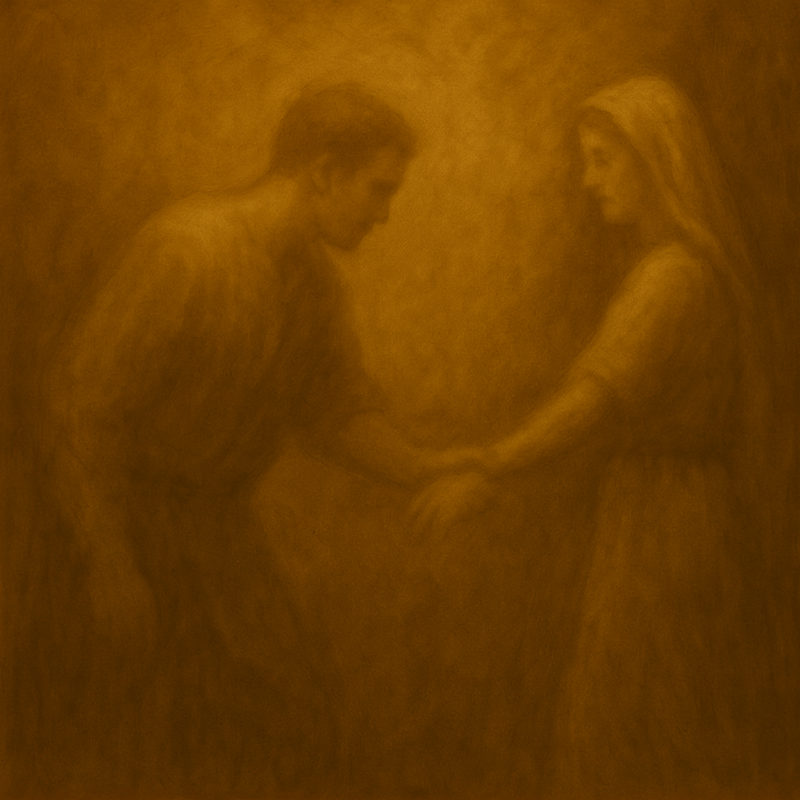
The air was still when Linora woke. Morning light crept through the shutters in narrow bands, soft and uncertain, not yet decided on its mood. The house below was quiet—no laughter from the servants, no clang of the forge—only silence, fragile and waiting.
Then came the sound—a hoof striking stone, then another. Slow, deliberate. Linora sat up, the unease that had followed her from sleep curling tighter inside. She moved to the window and peered through the lattice. In the courtyard, Gud stood beside a young colt, reins in hand, speaking with Nahala. The animal's hide glimmered pale against the dawn, its youth out of place among the old stones.
When Gud mounted, the realization struck her—not sudden, but low and dreadful, like the turning of a millstone that would not stop. He was leaving. And once he was gone, there would be no undoing what followed. Her chest tightened, ribs constricting around a hollow dread. She should have spoken, should have stopped him, should have done something before this ploy moved without her consideration.
She turned back to her chamber, to the bronze plate propped near the wall—polished smooth enough to hold her reflection, though it softened every line. She sat before it and began brushing her hair, each stroke an effort to calm the tremor in her thoughts. The face that looked back was both hers and not hers—a woman promised, uncertain, trapped between obedience and dread.
Outside, the hoofbeats faded toward the hills. And in their place, the estate began to stir—low voices in the courtyard, the clatter of pails from the well, the distant call of workers heading to the fields. From below came the faint clink of pottery and that familiar crackle of fire being coaxed to life in the forge. The world, it seemed, had already chosen to move forward—with or without her.
Linora settled her mind again and focused on the brushing, brushing, even strokes. The reflection wavered with each movement, the image itself resisting staying whole. She tried to quiet her thoughts with reason, whispering that love was not a spark to be fanned but a decision to be kept. A choice of faith, not feeling. But the words rang hollow, a prayer spoken to a void she wasn't sure was listening. Though outwardly calm, a knot tangled in her core—a heaviness that no brush could smooth away.
Through the window drifted new clatter of work—the ring of metal on stone, voices low in measured rhythm. Oren and Samuel were already outside, something about animal pens—their next project. Their voices rose and fell, steady as craftsmen's hammers, but something in the tone made her stomach twist—all that shared purpose, and still, not peace.
She went to the window, heat rippling faintly beyond the lattice. Not a leaf stirred in the courtyard; even the sound of the forge lay muffled beneath the weight of the day. The stillness pressed down, heavy and expectant, waiting for something to break.
Loshim was nowhere to be seen.
The thought carried both relief and unease—like missing a shadow that had followed too long.
She set down the brush, pressing her palms against the sill. The window let in the scent of dust and iron, the smell of work and order. Everything around her was alive with motion, yet she stood still, caught between paths—one that promised belonging and another that whispered freedom.
Linora then heard Oren's voice rise faintly, muffled by distance. A pause followed, then Samuel's reply—steady, decisive. "I'll go get it." His steps faded toward the outer wall.
The sound struck her like a small summons. She hesitated, smoothed her dress, then slipped on her sandals and floated down the stone steps. Outside, she spotted Samuel crouched beside a small pile of stones, his back to her, one hand shifting through the heap, searching for something precious and half-buried.
"Samuel," she called softly.
He didn't turn right away. "Be careful there—some of this rock still holds an edge," he said, his tone more instructional than affectionate. He plucked up a piece, held it to the light, frowned, and set it aside. "Useless."
"I thought I might help," Linora offered, stepping closer. "Or at least keep you company."
"Right," he cut in gently—kindly, though the edge was there. "You don't have to say what you think I want to hear."
Her smile faltered, genuinely confused. "I wasn't—"
He looked up then, his expression even, controlled. "You always soften your voice when you think I'm upset. It's sweet. But unnecessary." He brushed the dirt from his hands and reached for another rock. "If you came to speak about my brother again, don't. I've already forgiven him."
Had Linora's memory lapsed an entire conversation? Hoping for some grounding, she asked, "Forgive him for what?"
"That's funny. You're funny. I can appreciate what you're trying to do, but I don't need your pity." His attention stayed fixed on the stones, as though they were providing his words.
Her mind raced. How much did he know? Had Loshim spoken to him? What if I let something slip? She weighed different responses before saying, "Pity?"
He rose slowly, turning, the limp more pronounced in the uneven dirt. "You treat me like something delicate. You speak to him like he's made of steel. You don't even realize you do it."
Linora wasn't sure whether to feel relief or, well, pity. The thought hadn't occurred to her. She had been so focused on trying to be what Samuel needed. Was this crafted kindness actually a form of pity?
It was too much. She took a step to leave when—her hand was stuck. Samuel had taken hold—not rough, but with the steady finality of a man claiming what he believes is his. The fingers closed around her wrist lacked kindness, his thumb pressed just above her pulse.
For a heartbeat, neither moved.
"Don't," she said softly, pulling back.
He released her. The motion was small but sharp, leaving her skin tight where his grip had been.
"Oh, a little jumpy this morning, are we?" Samuel said with a chuckle.
It wasn't funny. It wasn't even a joke. It felt more like he was trying to hide something, something unrecognizable to her.
The forge's echo faded behind her as Linora crossed the courtyard. She needed distance—space to think—yet her pulse hammered in her temples. Her wrist still tingled where his thumb had pressed, a ghost of touch that refused to fade. She rubbed at it absently as she stepped into the care room, the familiar scent of herbs and ash giving her something solid to hold on to.
The place was quiet except for the faint buzz of flies near the open window and the rhythmic drip of water from a basin in need of a patch. Everything stood neatly in its place—folded linens, jars of balm, dried roots hanging from the rafters—all arranged by her own hand. It should have comforted her, but today the order mocked her.
She set about cleaning instruments that were already clean and resorting herbs. Anything to make her hands busy while her mind refused to still.
Had he truly meant it—pity? What does it mean to pity a man I'm supposed to respect?
It wasn't like Samuel to say such things, but then again, she'd never seen him like that. The laugh. The grip. That tone. Why must he turn everything into a joke?
Maybe she had changed him. Maybe she had pushed too far, trying to fix what wasn't hers to mend.
The sun climbed higher, pushing light through the small window until the shadows bent in the room. Linora's pulse finally slowed. She was binding a bundle of sage when footsteps sounded at the doorway.
Oren leaned in, one arm against the frame, his beard silvered with the day's dust. "So this is the place my son found his step," he said, looking around with quiet pride. "I'm still amazed at your talents."
Linora froze, the string tightening in her fingers. "Don't call him your son."
The room stopped. Oren blinked once, his brows knitting. "I know when I don't know. Please, share what's on your mind."
She turned toward him, arms folded across her waist to hold herself together. "How do you know he's the right pick? Did God tell you? Or did you just... decide it was right because it made sense to you?"
Oren exhaled slowly, taking a cautious step inside. "You're troubled," he said simply. "That much is clear."
She didn't answer, only watched the dust motes turn in the light.
He moved closer, the old floor creaking under his weight. "I've lived long enough to know that love rarely feels certain at the start. You learn the choice, and the feeling follows. Samuel is a good man. He—"
"A good man doesn't need to be reminded not to hold too tight," she said, her voice trembling though her eyes stayed fixed on the jars. "A good man doesn't laugh when nothing is funny," she said, nearly in tears.
Oren waited, the silence thickening between them. "Did something happen?"
Linora shook her head—too quickly. "Nothing worth mentioning. I know Samuel is a good man," she said, her tone softening.
"He's steady, loyal—everything a father could hope for in a daughter's husband. But my heart..." she hesitated, struggling to name it, "my heart is not with him. And it would be a cruelty to both of us to pretend it ever could be. Call off the betrothal. Please."
He was quiet again, she could feel his tender gaze, like weighing two halves of a broken stone. "You're asking me to undo a promise that binds not just you, but families—one I gave before witnesses. You think lightly of vows, Linora?"
Her throat tightened. "I think this promise feels like a chain."
That stopped him. His expression softened, the authority in his stance faltering into something more human. He stepped closer, lowering his voice. "I am torn," he admitted. "I love you, but I also love what's right—what keeps a name from shame. I will pray. Let me seek the Lord's answer before we act in haste."
She nodded, but the nod felt shallow—half relief, half defeat.
When Oren finally turned to leave, the doorframe caught his shadow for a moment, then disappeared down the hall.
Linora sank onto the low bench by the table, her hands trembling over the still bundle of sage. She had never spoken to Oren like that before. Shared conflicting feelings from her heart, challenged his wisdom, his honor—and though it changed nothing, the weight pressing her down had lifted; for now, at least.
The care room fell silent again, save for the slow drip from the leaky basin—steady, patient, like the waiting that would come next.
The afternoon drifted by in a haze of half-thoughts and restless hands. Linora stayed in the care room, her mind circling the same questions until they blurred together. The door creaked open, and Omri hurried in, clutching his arm. A crimson line glistened from wrist to elbow—a careless slip from grinding wheat, he explained.
Linora set to work without a word. She rinsed the wound, mixed a poultice, and bound it tight, her fingers moving with precision while her thoughts stayed far away. Omri thanked her, but Linora barely heard, already lost again in the conversation with her father—pray first, decide later.
By the time she looked up again, the light through the small window had turned amber, the shadows long and soft. The smell of baking bread drifted from the kitchen, and voices carried from the courtyard—evening meal approaching. She gathered her things, straightened the bench, and stepped outside.
Across the yard, Loshim stood by the well, filling a bucket with the slow, steady rhythm of someone trying to keep his hands occupied. Linora hesitated, then crossed the path toward him.
"Linora, I've been thinking more about the curse. What do you—," Loshim started.
"He said he forgave you," she cut him off, her voice low.
Loshim paused, glanced up. "Forgave me?"
"For whatever it was you two quarreled about," she said. "I wasn't told what that was."
He gave a dry laugh. "Then maybe I should confess, if I knew which sin to pick. This whole thing's getting too tangled for anyone's good."
She opened her mouth to reply—to ask what he meant—but before the words formed, a heavy step crunched behind her.
"Look at this! I find you two again, in the shadows. Secret talks," Samuel's voice forced what may have meant to be a laugh, but it sounded more like a cough.
"It's not what you think," Linora spoke quickly. Loshim turned and looked at her, his eyes narrow, asking, why bother?
Samuel cut through the dusk. "I'll accept that," he said, each word deliberate, "if the two of you can swear to me, right now, that nothing is going on between you."
The silence was a living thing. Linora turned to Loshim, he to her. She didn't know whether to speak or let him. Her throat tightened, words stuck somewhere too deep to reach. Loshim said nothing—only turned back to his brother, the bucket's rope twisting slowly in his grip.
Samuel roared, the sound raw and guttural. He lunged forward, his knuckles curling and driving hard into Loshim's jaw. The crack echoed against the courtyard walls.
Loshim stumbled, spat blood into the dust, then steadied himself. His arms held low, inviting another blow—which only enraged Samuel further. He struck again, wilder now—fists landing wherever they could, difficult to tell if fueled by heartbreak or hatred.
The two slammed into the low stone wall, scattering some debris from the top layer. The sound drew no one—the courtyard swallowed their fury whole. Blood streaked the dust between them, dark and wet where Loshim had spat. He caught Samuel's wrist mid-swing, held it tight between them. Samuel broke free with enough force that Loshim's heel caught a loose stone; he fell hard, dust rising around him.
For a heartbeat, Samuel loomed above, his chest heaving, face streaked with sweat and fury. Then Loshim kicked his brother's bad leg, and both went down together in a tangle of limbs.
"Stop it!" Linora cried, but her voice was swallowed by the chaos.
She took a step forward, then froze and looked down. Her foot was in blood, darkened, where it hit the ground. The sight hollowed her. Something inside her gave way—not fear, but despair too deep for sound.
Before either man could look her way, she turned and ran.
The courtyard blurred behind her, the evening meal forgotten, the only sound—a lump forming in her throat as the world narrowed to darkness and distance.
The forest closed around her—trunks rising like pillars, their crowns blotting the last of the sky. The ground was soft with moss and splintered bark, the scent of resin sharp enough to sting her lungs. She pushed through ferns and thickets, the folds of her dress snagging as though the trees themselves meant to hold her still.
When the land began to fall away, she followed the slope through a tangle of undergrowth. Her steps sought distance, not direction—the night itself leading her somewhere she already knew.
Moonlight flashed between the branches, catching on the broad scars of cut wood—the clearing, raw with stumps and drag marks. She moved along those paths, half-carved through the forest, her feet finding them by memory more than sight.
The wooden city rose ahead, dark against the paling sky. Its timbers caught the faint light, edges soft. Linora slowed as she neared the ramp, her mind focused from the run, sweat cooling on her back. She pressed both palms against the massive door and forced it open a small amount. The hinges gave a low groan that echoed into the emptiness.
Inside, the air was stale but still. She slipped through, pushed her back against the door, shutting it behind her, leaning against it—listening. Nothing. No wind, no footsteps. Only her own pulse in her ears.
Her breathing came rough, uneven. The silence comforted her, like being swallowed by something too big to judge her. Her heart still pounding, she waited until it slowed, then let her memory guide her through the dark.
The ramp to the upper chambers creaked beneath her steps. The wood smelled faintly of pitch and age. Her limbs were heavy, exhaustion weighing on her bones. She reached the guest quarters and felt along the frame until her fingers met fabric. The bed.
She sank onto it and lay back, her body slowly surrendering to fabric. Her limbs loosened, her mind still running even as her body gave out.
The silence deepened—not empty, but complete—and in that dark, Linora's breathing finally slowed to match the still rhythm of the wooden walls.
Sleep found her before she could pray.