Chapter 22 - Reconciliation
The curse that silenced the stables was no spirit nor judgment. It was inert gas asphyxiation—a death born not of wrath, but of air too still to give life. In that sealed space, breath itself became deceiving. The lungs drew in what seemed pure, yet it was dangerously low in oxygen (hypoxia). Life faded quietly, without struggle or sound, drifting into unconsciousness.
This is no forgotten danger of the past. Even now, men perish in chambers of their own design—silos, tunnels, ships beneath the sea—where the balance of air turns against them. The danger is not in poison, but in absence: a perfection so complete that life exhausts itself without knowing.
Such was the danger of the wooden city. Its builders sought permanence and achieved stillness; with the door closed for long periods of time, they sealed life out while preserving form. Yet among them, in mercy and curiosity, Linora found the truth and uncovered what many in ages hence would still rediscover—that air, like spirit, must move to remain alive.
The walk back to the estate bubbled into a near sprint. Linora floated light as a feather, her skin warmed by the sun, every breath crisp and new. The world roared louder than she remembered—birds calling, servants chatting, the soft creak of the gate in the wind. After the tomb-like stillness she had left behind, it was almost too alive. She blinked against the sunlight, laughing to herself at how colorful everything looked.
Voices carried from her destination. She recognized them before she saw the men—Samuel and Loshim, talking fast and loud beside the forge. A few servants pretended to be busy nearby, their eyes flicking curiously toward the commotion.
"There she is!" Samuel's voice rang out, full of relief. "We didn't know where you'd gone! You had us wondering half the night."
Linora's smile caught them off guard, like they had expected her solemn, not shining. Her step bounced with leftover joy, her tunic damp with morning dew. She opened her mouth to answer when Loshim stepped forward, his face lit with pride she hadn't seen in days.
"We've solved it," Samuel said.
For a moment, joy surged through Linora's core. She nearly clapped her hands. "You have? So have I!"
"Wait," Samuel lifted a hand, already smiling. "Let us go first. We want to show you our plan."
"All right," she said, eyes bright. "What's the plan?"
He glanced at Loshim, who gave the smallest sigh—the kind that meant he'd already lost this argument once. "We've agreed," Samuel went on, "that this situation—your situation—cannot go unresolved. So, we've made it fair."
Linora tilted her head, puzzled, trying to figure out what was fair about solving this curse.
"Three challenges," Samuel began, puffing with pride. "The first would be skill."
"Skill?" Linora echoed, curious but cautious.
"Yeah! But not running—obviously," he said, gesturing toward his leg.
"Or brute strength," Loshim added dryly.
"Right," Samuel continued, warming to the sound of his own system. "A test of skill that I come up with—and Loshim approves."
Loshim straightened a little. "Then I'll be in charge of the test of wisdom."
"Wisdom?" Linora repeated, blinking.
"Of course," Loshim said. "Wisdom's as important as anything else in a marriage."
"And I have to agree to that test," Samuel cut in.
"You will," Loshim said, crossing his arms. "And the third test—"
"Faith," Samuel finished proudly. "You come up with that one. You test our faith—this way, God decides through you." He spread his hands, magnanimous.
Loshim nodded solemnly, satisfied with the logic.
Linora stared between them, though still a little flattered, her earlier joy dissolving into disbelief. "Let me be sure I understand," she said, the words slow, like she was balancing on a thread. "Rather than fixing the curse, you've created a game. And the prize... is me?"
Samuel smiled, oblivious. "It's the fairest way. Three challenges, three virtues—"
She gave a short, incredulous laugh. "Virtues? You think peace comes from deciding which man I belong to?"
That stopped them both. Samuel's grin faltered; Loshim looked down at the ground.
"Linora," Samuel began carefully, "we only—"
She lifted a hand, still half-laughing at the absurdity. "No. You don't understand. You're still fighting over the wrong thing."
Both brothers exchanged baffled glances. They'd built something clever—why wasn't it working?
Loshim finally broke the silence. "So... what do we do?"
Linora laughed—not cruelly, but with genuine warmth. "Hmm. You listen," she said, her tone inviting, not scolding. "Stop competing for a moment, and observe."
That piqued their interest; both brothers leaned in, expectant.
She took a step past them, shaking her head with a smile. "You want to know the truth?" she said at last, her voice light but certain. "Then come and breathe it for yourself."
The brothers followed her, their steps matching her quick, confident stride along the dirt path. Daylight caught her hair as it spilled forward, glinting off the tarred seams of the wooden city ahead—black and gleaming like veins of glass.
At the threshold, Linora turned and said, "Before we go inside, I want you to try something."
They exchanged wary looks. "Breathe in," she instructed. "Deep as you can."
Samuel humored her first, drawing in deeply until his ribs showed through his tunic. Loshim followed.
"Hold it," Linora said. They stood there, lungs full, shoulders rising. "Now—exhale slowly. Do you feel dizzy? Light-headed?"
Loshim shook his head. "No."
"Good," she said simply. "Now remember that feeling."
"What are we—," Samuel began. But Linora shushed him before the sentence finished; both men remained silent.
She stepped inside and readied a lantern. The others followed and closed the door. They stepped softly against the wood. The sunlight thinned quickly; shadows grew on the other side, eyes adjusting to the change. She led them deep down the corridor, where the dark was strong. She kept going, maybe seventy-five paces, then stopped, and turned to them.
"Breathe the same way you did outside," Linora said.
They obeyed. "Hold it," she said gently. "Keep holding a little longer...now exhale slowly."
Samuel caught himself, like he was going to tip over, "Woh, that was weird."
Loshim did it a second time. "It doesn't fill like it ought," he said, voice low. "Like drawing through a wet cloth."
Samuel coughed once, shaking his head. "It's stale, that's all."
"No," Linora said. "It's more than that." She lifted her lantern, the light bending weakly against the walls. "The air here is perfect—but dead. The pitch sealed every seam so tightly that no wind can pass, no breath can renew. The flame flickers because it's starving, just like they did."
She gestured for them to follow as she led them back toward the door, instructing them to keep testing with large exhales. The flame slowly grew back in size. Linora slowed her steps and examined each stall. "When I came here last night, my muscles lost strength. I first thought it was fear. But it wasn't." She reached Yaruna's stall and stopped. "This is where she died."
Loshim looked uneasy. "You think this... air killed her?"
Linora nodded. "She wasn't cursed. She suffocated—peacefully—because she wasn't afraid. Her calm kept the meat sweet. The others panicked and ran deeper into the dark. They hadn't seen a demon, they were merely looking for an escape."
Loshim stared at the stall, thoughtful, eyes closed. "So, when we closed the door, before Shabbat..."
Linora took his hand, tenderness in her voice, resting her forehead on his, "We thought it was protection. We couldn't have known."
Samuel slipped in, taking both of Linora's hands away from his brother. "I didn't know either," He said softly. "How do we fix it?"
"Windows, obviously. It would bring in light and keep the space alive. That would do the trick," Linora spoke confidently. The brothers nodded, the answer was so simple. As elegant as the smooth structure looked, beauty was no excuse for the need for windows.
They walked toward the door, Samuel spoke up. "I'm ready to get out of here. Father's coming soon, so he decide where we start cutting holes. Speaking of," he paused for a few seconds, still walking, looking closely at both of them. "Where did we land on the tournament idea?"
Linora laughed first, causing the two brothers to laugh sheepishly in response as they reached the open door. "Maybe," she said with a grin, "we see which of you can catch me!" With that, she bolted down the ramp.
"That's definitely not fair," Samuel shouted after her as he limped at top speed. Loshim grabbed both his shoulders. "Better luck next time," then started into a full sprint, nearly tripping on the decline.
By the time evening settled, the courtyard had quieted again. The smell of cooked grain and roasted onion drifted through the open hall, and the family gathered slowly to eat. Linora washed and changed before joining them, still flushed from the day. She liked seeing the brothers squirm a little—the men who had charged ahead so confidently now treating her like royalty.
The house had new energy and excitement. The fire crackled, and the clink of bowls enhanced the lively conversation. Samuel, usually cracking jokes, kept his poise, exhibiting his best behavior. Linora loved it all. Nahala was the first to speak.
"The curse is ended," she said softly, setting her goblet aside. "Not by fear, but through prayer—and understanding."
Her words lingered. Loshim looked to Linora, meeting her eyes for only a second. "Thank you," he said simply.
Linora nodded, unsure how else to respond, and turned her gaze to Oren as he shifted.
He cleared his throat, folding his hands together on the table. "It seems," he began, "that the Lord has already blessed this house through wisdom greater than mine. And so," he paused, glancing between his daughter and Samuel, "we will wait on marriage. You, Linora, have already brought more life to this home than any union could."
The words broke Samuel's casual smile. He wouldn't look at Linora, almost embarrassed. She bowed her head slightly, humbled but inwardly tangled. Though she wanted this, it felt strange hearing it in Oren's voice. She looked at Samuel. Clearly, he had prepared himself for this, but it hurt all the same. "Thank you," she said, her voice low.
The meal continued with gentler sounds—spoons against bowls, the quiet sighs of full bellies, the soft flicker of lamplight warming the walls.
Before it fully ended, Linora rose. "If you'll excuse me," she said. "I'd like some time to pray."
Oren nodded. "You've earned your rest."
She smiled faintly and left the table, her feet light on the stone steps. Outside, the last glow of dusk stretched across the fields. Upon reaching her bed, she remembered how much softer this was than last night. While she wanted the Almighty to resolve her looming question, her prayers were no match for this level of soothing after the day she'd had.
Morning came in a blink. Linora stirred, half-startled, the rays already beaming wide across her bed. Warmth spread across her skin, curtains greeting her and scattering faint dust that shimmered like pollen in the light. She rubbed her eyes against the brightness, feeling the weight of sleep still clinging to her limbs. For a minute, she simply breathed—slow, resting, grateful—aware of being alive.
It was such a simple thing, this movement of air. Life, in its smallest form. Yet it filled her with wonder like discovering it for the first time.
Her thoughts wandered to Yaruna, to the lambs, to the brother that wanted her hand and the other her heart. It was strange, she thought, how easy it was to read the language of nature—wood, water, blood, and flame—yet how impossible it was to read her own desires. She understood a wound needs loose bandaging, how a flame needed new air. But what of her own need? Where could she find relief?
She sighed, closing her eyes, feeling the faint comfort of the day settle around her.
Understanding the world was one thing. Understanding herself—that was the harder craft.
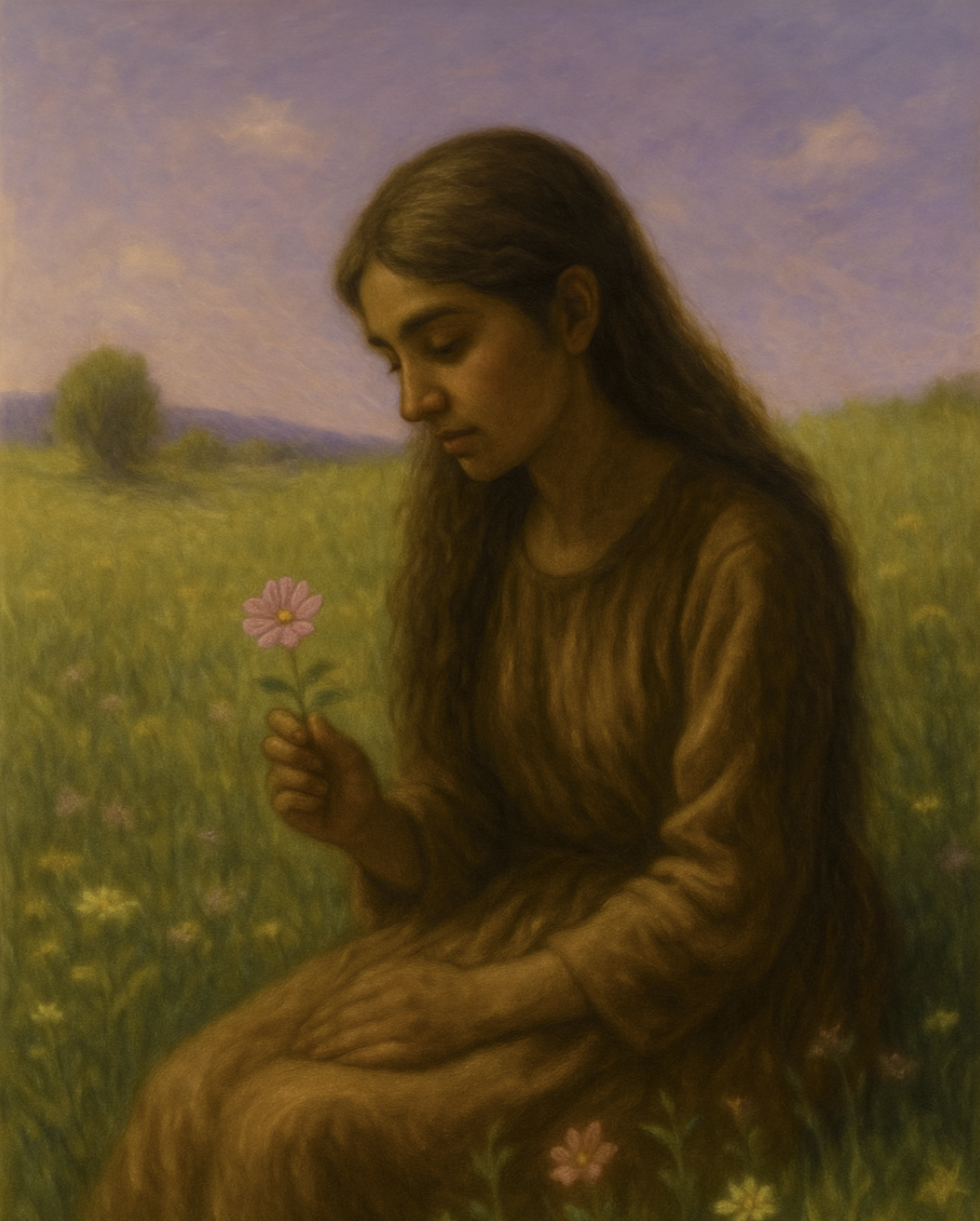
She rose quietly, slipping from her room, down and out the door. The flowers in the garden had begun to open early, pale blossoms cupping upward. She knelt near one, brushing its petals with her fingers like it was soft fur.
Her heart leaned toward Loshim—she could feel it as surely as a bird knows when it's time to fly—but the weight of it frightened her. What if I fall? To love him meant surrendering to something she could neither measure nor mend.
Footsteps approached behind her, soft but sure.
"The beauty awakes at last," Nahala's voice came gently.
Linora didn't look up. "It was bound to happen eventually," she said with a chuckle. The sunlight danced across the pedals, painting the garden in soft golds and greens.
Nahala stepped beside her, folding her hands before her as she studied the blooms. "You look," she said quietly, "as though your heart is full and heavy. Are you still thinking of betrothal?"
Linora's smile faltered into something thinner, more tired. "Maybe I am. I begged Oren to call it off." She hesitated, the words heavy on her tongue. "I was sure he wouldn't change his mind. I had started to accept it—that I'd be a bride soon."
She paused again, brow furrowed, searching for sense in herself, "I don't get it. It's like I always want the other choice before me. How can I live a life that way?"
Nahala reached down, resting a steady hand on her shoulder. "You are learning," she said softly, "that wisdom is not about knowing the answer, but about weighing the costs."
Linora looked up, catching her eyes. "Once again, no help from you," she teased, and they both laughed—a short, familiar sound that tasted like honey.
Nahala's expression softened. "We owe you a great debt," she said. "And if your desire is to join this family, we will give what we have. But know this—it may cost you everything. Marriage requires full surrender."
Linora nodded slowly, the truth of it settling deep within her. She understood what Nahala meant. To love meant leaving what was known. To start a family meant walking wherever they walked, even into the unknown.
"I think I am ready," she said at last. "I'm not afraid of sacrifice."
Tears welled in Nahala's eyes, glimmering in the sun. She swallowed softly through them. "Oh, child," she whispered, as she pulled Linora close, "if you only knew..."
In her voice, Linora heard more than comfort—a sorrow shaped by years of love's weight, carried and never set down.
They embraced—long, wordless, whole. The scent of soil and new blooms enveloped them. Linora hadn't expected to cry, but the tears came easily, loosening something inside her. She thought of what she had already given up—of Keziah's smile, of the hurried escape from her life in the city, of the good-bye she never said. The sorrow wasn't sharp anymore, though it still found her without warning. Yet she no longer mistook its return for failure; she understood now that ache itself was part of healing.
Her voice trembled when she spoke again. "Would Loshim have me?" she whispered into Nahala's shoulder. "After all of this mess?"
Nahala drew back just enough to meet her eyes. The tears on her cheeks had already begun to dry. "I can assure you," she said with quiet conviction, "nothing would bring more joy to this family."
They stayed like that, mother and daughter not by blood but by grace, their arms linked in subtle understanding. The garden moved gently around them—flowers trembling under the touch of the mild wind, shadows softening along the stones. Above, the sun lifted higher, igniting the blossoms like incense. Neither spoke, they didn't need to. The warmth settled around them like a blessing, sorrow released with each moment, each heartbeat a promise of beginning.