Chapter 23 - Journey
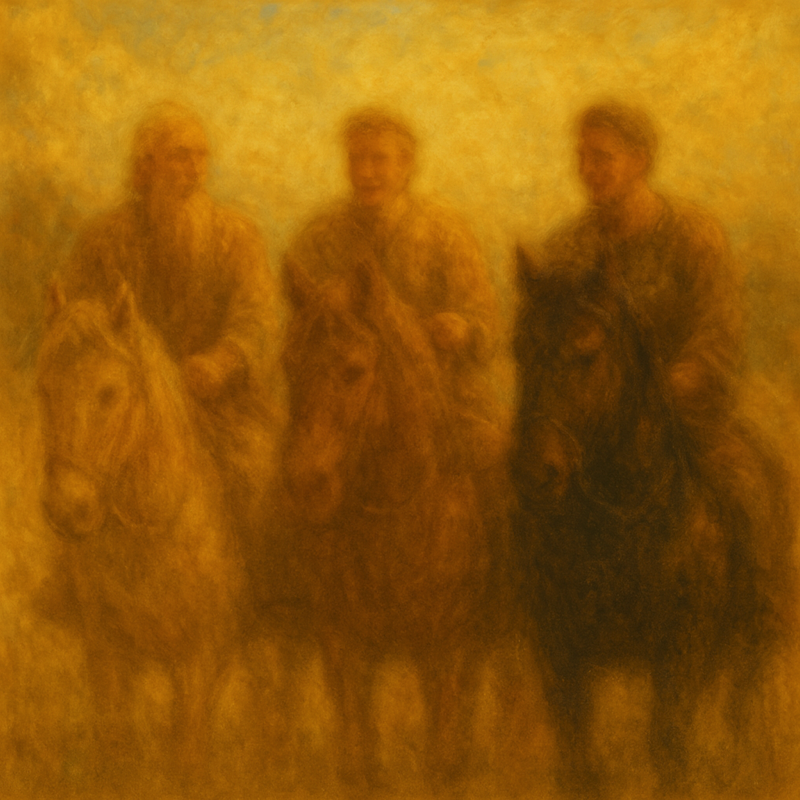
History does not remember Gud, a man of constancy. He was no prophet, no warrior, but the kind of servant upon whom great houses rise—steadfast, deliberate, loyal to the bone. Where others sought recognition, Gud sought completion. To him, obedience was not submission, but trust in the order of things.
The dawn mist clung to the courtyard stones where he found Nahala waiting. The first birdcalls broke the silence, answered by the low snort of a tethered colt. Gud bowed slightly, as Nahala looked north, her shawl drawn close against the morning chill.
"He's building a great storehouse in Nippur," Nahala said. "You'll find it near Ekur—the temple that still draws half the city to its shadow." Gud nodded, already mapping the distance in his head.
A servant appeared with a satchel—dried dates, barley bread, a flask of clear water. Nahala took the bag and handed it to Gud herself. "Go," she said, resting a hand on his arm, "and may the Almighty make straight your path."
Gud bowed again, this time lower, and turned to his colt—a lean, eager creature with more heart than experience. The saddle creaked as he fastened it, checked the waterskin twice, then led the animal to the open gate. The first light crested over the fields, painting the dewy grass in gold.
He mounted, looking once back at the estate—still quiet, still sleeping—then urged Kedar forward at a patient pace. The hooves struck softly against the damp earth. In the distance, the horizon brightened, and with it came the slow rhythm of faith in motion—one measured heartbeat, one steady step, carrying obedience toward whatever waited beyond the hills.
The road eastward unfurled in silence. Gud rode slow, letting Kedar find his rhythm—not the bounding eagerness of youth, but the long patience of distance. The colt's hooves beat a steady pulse in the dirt, each stride matched by the low creak of leather and the rhythmic sway of the saddle. The morning was cool, but already the sun promised heat.
Every few miles, Gud dismounted and walked beside him, giving the animal's back a rest. They stopped at a trickle of stream where reeds grew thick, letting Kedar drink. Gud filled his own flask, poured some over the colt's neck, and rubbed the dust from its coat. The place was kind—bright, open, full of birdsong. He savored it. By foot, it takes nearly five hours to reach the plains before Drevibad; by horse, with care and stops for watering, the distance passed in only three.
Nearing midday, the environment began to change. A gray smear thickened on the horizon, spreading like a bruise. Gud slowed the colt to a walk. The smell reached him first—faint, metallic, and wrong. Ash. Smoke rose beyond the ridges to the east, where Drevibad stood. The wind carried a low hum, the sound of something vast and spent. This was worse than what he saw only the week before.
Gud kept to the low ground, skirting the high road. The terrain grew rough, forcing him to lead Kedar by the reins. Once, he looked back—the smoke curled like a pillar, reminding him of old stories marking the wrath from heaven. He didn't know if more judgment had fallen, only that he didn't want to find out.
Quietly, he prayed—the way shepherds do, trusting God would answer through the rhythm of hoof and step. "Keep us steady, Lord. Keep our hearts strong." Kedar flicked a listening ear, and Gud smiled faintly. "That's right, boy. One step at a time."
The path ahead narrowed between low hills, and the wind shifted, pushing the smoke behind them. The acrid smell faded, replaced by the scent of wild thyme and dust. "That's better," he murmured. "We'll stop soon."
He patted Kedar's neck, the dark mane glinting under the sun, and led him onward, north—toward Nippur.
By noon the sun had grown merciless. Gud found shade beside a low stream that wound through the scrub like a line of glass. He slid from Kedar's back, leading the colt to drink. As the horse bent to the water, something shifted in the reeds—not the quick rustle of an animal, but the labored movement of a man.
Gud froze, instinctively putting one hand on his dagger. Then, cautiously, he stepped closer.
The man lay half in the mud, half in the trickle, his face blistered by sun and streaked with dirt. His lips moved, but no sound came until Gud knelt beside him.
"Bread," the man rasped.
Gud tore a piece from the barley loaf in his satchel and held it out, then lifted the flask for him to drink. The man took both with shaking hands, devouring like one who had forgotten the rhythm of swallowing.
After a while of looking like he was concentrating on his own digestion, the beggar spoke again—clearer now, though his eyes never quite met Gud's. "You're coming from the south."
Gud nodded.
"Then you've seen it."
"The smoke," Gud said.
The man gave a hollow laugh that broke into a cough. "Drevibad burns itself. Drev knows how to conquer, not how to rule. The walls will eat them in the end." He leaned back, his chest heaving. "Next will be Nippur. Mark me—the fire spreads north."
Gud frowned. "How do you know that?"
The man's gaze turned distant, haunted. "Because I've seen this before. Some men destroy everything they touch."
Silence settled again, heavy as heat. A dragonfly skimmed the surface of the stream, and the man's eyes followed it, already losing focus.
Gud rose, tightening Kedar's reins then mounted and turned back to the road. The wind shifted again, carrying the smell of smoke northward. He urged the horse into a slow trot. "Not us," he murmured. "Not this time."
By dusk, the road bent west toward the ruins of Adab. What once had been a sizable town was now little more than broken outlines and half-buried stones. The wells were long dry. Still, a few families lingered near the old structures, their tents pitched where the canals had once flowed. Gud offered a few barley from his pouch—the cost of sleeping close enough to hear voices through the dark.
He tethered Kedar near a patch of thorngrass, rubbing the colt's legs and murmuring softly as he worked. The animal nickered, lowering its head into his palm. Gud waited until the tension left the colt's neck before offering oats, then giving the last of his water, letting the colt drink in slow, shallow gulps. When the stars rose, he brushed the dust from its coat with a handful of dry reeds, the strokes steady and sure. "You've done well, boy. We'll be there tomorrow." Kedar flicked his tail, weary but trusting.
When night came, Gud built a small fire from brittle kindling and driftwood. The flames bent low in the evening wind, steady but uncertain. He warmed a piece of bread over the embers, broke it, and ate slowly, savoring the warmth more than the taste. Around him, the ruins of Adab whispered with wind—the faint sigh of a village taken by drought, not war.
Before lying down, he prayed—not loudly, but like a man talking to a friend. "Let the road hold. Let us finish what we've begun."
No answer came, save the wind moving through the empty paths, soft as a hand brushing over sleep.
The eastern horizon broke pale and thin, a quiet shimmer beyond the ruins. Gud stirred before the first rooster call, his bones stiff from sleeping on packed soil. The embers of his small fire still glowed faint red, enough to warm his hands. He stood, brushed the dust from his cloak, and whistled softly for Kedar. The colt came, tail flicking, eyes bright with sleep. Gud fed him the last of the oats and affixed the saddle, murmuring as he worked. "Almost there, boy. Just one more stretch."
They rode north as the sky blushed with sunrise. The road curved through low growth, the earth damp beneath the hooves. When the sound of water reached them, Gud slowed the pace, leading Kedar to a shallow stream. He let the colt drink and refilled his own flask, kneeling to scoop a handful for his face. The chill woke him fully. A heron lifted nearby, wings cutting silver in the light.
By midday, the flat plain ahead began to rise—a cluster of walls, ziggurat towers, and smoke curling like banners above the roofs. Nippur.
The southern gate loomed ahead, its mudbrick arch etched with faded inscriptions. Two guards stood in the shade, spears crossed, eyeing the dusty rider. Gud greeted them with a nod.
"I seek the Ekur—temple of Enlil," he said.
The older guard pointed with his spear toward the city's heart, where a massive ziggurat rose above all else. "There. You can't miss it."
Gud led Kedar through the gate, swallowed by the hum of a living city—stonecutters shouting for rope, traders arguing over grain measures, a woman carrying a basket of new pottery to the kiln. The air smelled of dust, sweat, and wet clay. Near the Ekur, scaffolds stretched like exposed ribs across a nearly-finished structure of stone and timber. The walls gleamed pale beneath the sun, smoother and heavier than any Gud had seen. A great storehouse—its foundation deep enough to outlast dynasties.
He dismounted and found a workman—asked who oversaw the project. The man, his arms powdered white with lime dust, pointed to a tent at the edge of the site.
Inside, the tent was cool and smelled of clay. A tall figure stood over a wide table, a reed stylus in hand, tracing lines on a half-dried tablet. The man's beard was streaked with silver, his robe plain but spotless. He did not notice Gud at first, focused on the measure before him—not of walls, but of order itself.
Then, sensing before hearing him, the man looked up. His eyes were clear as still water, calm yet searching, and when he met Gud's gaze, the tension in his shoulders eased into a smile.
"Master Noah," Gud said, his voice breaking with both reverence and relief. "I bring good news."
Noah's stylus fell softly to the table. He crossed the tent in three strides and gripped Gud by the shoulders. "I knew from your face," he said, drawing him into a firm embrace. "If you've come all this way, it must be so."
He stepped back, studying Gud as one might study a son long unseen. "You've grown thinner," he said. "The road was not kind, I see."
Gud laughed lightly. "Nor was the sun, Master. But the message carried me faster than any horse could."
Noah's eyes gleamed with quiet anticipation. "Then speak," he said, voice warm but commanding. "What news do you have for me, son?"
Gud straightened, smiling now despite the dust and weariness of travel. "It's joy that brings me—not warning. Samuel is to be wed."
Noah's face softened. His shoulders dropped, as if a burden he hadn't known he carried had just lifted. "Ah... the young lion finally lays down his hammer," he said. "And the girl—she's worthy?"
"Beyond so," Gud said. "Her name is Linora. Nahala says she carries both grace and wit enough to steady him."
At this, Noah chuckled—a low, honest sound, ending in a slight cough. "Then the Almighty still writes poetry among men." His smile deepened, touched by affection and gravity alike.
"Then we will go. Not today—but soon. The work here can spare me a fortnight, and the men know their charge." He carefully covered the tablet so the clay would not dry uneven.
"Rest here tonight," Noah said. "Eat, wash, and let your colt recover. The timing works well since Japheth is between trips. He is within the city, likely trading supplies for his next voyage."
Noah stepped out from under the tent, his height casting long lines across the ground. As he drew a deep breath, it came unevenly—a faint rasp in the exhale that caught Gud's ear. Noah brushed at his chest, swatting dust, but the motion lingered a little too long to be casual.
"At dawn," Noah continued, voice steady again, "we prepare for the road. Weddings and journeys both deserve readiness."
Gud bowed slightly, though his eyes held concern. "Of course, Master Noah." Then, after a pause, with a hint of warmth, "Linora will be glad to meet you. She has a healer's mind—and she doesn't miss much."
That earned a small laugh from Noah, rough but genuine. "Is that so?" he said, turning toward the horizon. "Perhaps she'll help clear this dust from my lungs."
His tone softened, the weariness behind it fading into affection. "And I will be glad to see Nahala again. It has been too long."
The next morning, by the time the sun reached its edge on the horizon, they were already riding—three figures on the southbound road, their shadows stretching long before them. The morning was clean, bright with early dust. Noah rode steady, his posture upright but deliberate, guiding his mount in rhythm that was itself prayer. Japheth kept a small pace ahead, the ocean still in his movements—his gaze always measuring the distance like a tide to read, the road rising and falling in long, gentle waves.
Gud kept close to Noah's side, matching the elder's pace with quiet attention. The sound of hooves and wind filled the spaces between their words, but Gud did not stay silent long. He began recounting the strange days behind him—the curse that was claiming livestock.
As they went, he spoke of how Samuel had nearly been lost but was slowly mending under Linora's care. Noah listened without interruption, his eyes distant yet alert, the slow nods of a man who carried both sorrow and pride for what the younger generation was becoming.
"Linora," Gud said, smiling faintly, "she sees more than most men think to look for. Nahala says she's given the estate new life." Noah's face brightened with satisfaction.
While stopping at a stream, Gud shared his troubling encounter. "I met a man on the road south of Adab," he said, almost to the water itself. "He warned that Drevibad won't stop with its own ruin. He said they'll march north before long—maybe even Nippur."
Noah's jaw tightened slightly. "Men who rule through fear must always find someone new to fear them," he said. "If pride can't build, it devours."
Japheth gave a low hum of agreement from where he crouched, testing the girth strap on his packhorse. "Yes," he said, "if Drevibad attacks again, Nippur would be a tempting mark. Too much wealth. Too much stone. No king to guard it."
Noah's gaze followed the southern hills, where the land began to climb. "Then we will keep watch," he said simply. "And keep faith."
They mounted again and pressed forward until the sun slipped low. The light softened to amber, the world thinning to silhouettes of grass and wind. When the first stars appeared, they led their mounts from the main road—a hundred paces out—and made camp in a hollow sheltered from the breeze. The fire was small, the talk grand. Japheth shares stories from distant lands.
The flames died and Noah's cough returned briefly as he settled against his pack, but he waved away concern with a hand. "The dust again," he murmured. "Nothing more."
Gud lay awake a while longer, watching the thin smoke drift upward into the night. It rose straight at first, then bent, finding the wind that would carry it away.
Dawn came cool and pale. The men woke with first light, brushing sleep from their eyes while dew gathered on the leather tack. Noah moved slower than the others, but his hand was sure as he checked each strap himself. Kedar stamped at the ground, eager, and Gud smiled at the colt's restlessness. By sunrise they were mounted again, the road before them bright with promise.
The journey home passed quietly. They kept to the lower ridges, giving Drevibad a wide clearance. Smoke still smudged the horizon there—not thick, but enough to remind them of what had fallen. No one spoke as they went around the ruins. Even Japheth, whose stories usually filled the silence, held his tongue. They made good distance, stopping only to water the horses and rest their backs, the light turning golden as the second evening neared.
By the time they reached the estate, night was settling. The courtyard lamps burned low, their glow soft and inviting. Servants hurried to the gate when they saw the travelers approach. Those familiar broad steps near the double doorway, framed in pale stone, is where Nahala and Linora stood waiting, their garments catching the lamplight like banners of welcome.
Gud dismounted first, bowing deeply. Nahala rushed forward, her face bright with disbelief and joy. Noah swung down slowly, favoring one side, and greeted her with a hug and weary laugh that ended in a cough. He waved off concern as usual. "Only the dust," he said, though Linora's eyes lingered on him a moment longer than courtesy required.
Japheth arrived behind, taller than both, his sea-worn calm carrying the bearing of a man who'd seen far horizons. His gaze found Linora, steady but not forward—seeing not her face, but the quiet strength behind it. Something in him stirred, recognition that she would change his brother's path. Samuel and Loshim ran up and took turns testing their strength on Japheth's stature, clearly pleased with the surprise visit.
Oren entered last, drawn by the commotion. When he saw Noah, his steps slowed, reverence overtaking surprise. They clasped arms wordlessly—two men who had prayed for the same wisdom and lived long enough to see it take form.
The evening feast ended in prayer. Noah's voice carried over them all, low and strong: gratitude for the road and the mercy that brought them home. His words rose with the firelight, until the lamps burned low and silence fell again.
The house was at peace, and Gud sighed with relief, having completed his task with excellence.