Chapter 25 - Celebration
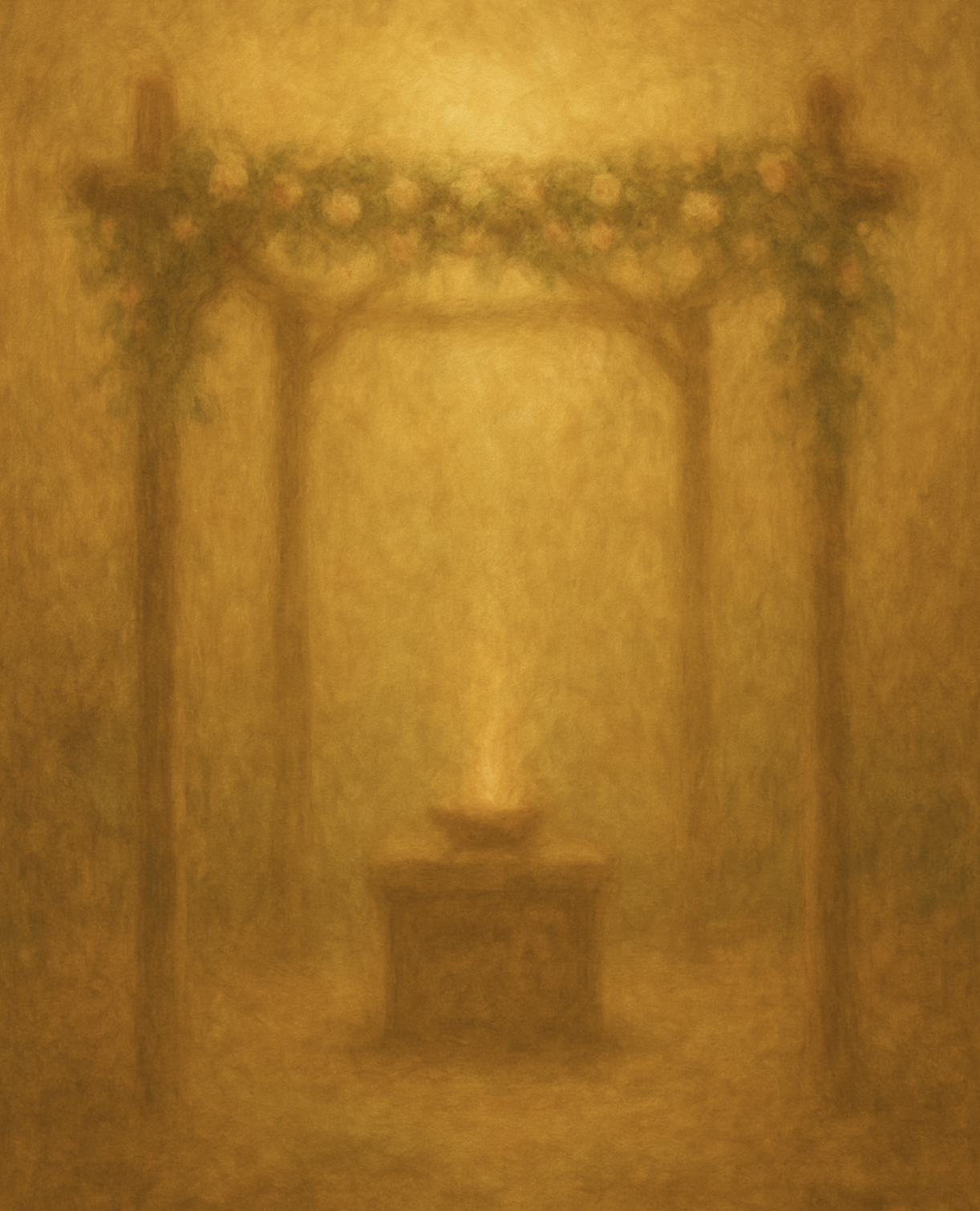
Since the days of Adam, men have known to leave father and mother and be united to a wife. Marriage, first spoken by God in the garden, was counted as covenant—not the binding of bodies, but the joining of destinies. To speak a vow beneath the open sky was to summon heaven as witness and to seal the union of two souls into one accord.
Among the righteous, such sacraments were not marked by gold or splendor, but by gratitude. They brought living offerings to the altar—not for atonement, but in remembrance that all life is borrowed, and that love itself is a gift returned.
The morning broke clear and cool over Nahala's estate. Dew clung to the olive leaves like scattered glass, and the air smelled of earth newly stirred. The household was alive with movement—laughter, footsteps, the scrape of wooden chairs pulled into the courtyard.
Birds called to Linora's ears, her heart steady, her shoulders loose. The house felt different—opening its eyes again after a long asleep. The walls were lighter, the morning quieter, the rhythm of life restored. She brushed her hair slowly, each motion deliberate, grateful. The woman gazing back from the bronze plate looked joyful, confident, reverent—a woman Linora longed to become.
From her window she saw Nahala in the courtyard, overseeing the servants with quiet command. They were sweeping the flagstones, hanging fresh garlands, and draping linen between the pillars. Tirzah sat on the bed with Asa while Lirit moved like a dove through Linora's chamber—adjusting seams, brushing fabric, fixing curtains. They said Omri was already helping Loshim with his robe, commenting about how handsome he would look.
Beyond the bustle, Noah walked the outer grounds, hands folded behind his back. His cough subdued after his morning treatment. Each step was slow, prayerful.
Linora was here for all of it and felt the day unfold like a blessing spoken aloud. This union was more than promise; it was restoration. Breath joined to endurance, mercy to faith.
"Are you ready?" Lirit asked, the words half-whisper, half-smile.
Linora turned from the bronze plate, still holding the brush in her hand. "Almost."
"Then you'll want this." Lirit beckoned her stand beside the bed and draped the wedding garment over the sheet—a linen robe finer than any Linora had ever worn. Its weave was tight but soft, glimmering faintly in the sun that spilled through the window. Along the waist, a narrow cord of woven gold and white thread served as a drawstring, looped through small bronze rings so that it gathered neatly when pulled.
At the collar, a small clasp of burnished copper caught the light—Oren's handiwork. The metal was etched with the shape of his flame sigil, a mark of both blessing and protection.
"It's beautiful," Linora whispered, fingertips tracing the cord's pattern and the copper clasp.
Tirzah leaned in. "It's more than beautiful," she said gently. "It's meant to last—like a promise."
Together, they eased the garment over Linora's shoulders. The linen whispered as it settled, the gold cord tightening with a careful pull that cinched her into the moment itself. Lirit stepped back and smiled. "Now," she said, voice warm with affection, "you look like the woman Samuel has been waiting to meet."
Tirzah's head snapped up, her expression half-scandalized. With a soft gasp, she flicked Lirit lightly on the shoulder.
Lirit stammered, cheeks flushing. "Loshim. I meant Loshim."
Linora couldn't help it—a laugh escaped her, bright and genuine. "It's all right," she said warmly. "I'll take it as a compliment to them both."
The room softened again, laughter replacing the brief embarrassment. The tension of the day dissolved into something easy, human, and light.
Tirzah shifted Asa in her arms, the child's fingers curling sleepily around the braid at her shoulder. "Shall we?" she asked softly.
Linora smiled, but a little puzzled. "Are you coming to the courtyard?"
But Tirzah shook her head. "Not today. The air is cooler outside than it looks. I'll watch from here." She nodded toward the wide window, where sunlight was spilling across the sill. "I can see almost all of it."
She eased back onto Linora's bed, propping herself with pillows, Asa nestled warm against her side. From this high place, she could look directly down into the courtyard below.
"Go," Tirzah said, reaching for Linora's hand, her voice full and steady. "Let me see you become the bride you were meant to be."
Lirit gathered the train of Linora's robe while steadying her at the elbow. Together they descended the wide steps, sunlight catching on the gold thread of the gown. The scent of crushed myrtle drifted from the garlands above, mingling with the sweetness of baking bread from the kitchen below. The newly polished stone glistened beneath their feet as they approached the door. Every corner of the courtyard was awake—the murmur of guests, the hum of wind, the soft creak of the canopy poles swaying slightly in the breeze.
Linora's heart beat in rhythm with her steps. When they reached the lower terrace, she paused, taking it all in. Oren stood at one side of the gathering, his forge-worn hands folded before him, pride softening his usual reserve. Beside him, Samuel sat with his cane across his lap, head bowed. On the other side, Nahala and Japheth stood together, sunlight tracing their shoulders in gold. Even the servants held their places like honored guests; no one wanted to disturb the peace that had settled over the day.
Under a canopy woven from blooming garden branches, Noah waited. The flowers—almond, hyssop, and violet—bowed faintly in the wind. His robe was simple linen, his hands spread before him. When he raised his eyes, the courtyard hushed.
Then Loshim stepped forward. His wedding robe was of deep blue linen, belted with the same gold-threaded cord that bound Linora's gown. Around his wrist he wore a thin bronze band—not ornament but emblem. The breeze caught the edge of his garment, and for a moment he became part of the sky itself.
He turned to face the gathering and spoke clearly, his voice steady but rich with meaning.
"From my youth," he said, "I have been called 'Lo-shim', 'no-name'—the boy without a name. But today, before my bride and before my God, I take the name my father kept for me: Shem."
A ripple moved through the crowd—surprise, then approval, then a quiet stillness. Noah's expression did not change, but light gathered in his eyes. "I never liked the name Loshim," he said, as others chuckled. "Let Shem truly be renowned in heaven and on earth."
Guided by Noah's outstretched arm, the assembly turned to face Linora. She began her slow walk toward the altar of unfired clay, the pluck of a lyre rising softly in the background. Each step carried her deeper into the moment—everything alive with light and scent. As she passed, she met the eyes of each loved one in turn, storing them like keepsakes in her heart. When her gaze reached the empty chair beside Oren, a single tear slipped free, shining as it fell.
Linora joined Shem beneath the canopy. Noah took a narrow strip of white linen and wound it gently and loosely around their joined hands, speaking as he worked.
"The Almighty who gives breath to all things..." His voice lowered as he reached the final turn, the tail end resting between his fingers. For a moment, he held still—the linen taut, the silence deepening around him.
Then, as he drew the strip free, he said, "Breathe into this union."
The fabric unwound softly, slipping from their hands like breath released. Nahala held her hands to her chest, eyes glistening. Oren's lips moved in silent prayer. The incense bowls smoldered at the corners, threads of smoke climbing toward the open sky.
Noah lifted his hand. "Now speak your vows before God and these witnesses." Then, turning to the bridegroom first. "Shem, say your piece."
Shem met Linora's gaze. His voice was steady but low, meant for her more than the guests.
"This day, and every day, I will honor you, Linora. Before God and before men, I will guard your peace as my own. May my labor bring you rest, and my patience give you strength."
Noah turned to the bride. "And you, Linora?"
She paused, her eyes bright with unshed tears.
"This day, and every day, I will honor you, Shem. Before God and before men, I will walk beside you in all seasons. May your name be found worthy through my life, and your home through my heart."
Noah nodded once, the faintest smile beneath his beard, and spoke low so only the two of them could hear, "Beautiful."
He turned to the small wicker cage on a table near the altar. Inside, a dozen sparrows fluttered gently, their feathers rustling like whispers of wind. "As life is given, so must life be honored," Noah said. "Choose now, each of you, one without blemish."
Shem reached first, his hand steady as he caught a bird with mottled gray wings. Linora followed, choosing a smaller one, soft brown with a white crest. Together they raised their sparrows toward the light.
"Give thanks," Noah instructed.
They did—each whispering words only heaven would hear. Then they stepped forward. Noah brandished a polished dagger and received Shem's sparrow with solemn hands. Swift was his motion, merciful in its purpose. The offering was clean, without struggle. After repeating the act with Linora's sparrow, both birds were laid upon the small altar.
Omri approached, reverent, a torch held firmly in his grasp. The couple received it together, their hands brushing as they leaned toward the altar. With one motion, they touched flame to the edge. Fire leapt—not wild, but sure—consuming in its hunger. Smoke rose, white at first, then gold, curling skyward until it vanished into the heights above.
Silence held the moment.
Then Noah spoke again.
"As these lives return to their Maker, so may your own lives return to one another. Through the offering of sacrifice and vows, joined not by chain, but by will; not by custom, but by covenant."
He raised his hand over them, the firelight flickering across his face. "You are one."
Joyous applause broke in unison. Servants threw handfuls of petals into the air, their colors spinning in the sunlight.
From the side, Nahala removed the top from the wicker cage. The remaining sparrows burst out in a rush of wings, scattering skyward—a shimmer of light and motion. Linora looked up, smiling as they wheeled and vanished into the violet heavens.
The courtyard filled with laughter and music, the sound of flutes and strings rising toward the heavens. The sun stood high, blessing them both.
Noah put one hand on Linora's shoulder, his other on Shem's. Looking at both he said, "This union is of the God of Adam. Through the two of you, a line of blessing will endure."
As the afternoon waned and the fire on the altar had long since burned to ash, the courtyard's hum softened into the steady pattern of celebration. Golden light stretched over the estate; laughter drifted from every corner. Servants carried baskets of fruit and roasted grain toward the great hall, where wine gleamed in earthen cups.
Linora was not used to all the attention, but appreciated it all the same. The table was filled with bread, oil, fruit, and sweet herbs. Lyre, flute, and frame drum weaving together over the laughter that rose and fell like waves, the hall alive with warmth. Noah sat at the head, his cough quieted, his spirit bright, surrounded by his sons and new daughter, voices blending in gratitude. The day had stretched long, yet no one wanted it to end.
Hours passed in cheer and song that bound memory into music. Cups emptied and refilled, the sounds of happiness echoing off the walls. It was then, as the sun slanted low and the wine had softened the edge of restraint, that Samuel rose to his feet, swaying slightly, cup in hand.
"To my brother—or should I say, to my better?" he called, his words cutting through the chatter. The crowd stilled slightly, smiles pausing mid-motion. "The one who stole my bride and my peace in a single stroke. But I see now..." He lifted his cup toward Shem and Linora. "God must have had a hand in it."
Awkward laughter stirred at the edges of the room. Samuel's grin widened. "They say my name means 'God heard me.' But tell me—did He?" He thumped his chest. "Not once! Not when I prayed for victory, or for love, or for legs that didn't limp. So no—no more 'God heard.' From now on, if my brother can take his true name, then so will I."
He raised his cup high, wine sloshing near the rim. "Call me Ham! Because if nothing else, there's still fire in me!"
Laughter rose—genuine this time, though not without unease. Even Noah smiled faintly, his gaze steady on the son before him.
Ham called out again. "Fire can forge, or it can consume." He lowered his voice just enough for the table to hush again, looked directly at his father and said, "We'll see which your son chooses."
The stillness that followed was sharp, almost brittle. Then Japheth rose quickly, setting down Ham's cup. His tone was calm, patient. "Come, brother," he said, resting a hand on Ham's shoulder. "The wine has spoken enough for one night."
Ham's defiance flickered, then eased. With a rough laugh, he let himself be led away, the sound of his steps echoing down the hall. The tension ebbed from the room like a slow tide.
Oren stood, his eyes bright with both pride and caution. He raised his hand. "Blessed be this house," he said simply, his voice steady. "Bless the father who built it, and the sons who will keep it. May peace be its portion."
A murmur of agreement swept through the hall. Cups lifted again, music resumed—slower, softer—the tone of a family bringing its pup to heel.
As the feast waned, dusk crept in, and the house began to quiet. Servants moved through the halls snuffing the smaller lamps, leaving only the gentler light of candles and stars. The laughter that had once filled the halls faded into murmured blessings and the rustle of garments being folded away for Shabbat.
Linora and Shem slipped from the hall unnoticed, their hands finding each other naturally. The air outside was soft and clear—the temperature inviting. The scent of grain and cedar lingered faintly in the breeze.
The moon hung low as they crossed the pasture in joyful silence, each step light with wonder. Weaving through the forest, they reached the clearing, light painting silver across the wooden beams of the city beyond. Their pace grew, hands held tight, and ascended the long ramp toward the large main door, which was already open. A suspiciously placed small lantern sat just outside, already lit.
Using the small lantern, Shem led Linora inside, showing her the slanted block of wood he placed to keep the door propped open wide. She smiled and nodded with recognition, and they strolled up toward the living chambers.
At the threshold of the guest room, Shem paused to open the door, letting the lamplight fall over what he had prepared. The space was simple, but touched with care—a woven blanket, a small pitcher of wine, two cups, and sprigs of olive laid across the end table. Even a change of clothes for each of them. The walls still carried the faint aroma of cedar and old grain.
Linora smiled softly, tracing the room with her eyes. "You thought of everything," she whispered.
Shem shook his head. "Only what mattered."
Before entering, he set down the lantern and, without a word, lifted Linora into his arms. She laughed softly, startled but not resisting, her hands finding the back of his neck. He carried her across the threshold like a triumphant king, the lamplight catching the edge of his smile.
Inside, he set her gently upon the bed—the nearness itself enough to stop the world. Words became unnecessary; the symmetry of their eyes said more than vows could hold. He poured the wine, and they shared it in reverence—one cup, then the other—as the lantern flame bent toward them like a listening ear.
The room dimmed around them and their pulses found the same rhythm—the covenant sealed not in flesh alone, but in peace. They lay together in the hush that follows vows, the night breeze drifting through the open door, carrying the sound of distant water and the faint call of birds settling for rest.
And in that stillness, this ark that had long endured finally slept.