Epilogue
Deep in the forest of Noah's estate, the wooden city stood—vast, silent, nearing completion. Its frame caught the sunlight like a living thing, and the wind brushed against its unyielding beams. In ages to come, scrolls would remember it not as the work of pride, but as the mercy of warning.
For ninety and six years Noah had gathered, purchased, rescued, and reclaimed. He built with patience, keeping watch over each work of his hands. Since the birth of his firstborn, Japheth, he had labored in obedient faith, moved by a word once spoken from heaven above—a prophecy that shaped his days as the current shapes the shore.
Morning light spilled across the courtyard, warm and golden, glancing off the jars by the wall. The morning was gentle, save for the soft hum of bees that lingered near the fig trees. It was Shabbat—the one day when the house rested from its own rhythm, when even the servants laid down their tasks.
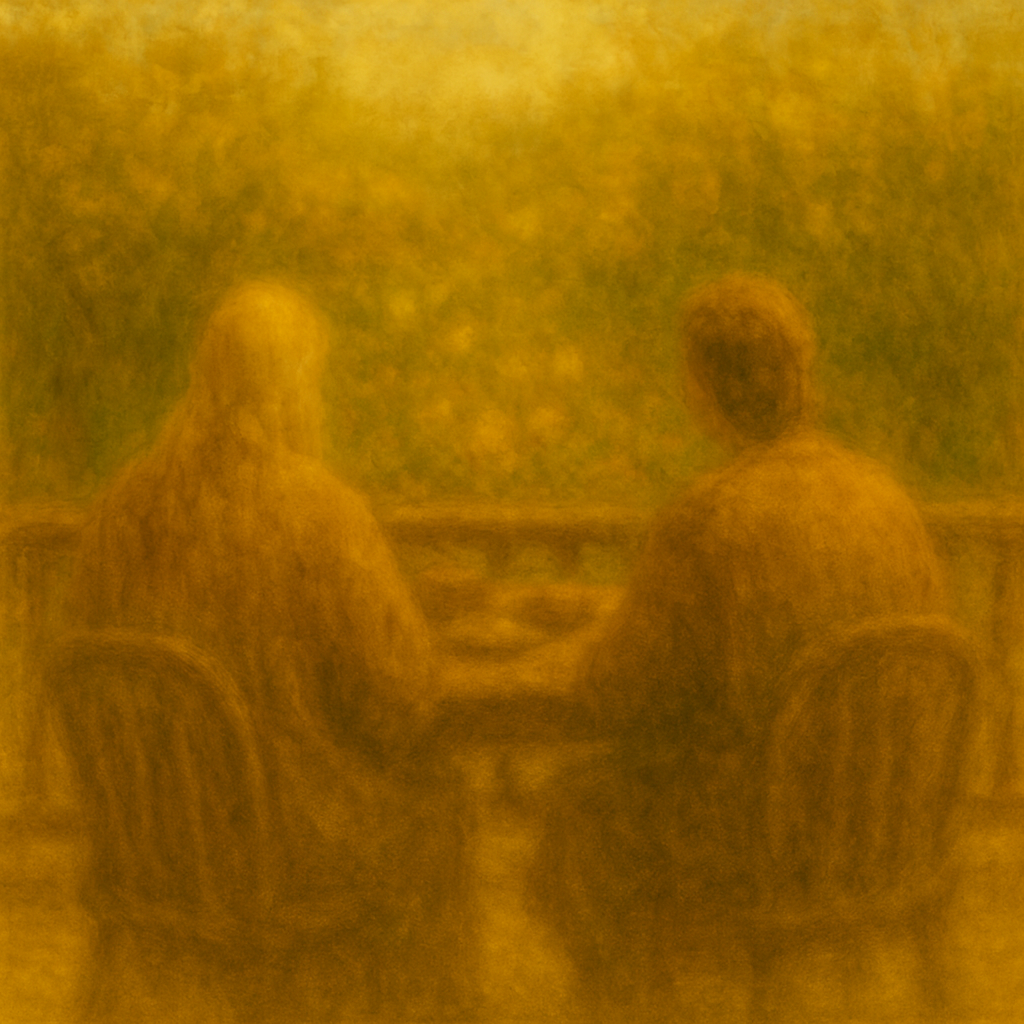
At a small table shaded by an awning of woven reeds, Noah and Nahala shared their meal—barley bread, figs, a bowl of honey, and watered wine. No attendants, no commotion. Only the sound of their own voices, chewing, the clink of clay against wood, and the slow rustle of linen in the morning breeze.
Five months apart had made the moment tender in unexpected ways. Noah's eyes moved often to her hands, reacquainting himself with them—the same hands that had grounded him so many times and still, somehow, held it together. Nahala smiled at his watchful fondness.
"You manage the house better without me," he teased, breaking a piece of bread. "I return to find it cleaner, calmer, and inviting all at once."
She poured a little more wine into his cup. "Someone has to bring order," she said. "And we both know you are too distracted to do it."
He laughed, deep and genuine, though it turned into a short cough before it faded. His breathing had steadied since Lirit's treatment the night before, and again this morning—the mint and sage still faint in his lungs. He took another sip of wine and exhaled contentedly.
"We should thank that girl," he said. "She's as attentive on Shabbat as she is in her chores. Tell her I'm grateful—and tell her I mean it."
"I can certainly tell her," Nahala said softly, studying him with quiet affection. "She's becoming a skilled little healer. Though I think she'd be equally pleased hearing it from you."
Noah smirked, brushing crumbs from his robe. "But words sound so much sweeter coming from your lips."
They sat together a while admiring the garden, listening to the soft creak of the wind through the lattice. Nahala watched the shadows slide slowly across the courtyard, then turned to him again.
"When do you plan to tell them?" she asked.
Noah leaned back, sighing—not weary, but thoughtful. "When I find them," he said. "I first have to figure out where they've disappeared to."
Nahala gave a short laugh, though it faded quickly. Her gaze drifted, softened by some memory only she could see. "I pray they take it better than I did," she murmured. "My heart aches for what they're about to experience."
Noah nodded, his expression gentling. He shared her ache—sorrow not for what had been lost, but for what must soon be told.
After the meal, Noah rose and set out through the courtyard, the sun climbing higher over the ridge. The house was resting with the hush of Shabbat, deepened by the absence of work. Yet from the other side of the estate came the faint ring of metal on stone.
He followed the sound to the forge.
Inside, heat shimmered around the forge, the scent of ash and oil rising from the coals. Ham sat before the anvil, stripped to his tunic, drawing a length of iron across the whetstone. His focus was sharp—every motion deliberate, confident, the way a musician learns to feel the song beneath the noise.
Noah paused in the doorway, watching for a moment. "Still tuning your craft on Shabbat?" he called, voice warm with amusement.
Ham straightened, startled, then dipped his head. "I can rest in my own way," he said. "The forge was calling."
Noah stepped inside, the light from the coals brushing his face. "I can appreciate a man for answering a call like that," he said, smiling. "Your touch grows truer each season, Sha—" He caught himself, dodging the old name before it left his lips. "—Ham."
Ham's hands stilled on the iron. The correction hung between them, kind yet heavy.
Noah paused, choosing his words carefully. "The name will take some getting used to," he said, his tone steady. "But I've been thinking on it. 'Ham' means warmth, does it not? Heat. It suits you—a man who wrestles with fire both in his craft and in his heart."
Ham looked away, uneasy. "I didn't choose it to sound righteous," he said. "It was ringing in my head, loud, so I took it...and I'm sorry for my reaction."
"That's often how the best names come," Noah said quietly. "Through struggle." He reached out, resting a hand on his son's shoulder. "You said something last night—about the nature of fire. You were right. It can forge or destroy, depending on whose hand tempers it. The trick is learning to control your hand, before gracing the fire."
Ham's shoulders eased, the tension in his grip slackening.
"Keep learning under Oren," Noah said. "He's a good man, and his patience will shape yours. But you must also begin anew—your own search for a wife, one pure of heart and of blood, so your children may walk unburdened by what mixed blood has cursed."
His voice stayed steady, more gentle than stern. "Perhaps find a woman who shapes with clay the way you shape with stone. Both of you refine with fire."
Noah's eyes softened, a trace of humor rising beneath their calm. "You never know when someone like that might be useful to have around."
Ham finally smiled—faint, genuine. "Yes, Father."
"Good," Noah said, giving his shoulder a final squeeze. "I am proud of you, son."
Ham nodded. The glow from the forge caught in his eyes. Noah turned toward the doorway, the heat against his face now smelling more of creation than of conflict. Behind him, the rhythm of the whetstone resumed—slow, deliberate, newly peaceful.
The heat of the forge still lingered on Noah's robe as he crossed the pasture. The world beyond the house was bright and lively, filled with the hum of insects and the low rustle of leaves. He passed through the vineyard, down the slope where the soil gave way to packed earth and gravel. Ahead, the wooden city rose from the forest floor—mighty and silent, a mountain of cedar and faith. Each time he returned, the sight filled him with awe.
He walked the long ramp, every step measured—testing the boards beneath his feet, listening to their soft creak, the wood remembering his weight. The great door stood ajar, sunlight cutting a single bright path through the dust. For a moment he paused at the threshold, listening to the breath of the woods—wind brushing through the opening, a distant dove cooing somewhere unseen.
The temperature dropped as he stepped inside—cooler, dense with the mingled scents of pitch and cedar. Beneath it lingered the faint trace of incense, which clings to wood after years of smoke and prayer. He paused, letting the scent settle over him—dryness held in check by resin, the smell of labor preserved. The stillness was not emptiness but structure built to last.
Noah moved slowly through the half-light, his hand tracing the grain of the nearest beam. The wood was smooth and warm, darkened by years of oil and labor. He could feel the memory of his tools in it—the cut of the chisel, the stroke of the plane, the sound of his sons' singing as they worked.
He murmured as he went, words low and personal, neither prayer nor remembrance but something between. "Grant me wisdom to finish what I began," he said. "And grant this ark the breath to live when all else is gone from the world."
He paused then, letting his hand rest flat against the timber. A slight breeze slipped through, carrying with it a whisper of warmth and sawdust. It stirred enough to make the light shift—thin, moving lines upon the floor—and Noah smiled faintly, accepting this small gesture as an answer.
A sound rose, slipping through the boards—soft at first, then unmistakable. Laughter. A woman's voice, bright and quick, followed by a man's lower murmur trying to quiet it. Noah blinked, half smiling. It had been years since he'd heard laughter inside these walls.
He tilted his head toward the ceiling. "Hello? Who's there?"
A quick rustle, then Shem's voice called back, playful but respectful. "Yes, Father—you found us. We thought this place would be empty."
Noah chuckled, the sound echoing faintly through the hollow space. "So this is where you two hide on Shabbat—clever."
More giggles drifted down—Linora's this time—light as birdsong through the rafters.
He shaded his eyes, looking toward the interior ramp that led to the upper section. "Are you two clothed?"
Shem's answer came at once, full of humor. "We are now!"
Noah smiled to himself, shaking his head. "Then I suppose I can join you."
He began the ascent, hand over hand on the smooth cedar rail. The boards groaned softly beneath his weight, answering each step like an old friend recognizing his tread.
The upper deck was warm with light. Large beams fell through the open roof, propped up with sticks. Shem and Linora sat together near the open hatchway, their hands loosely intertwined, the calm of new marriage still around them like a soft mantle.
Noah joined them slowly, settling across from the pair. For a time they spoke lightly—of the meal that morning, of the vineyard's promise, of small things that delayed the weight of what must come. But the daylight between them began to shift, and with it, Noah's tone. His eyes had grown thoughtful, distant, watching something beyond their sight.
At last he said, "Shem, I've kept something from you—not to deceive, but to protect. I wanted you to choose your wife by love, not by fear."
Shem straightened, his brow furrowing in quiet concern. Linora's hand tightened on his. "Protect us from what?" he asked.
Noah's gaze drifted toward the rafters above them, where sunlight fractured against the dust. "Nearly a century ago, before any of you were born, the Lord spoke to me. He told me of a cleansing—not by sword, nor by famine, but by water. A judgment to wash the earth of its corruption."
The words hung there like smoke. A knot of dread tightened in Linora's chest; Shem's eyes narrowed, not in defiance but in thought. "A cleansing," he repeated. "By water? Father, you've always said the Lord speaks through His works—through sow and harvest, through what He gives and withholds. But direct prophecy? That hasn't happened since..." He hesitated, trying to recall the stories from his youth. "Since the days of Enoch."
Noah nodded. "I never met my great-grandfather, but your great-grandfather, Methuselah, knew him for three centuries. Enoch was a prophet of the God of Adam. He walked with the Almighty until taken from the earth—not by death, but by divine hand. I have brought my own doubts, many times, to the wisdom of Methuselah, and he has spoken plainly: this is the same voice. The same certainty. Undeniably the voice of our Creator."
Shem's mouth tightened. "Then the Lord would end what He created."
"The Lord would renew what men have spoiled," Noah said gently. "And He would preserve what is pure and faithful."
He rose halfway, touching one of the great beams beside them. "He commanded me to build this enormous box—used the word 'ark'. I told you it was merely a passion project, to hide the painful truth..." he gave a faint, weary look. "That this vessel is designed to carry us above His judgment."
Shem and Linora sat frozen, their faces caught between horror and disbelief. After a pause, Linora found her voice. "When will this happen?"
Noah's expression turned inward, his tone gentler now. "I don't know when it will come. Only that the time draws nearer. The Lord told me to seal it—every seam, every joint—so that no water enters."
Linora looked around, then leaned forward. Her voice breaking through her composure. "If it must be sealed so tightly," she said, "how can we make the windows for the air?"
Noah hesitated, his faith steady though his understanding was not. "We can't," he said quietly. "No windows along the sides. His command was clear—only the roof may open to light."
The three sat in silence. The stillness grew heavy, cool and unbroken, the smell of cedar deepening.
Noah looked to her, moved by both the question and the tenderness beneath it. "That," he said, "is one of the mysteries I've not yet solved. How to preserve breath within God's seals. I have prayed for the answer, but it hasn't come—" he stopped himself, mid-thought, then looked in Linora's eyes. "Or perhaps it has—through you."
Her lips parted to reply, but no words came—only the weight of what he'd spoken.
Shem bowed his head, like it was heavy with thoughts he could not release. "If this is true," he said finally, "then the world as we know it will drown. How can a man rejoice in such a day?"
Noah's hand came to rest on his son's shoulder. "By remembering what is spared," he said. "We mourn what will die, but we give thanks for what lives. That is how faith endures—not in blindness, but in sorrow accepted."
Linora's eyes brimmed with tears. "This ark is not your work alone," she whispered. "Not any more."
Noah smiled faintly with relief—this massive boulder, now shared. He nodded.
The light flickered, gold against their faces. Outside, the wind shifted, a sigh through the trees.
Noah turned back to Shem, his voice lowering. "You must not speak of this to your brothers. Not yet. Each must find his wife. Before you were born, His voice was clear: my sons' wives will board. When married, they will find out, same as you. For now, let peace remain in the house."
Shem rose abruptly, his hands clasped behind his head as he turned toward the rafters above. His jaw tightened, the motion not defiance but the strain of comprehension pressing against faith.
Linora's gaze lifted. "And Nahala?" she asked quietly.
Noah gave a small assent.
Shem's head turned toward her, but Linora was already staring at her own hands. One by one, her fingers curled inward as she counted, lips moving. When the realization struck, her voice trembled out—not loud, but enough to break the stillness.
"That's eight people," she said. "Eight... people?"
The word echoed against the beams. Noah said nothing. He knew the number, had known it for years, but hearing it spoken aloud—in her voice, heavy with love and all it implied—made it sound newly terrible.
He bowed his head, his voice catching. "Eight," he repeated softly. "And the rest..." He paused, barely able to finish. "The rest belong to God."
Shem dropped his fists, the fight leaving his body. Linora's fingers remained folded in her lap, as if she dared not unfold them again.
For a long time, no one spoke. The weight of what they'd heard settled around them. The great vessel held its silence, vast and unbreathing—a mercy waiting to be called upon.
Then Shem straightened, his face pale but steady. He looked at Linora, then at his father. "Eight," he said softly, testing the number again. "Then we have so much work to do. We'll build until it's ready."
Noah's eyes lifted, meeting his son's with a flicker of pride—not pride in survival, but in readiness. "Yes," he said, rising with care. "No time to waste."
The light from the roof shifted, catching the edge of the timber above them. It burned gold for a moment, then dimmed as the wind passed. Outside, a wind rose through the forest, stirring the dust into motion.
Shem reached for Linora's hand, and together they followed Noah down the ramp. The boards groaned beneath their steps—not in weariness, but like a living thing waking to its purpose.
Before exiting, Noah stopped, and turned to face the couple, his gaze filled with love and the faint sorrow of foresight.
"Enjoy the world while it still sings. Soon enough, every sound we know will change."